
Crepidotus autochthonus
Crepidotus autochthonus
Description
Symptoms
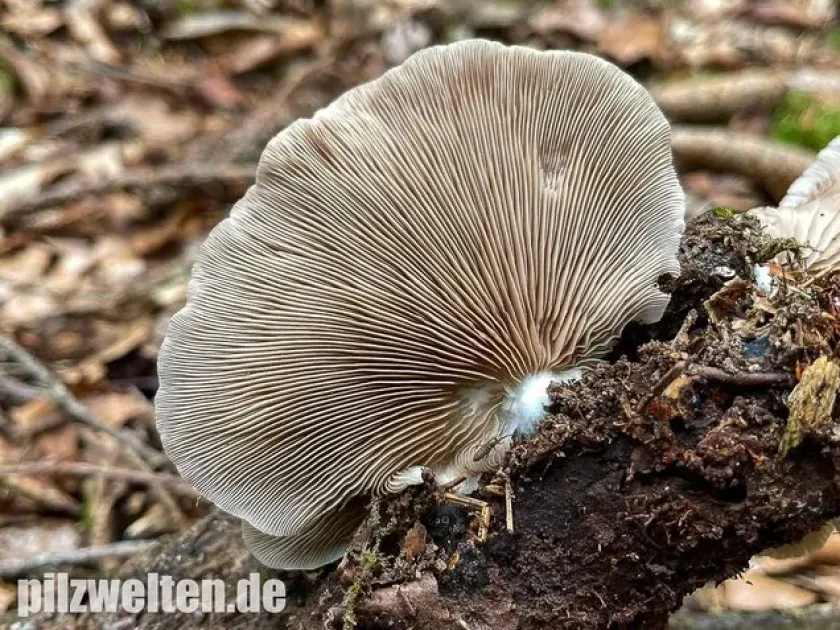
The most visible sign of infection is the emergence of characteristic fan-shaped fruiting bodies. These often appear in clusters, with a creamy or white coloration, usually attached to the sides of trunks or branches.
Infected wood becomes soft, spongy, and loses its natural structural density. The degradation process leaves the wood fiber-like and brittle, which is a direct consequence of enzymatic activity.
Fruiting bodies often appear near existing damage sites, such as frost cracks, previous pruning wounds, or areas suffering from mechanical bark injury. Their presence indicates that the interior wood has already been significantly colonized.
Other signs include crown dieback, reduced leaf vitality, and the premature shedding of smaller branches. In severe cases, the tree may show overall stunted growth due to impaired nutrient transport.
During humid weather, the mycelial activity may increase, and the area around the fruiting bodies may emit a damp, earthy smell. If the wood is probed with a tool, it will show signs of soft decay, easily crumbling away.
Pathogen
Crepidotus autochthonus is a species of fungus belonging to the family Crepidotaceae. In the context of arboriculture and plant pathology, it acts as a wood-decaying fungus that primarily targets weakened or dead woody tissues.
The pathogen spreads via spores that settle on damaged bark, wounds, or pruning cuts. Once established, the mycelium secretes enzymes that decompose cellulose and lignin, the primary structural components of the tree's internal wood structure.
Biologically, this fungus manifests as small, sessile, fan-shaped fruiting bodies that grow directly from the substrate. It is highly efficient at utilizing the organic matter of the host tree to expand its mycelial network throughout the woody tissue.
While often classified as a saprotroph, it can exhibit opportunistic parasitic behavior on physiologically stressed trees. Its ability to colonize living wood makes it a notable organism in terms of tree structural integrity.
The fungus is highly adapted to temperate forest ecosystems, where it plays a dual role: recycling dead biomass and potentially degrading the health of weakened ornamental or orchard trees.
Conditions for development
High humidity and moisture are the primary drivers of Crepidotus autochthonus development. Prolonged rainfall and damp environments favor the rapid growth of the fungal colony.
Mechanical damage to the bark creates ideal entry points. Without proper wound healing or sealant application, these areas become prime targets for spore germination.
Dense planting environments with poor air circulation contribute to a microclimate that remains moist for extended periods, facilitating the colonization of the fungus on susceptible wood surfaces.
The fungus thrives within a temperature range of +15°C to +25°C. During these conditions, the enzymatic degradation of the wood occurs at its maximum rate, leading to faster structural damage.
Trees that are already suffering from drought, poor nutrition, or secondary pest infestations are particularly vulnerable, as their natural defensive responses are not strong enough to halt the fungal invasion.
Why it matters
The main risk posed by this fungus is the destruction of the tree's structural heartwood. This degradation significantly increases the risk of trunk failure, limb breakage, or windthrow during storms.
By disrupting the xylem and phloem, the fungus hinders the tree's ability to move water and nutrients effectively. This leads to chronic physiological stress and a decline in overall tree health.
For fruit trees, the presence of the fungus impacts productivity and fruit quality, as the tree redirects energy toward survival rather than yield. Eventually, this leads to a shortened lifespan for the tree.
The fungus serves as a source of spores that can easily spread throughout a nursery or orchard via air currents. This poses an ongoing risk to neighboring trees that may be susceptible due to minor wounds.
In mature or valuable landscape trees, structural damage caused by Crepidotus autochthonus can lead to the necessity of total removal to prevent property damage or hazards to public safety.
Protection
Effective management begins with good arboricultural practices. Regular inspection of the trees and the removal of dead or dying branches are essential to reduce the potential for infection.
All pruning must be done with sanitized tools to prevent the accidental transfer of spores. Significant pruning wounds should be treated with protective sealants to prevent fungal entry.
Maintaining clear surroundings and ensuring that the tree has proper access to light and air is crucial. Removing decaying woody debris from the base of the tree is a standard sanitation procedure.
If fruiting bodies are found, they should be mechanically removed, and the affected wood should be treated. In advanced cases, fungicides may be used, though they are only effective as a supporting measure.
- Consistent monitoring of tree health throughout the growing season.
- Adequate irrigation and fertilization to keep trees vigorous.
- Immediate removal of trees that show significant structural decay.
Discussion
No discussions yet — be the first.