
Craterellus ignicolor
Craterellus ignicolor
Description
Symptoms
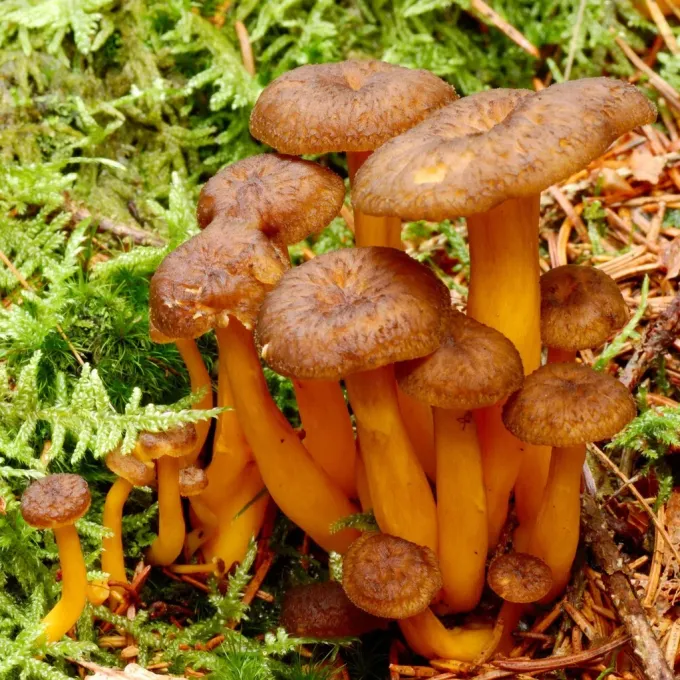
The fruit bodies of Craterellus ignicolor are distinguished by a delicate funnel shape, typical of the genus Craterellus.
They are characterized by vibrant colors, ranging from bright yellow to deep orange and red tones, which inspired their specific epithet.
The cap is relatively thin, with irregular or wavy margins that develop as the mushroom matures.
On the underside of the cap, the hymenium consists of shallow, gill-like folds rather than true, sharp-edged lamellae.
The stem is typically hollow and tapers toward the base, maintaining a color profile consistent with the rest of the mushroom.
Pathogen
Craterellus ignicolor, often referred to by its scientific name, belongs to the family Cantharellaceae. It is important to clarify that this fungus is not a plant pathogen or a disease agent affecting crops.
Biologically, it is classified as a saprotrophic fungus that inhabits forest floors, focusing on the decomposition of organic matter rather than infecting living plant tissues.
The mycelium of this fungus resides in the soil or leaf litter, where it plays a positive role in nutrient cycling within the forest ecosystem.
It lacks the physiological mechanisms required to colonize or harm vascular plants, making it irrelevant to plant pathology and agricultural pest management.
Consequently, in an agronomic context, Craterellus ignicolor does not pose any risk to fields, orchards, or horticultural plantations.
Conditions for development
The development of this mushroom is strictly tied to moist forest environments that feature a thick layer of organic debris and humus.
Optimal growth conditions occur during periods of sustained rainfall and moderate temperatures, which prevent the mycelium from drying out.
It prefers shady habitats under broadleaf or mixed forest canopies where the soil remains cool and damp.
Stable soil moisture and rich organic composition are critical factors for the emergence of the fruit bodies.
Due to these specific environmental requirements, it is rarely found in open agricultural fields or managed farmland.
Why it matters
As a saprotroph, Craterellus ignicolor does not cause any harm to commercial plant production or agricultural crops.
It is not associated with wilting, root rot, or any other signs of infection that might affect plant health or yield.
On the contrary, it contributes to soil health by assisting in the breakdown of fallen leaves and organic materials into simpler compounds.
There is no economic damage associated with this fungus, and it does not act as a vector for any plant-borne diseases.
Farmers do not need to take any action against it, as its presence is a sign of a healthy, functioning forest ecosystem.
Protection
Because Craterellus ignicolor is not an agricultural pest or pathogen, there are no control methods or mitigation strategies required.
The application of chemical fungicides in an attempt to suppress this fungus is environmentally harmful and entirely unnecessary.
Effective agricultural management focuses on identifying true pathogens, whereas saprotrophic fungi should be treated as part of the natural environment.
The best practice for land managers is to maintain general soil health and observe natural biodiversity without unnecessary intervention.
Future monitoring should prioritize the detection of real crop diseases rather than the presence of beneficial or neutral forest fungi.
Discussion
No discussions yet — be the first.