
Jute corynespora blight
Corynespora corchorum
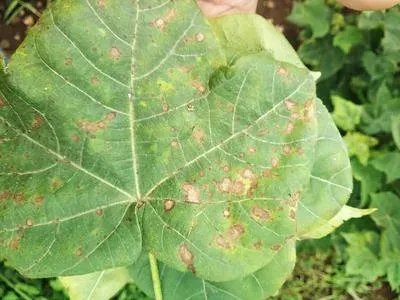
Description
Symptoms
The early symptoms appear as small, chlorotic or light brown spots on the lower leaves of the plant. As the disease advances, these spots expand, often developing an irregular or angular shape restricted by the leaf veins.
A hallmark of the disease is the development of a zonate pattern within the necrotic spots, where the center turns greyish-white while the margins remain a dark brown or purplish color.
Under high humidity, the undersides of the leaves show a fine, olive-colored fungal growth consisting of conidiophores and conidia. This indicates active sporulation and high potential for secondary spread.
Stem infections manifest as elongated, dark streaks or lesions that can penetrate deep into the cortex. These lesions compromise the plant's structural integrity and its ability to transport nutrients and water effectively.
Severe infestations lead to extensive defoliation, starting from the lower canopy and moving upward. This significantly reduces the photosynthetic area of the plant, leading to stunted growth and poor fiber development.
Pathogen
The causative agent of this disease is the phytopathogenic fungus Corynespora corchorum. This pathogen is a member of the class Deuteromycetes and is highly specialized in attacking fibrous crops, primarily those within the Corchorus genus.
The fungus survives in soil and on crop debris as mycelium and conidia, exhibiting significant resilience to adverse environmental conditions. It acts as a facultative parasite, actively infecting the plant during its vegetative stages.
The infection process initiates when spores land on plant tissue, germinating under suitable moisture levels. The germ tubes penetrate the host through stomata or directly through the epidermal cells by producing specific enzymatic complexes.
Once inside the plant tissue, the fungus secretes phytotoxins that degrade cell walls and cause localized necrosis. This allows the fungus to spread further and colonize large areas of the leaf and stem tissues.
The life cycle of Corynespora corchorum is highly efficient, allowing for multiple generations of conidia production throughout the growing season, which ensures the persistence of the disease in jute-growing regions.
Conditions for development
The development of jute corynespora blight is strongly favored by high relative humidity (above 80%) and temperatures ranging from 22 to 28 degrees Celsius.
Frequent rainfall and persistent morning dew create the necessary leaf-surface moisture for spore germination. Such weather conditions during the mid-to-late growth stages of jute are critical for outbreaks.
Dense planting patterns that restrict airflow create a stagnant microclimate with high humidity levels. This condition is ideal for the rapid proliferation of Corynespora corchorum across the field.
Plants subjected to poor soil fertility or nutritional imbalances, particularly potassium deficiency, show reduced resistance to the fungal pathogen, making them more susceptible to severe infection.
Fields with a history of monocropping or short crop rotation cycles are prone to high inoculum pressure, as the pathogen persists in the soil debris from previous infected harvests.
Why it matters
The primary economic impact of this disease is the reduction in both the quantity and quality of jute fiber. Infected plants produce fiber that is brittle, lower in tensile strength, and lacking in luster.
Significant defoliation hampers the plant's metabolic capacity, reducing the total biomass accumulation. Consequently, farmers experience lower yields of raw material per hectare.
In cases of severe infestation, yield losses can reach 30% to 50%. The disease complicates the processing of fiber, as diseased stems are more difficult to ret and yield lower-grade fiber after extraction.
Beyond the immediate yield loss, the disease negatively impacts the seed quality. Seeds from heavily infected plants often show reduced germination rates and weakened seedling vigor.
The presence of the disease necessitates additional expenditure on chemical control and labor for implementing integrated management practices, which increases the total cost of cultivation.
Protection
Integrated management is essential, beginning with a strict 3-4 year crop rotation plan to break the pathogen's life cycle and reduce the inoculum present in the soil.
Deep plowing after the harvest is a recommended cultural practice to bury infected plant debris deep into the soil, where decomposition occurs faster and fungal survival is minimized.
Seed treatment with systemic fungicides is a crucial step to protect the emerging jute seedlings from both seed-borne and soil-borne infections during the early growth phase.
- Ensuring proper plant spacing to improve air circulation and reduce canopy humidity.
- Balanced application of fertilizers, emphasizing potassium to boost plant immunity.
- Applying recommended foliar fungicides immediately upon the detection of initial disease symptoms.
Regular field monitoring is vital for timely intervention. Early detection allows for localized applications of fungicides, which is more cost-effective and environmentally friendly than widespread treatment.
Discussion
No discussions yet — be the first.