
Cortinarius varius
Cortinarius varius
Description
Symptoms
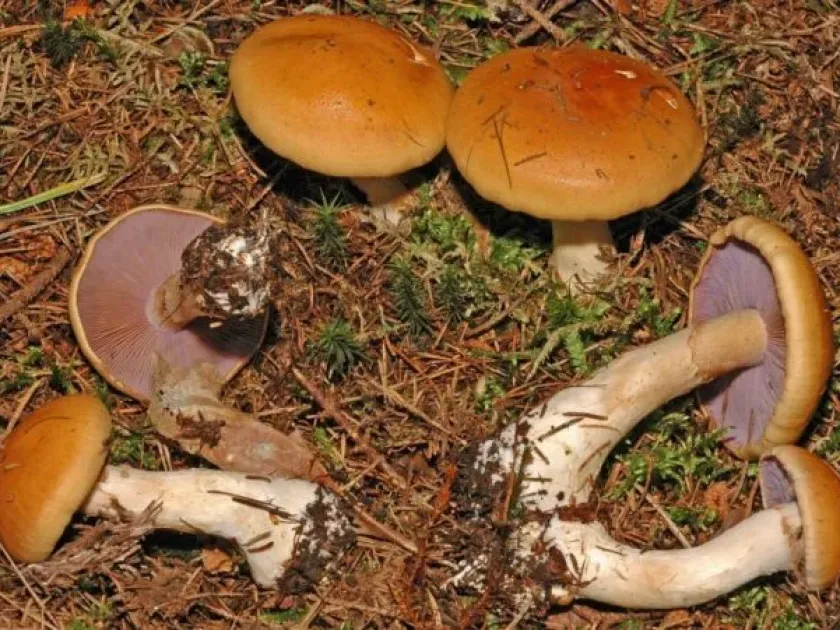
The mushroom is identified by its bright yellowish-ochre cap, which is often convex and feels slightly sticky when wet due to its natural coating.
A primary diagnostic feature is the distinct cortina, a spider-web-like veil that protects the gills in young specimens and leaves characteristic remnants on the stem.
The gills transition in color from a pale violet or blueish tint in young specimens to a rusty brown color as the spores mature and are released.
The stem is robust, thick, and typically white or yellowish, often widening towards the base, providing structural support for the cap.
- Cap diameter: 5 to 12 cm.
- Gills: Crowded, initially pale violet.
- Stem: Thick, solid, cylindrical shape.
Pathogen
Cortinarius varius is a fungal species belonging to the family Cortinariaceae. It is strictly a mycorrhizal fungus and is not classified as a plant pathogen or a disease of crops.
The fungus forms a symbiotic relationship with the root systems of coniferous trees, aiding in nutrient absorption and soil stability, rather than acting as a parasite.
Research confirms that this species plays a vital ecological role in forest health. It does not cause wilting, necrosis, or structural decay in the plants it associates with.
In the context of agricultural science, Cortinarius varius is considered a beneficial component of forest soils, contributing to the biodiversity and nutrient cycling.
The fungus is highly specialized and relies on the presence of specific tree hosts, making its existence dependent on a stable and natural forest environment.
Conditions for development
This species thrives in coniferous forests, particularly in areas with acidic soil types and thick organic matter or moss cover.
It requires stable moisture levels to initiate the production of fruit bodies, typically occurring during the late summer and autumn seasons.
The development of the mycelium is intricately linked to the health of the surrounding root zones, as it receives carbohydrates from the trees in exchange for minerals.
Pollution and soil compaction negatively affect the growth of this fungus, indicating that its presence is often an indicator of good forest habitat quality.
Spore dispersal is facilitated by wind, which carries the microscopic particles from the gill structure of the mushroom to suitable germination sites.
Discussion
No discussions yet — be the first.