
Bog Cortinarius
Cortinarius uliginosus
Description
Symptoms
The fruiting bodies of the Bog Cortinarius typically appear during late summer and autumn. They can be identified during field surveys of wet forests or riparian zones where willow thickets are present.
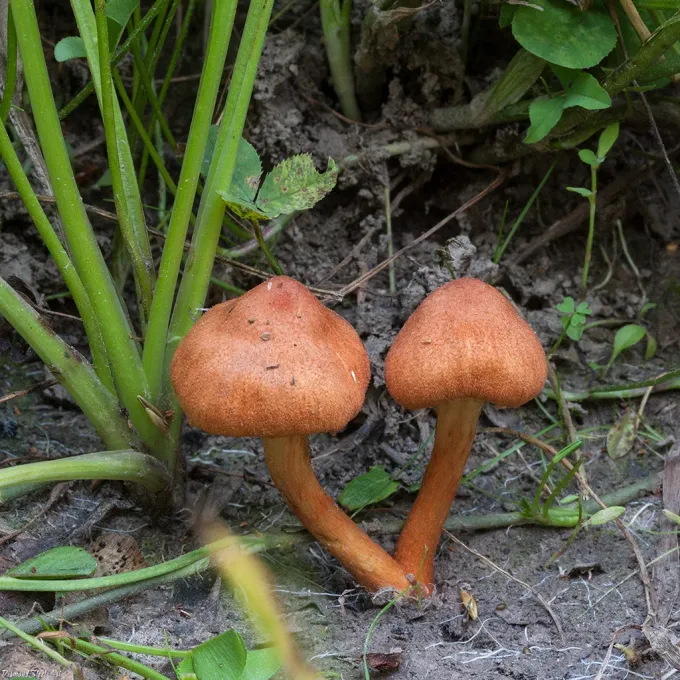
The cap, ranging from 2–6 cm in diameter, exhibits a vibrant ochre-orange to coppery-brown color, often featuring a slight central umbo. The cap surface is typically fibrous or slightly scaly.
In young specimens, the gills are shielded by a cobweb-like cortina. As the fungus matures, the gills develop a distinct rusty-orange color due to the maturation of spores.
The stem is slender, often curved, and colored similarly to the cap. Occasionally, remnants of the cortina can be seen on the stem as a faint, delicate ring.
The fungus is distinctively delicate in appearance, which helps distinguish it from other wood-decaying or soil fungi found in similar boggy environments.
Pathogen
Bog Cortinarius (scientific name Cortinarius uliginosus) is not a plant pathogen and does not cause diseases in agricultural crops. It is a basidiomycete fungus that serves as a mycorrhizal symbiont in its natural ecosystem.
Biologically, this species is closely associated with trees, particularly willows (Salix spp.), forming ectomycorrhizal relationships. The mycelium helps the tree host access water and mineral nutrients from the soil.
Classified under the family Cortinariaceae, the fungus is characterized by its specific morphology and the presence of a cortina — a spider-web-like veil covering the gills of young specimens.
It is important to emphasize that Cortinarius uliginosus does not parasitize crops. It does not produce phytotoxins and is not responsible for any wilting, rotting, or leaf spots observed in farming.
This fungus plays a vital role in forest ecosystems by participating in the decomposition of organic matter and supporting the symbiotic health of woody plant communities.
Conditions for development
High moisture levels are the primary requirement for the development of the Bog Cortinarius. It thrives in boggy terrains, wetlands, and damp woodland areas where water is consistently present.
Symbiosis with willow trees is a critical factor for its lifecycle. The fungus relies on the host's root system for carbohydrate exchange, enabling the formation of fruiting bodies.
Optimal temperatures for development range between +12°C and +18°C. During the autumn season, stability in moisture levels ensures active mycelial growth.
The species is generally confined to humid forest habitats, banks of streams, and marshes. It is rarely found in open agricultural fields unless they are adjacent to damp forest edges.
Dispersal is achieved via spores spread by wind and rain droplets, though successful colonization depends on the presence of a compatible tree partner in a high-humidity environment.
Why it matters
In terms of agriculture, Cortinarius uliginosus poses no threat to farming operations. It does not damage harvestable parts of crops and has no impact on crop yield or quality.
There are no scientific reports identifying this species as a pest. It is considered a neutral biological component of the environment without any economic significance for pest control.
From an agronomical perspective, this fungus requires no mitigation or control strategies. Its presence is purely a sign of a specific ecosystem type rather than an agricultural issue.
Since the fungus is non-pathogenic, it does not interfere with crop rotation, soil quality, or any standard farming practices conducted on neighboring lands.
Consequently, the Bog Cortinarius should be regarded as a natural indicator of environmental conditions rather than a damaging agent requiring intervention.
Protection
As this species is not a pathogen, specific protection or control measures are unnecessary. Eradication of the Bog Cortinarius is not an objective in agricultural practice.
Effective management of water regimes, such as proper field drainage, naturally prevents the development of these fungi on agricultural land by eliminating the necessary high-moisture conditions.
The use of fungicides to target this species is not recommended, as it would be ecologically unsound and could harm beneficial soil microorganisms.
If its presence is noted, no action is required. The fungus will naturally disappear if the substrate dries out or if the host tree population changes.
Farmers should focus on standard crop protection programs targeting genuine pests and pathogens, leaving non-damaging fungal species to function within their natural forest niches.
Discussion
No discussions yet — be the first.