
Guava anthracnose
Colletotrichum psidii
Description
Pathogen
The causal agent of this disease is the pathogenic fungus Colletotrichum psidii, which primarily affects guava plants. It is a highly specialized fungus that thrives in warm, tropical environments.
The fungus survives as mycelium or spores within infected plant debris, twigs, and mummified fruits. These remnants serve as the primary inoculum for the next growing season, especially during rainy periods.
The life cycle involves the rapid production of conidia (asexual spores) which are disseminated by wind-driven rain, splashes, and insect vectors. Once in contact with a host, the spores germinate and penetrate the epidermal layers.
The pathogen is known for its ability to persist in a latent state within the plant tissues. This means the infection can occur early in fruit development, but symptoms only appear as the fruit begins to ripen.
Research indicates that C. psidii uses complex enzymes to break down plant cell walls, allowing it to colonize the host internally and extract nutrients, leading to tissue degradation.
##signs##Early symptoms appear as small, water-soaked spots on young leaves and succulent shoots. These spots gradually expand and turn dark brown or black, often with a chlorotic halo surrounding the lesion.
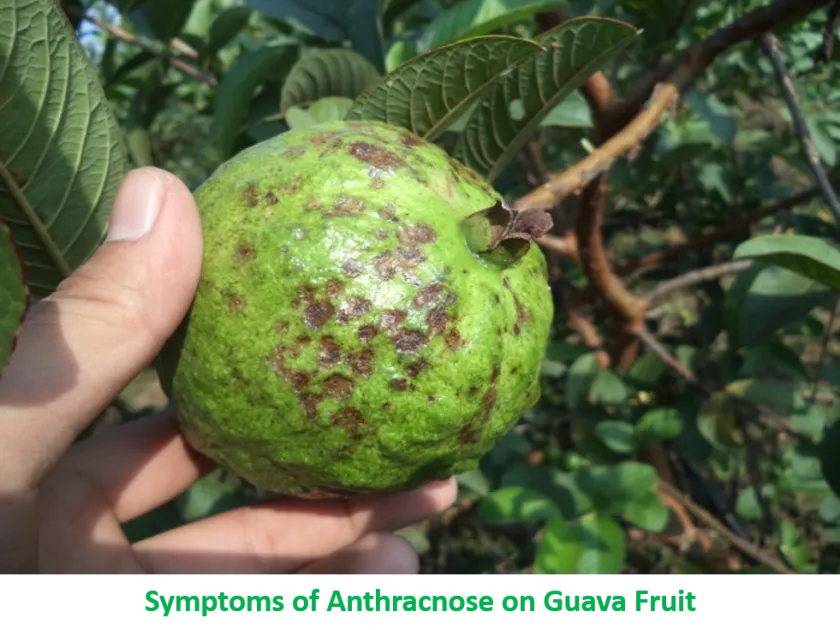
On mature fruits, anthracnose is characterized by circular, sunken lesions. Under high humidity, these lesions become covered with masses of pink or orange spore-bearing structures, which is a classic diagnostic sign.
Floral infection is particularly devastating, leading to the withering and blackening of flowers. If the fungus reaches the pedicels, it causes premature fruit drop, significantly reducing total yield.
Twigs and branches may develop necrotic lesions or cankers. When these lesions encircle the branch, they lead to dieback, where the distal parts of the branch turn brown and die off due to the interruption of water transport.
Internally, affected fruits show deep, rotting pockets of softened tissue. This internal rot makes the fruit completely unacceptable for fresh market consumption or export.
Conditions for development
Guava anthracnose is favored by high humidity (often exceeding 85%) and frequent rainfall. Free water on the surface of plant parts is essential for spore germination and infection processes.
The optimal temperature range for the rapid development of the fungus is between 22°C and 28°C. During these conditions, the fungus can complete its cycle and produce new inoculum within a few days.
Poor orchard sanitation and inadequate pruning contribute significantly to disease spread. Dense canopy growth prevents sunlight penetration and restricts airflow, keeping the foliage damp for longer periods.
Imbalanced fertilization, particularly high nitrogen levels, leads to lush, succulent vegetative growth that is more susceptible to fungal penetration. Proper nutritional management is crucial for maintaining plant vigor.
Mechanical damage caused by pests or agricultural practices provides entry points for the fungal spores, allowing the disease to establish itself more effectively within the healthy plant tissues.
Why it matters
The economic impact of guava anthracnose is severe, as it directly affects both the quantity and quality of the fruit. In favorable conditions, it can lead to losses exceeding 70% of the production.
Beyond fruit loss, the disease weakens the tree, leading to reduced photosynthetic capacity and overall decline. Repeated defoliation drains the plant's resources, limiting its growth and future yield potential.
- Significant reduction in fruit marketability.
- High post-harvest losses during storage and transport.
- Severe defoliation weakening the tree.
- High costs associated with fungicide applications.
- Loss of market share due to poor fruit quality.
The disease causes significant losses during the post-harvest phase. Fruits that appear healthy at the time of picking may develop rot during transit, leading to substantial economic waste at the supply chain level.
Protection
Sanitation is the cornerstone of anthracnose management. Removing and destroying infected twigs, leaves, and fruits from the orchard is essential to eliminate the primary sources of inoculum.
Pruning is critical to ensure proper airflow and light penetration. An open-canopy structure dries quickly after rain, which creates an environment hostile to spore germination and fungal growth.
Chemical control involving copper-based fungicides or systemic products (such as triazoles or strobilurins) can be highly effective when applied preventively during the flowering and fruit-set stages.
To prevent the emergence of resistant fungal strains, it is important to implement a rotation program using fungicides with different modes of action, avoiding the continuous use of a single chemical class.
Breeding and planting resistant or tolerant guava cultivars remains the most sustainable long-term solution. Integrating biological control agents and resistant varieties is the future of integrated disease management.
Discussion
No discussions yet — be the first.