
Anthracnose of cucurbits
Colletotrichum orbiculare
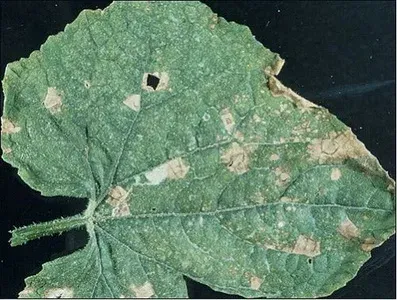
Description
Symptoms
Early symptoms appear as small, water-soaked, yellowish or brownish spots on the leaves, which enlarge and become necrotic over time.
Lesions on stems and petioles are typically elongated, sunken, and can lead to structural weakness or breakage of the plant.
Fruit symptoms consist of circular, sunken lesions that often develop a pinkish or salmon-colored gelatinous mass of spores in the center.
As the disease progresses, large portions of the foliage may wither and die, significantly compromising the plant's photosynthetic capacity.
In severe cases, entire fruits can become completely covered in lesions, rendering them entirely unmarketable and susceptible to soft rot bacteria.
Pathogen
The causal agent of anthracnose in cucurbits is the fungus Colletotrichum orbiculare, a significant agricultural pathogen.
The fungus survives between seasons on infected crop debris, within soil, and on susceptible weed hosts in the cucurbit family.
During the growing season, it produces conidia in acervuli, which are dispersed primarily by rain splash, overhead irrigation, and field workers.
The pathogen penetrates the host cuticle, colonizing plant tissues and extracting nutrients, eventually leading to localized tissue death.
It is classified as a polycyclic disease, meaning it can produce multiple generations of spores within a single growing season under favorable conditions.
Conditions for development
Warm, humid conditions are essential for the development and spread of Colletotrichum orbiculare on host crops.
Optimal disease progress occurs at temperatures between 22°C and 27°C, coupled with high relative humidity or prolonged leaf wetness.
Overhead irrigation and high-density planting exacerbate the problem by maintaining a favorable microclimate on leaf surfaces.
Poor ventilation in greenhouse environments leads to moisture accumulation on foliage, which facilitates rapid spore germination.
Weather patterns involving frequent storms and rain showers significantly increase the rate of secondary infections across a field.
Why it matters
Anthracnose can cause severe yield losses, often exceeding 50% in untreated or highly susceptible commercial crops.
The loss of foliage leads to fruit sunscald and prevents proper fruit development, negatively affecting the total harvest weight.
Diseased fruit are prone to post-harvest decay, which makes long-term storage and international trade virtually impossible.
In addition to direct losses, farmers face increased operational costs due to the need for multiple fungicide applications.
General plant vigor is reduced, making the crop more susceptible to other abiotic stresses and secondary pest infestations.
Protection
Integrated disease management begins with the use of certified, disease-free seed and the implementation of resistant cultivars.
Strict crop rotation (at least 3 years) is necessary to reduce the inoculum density of the fungus in the soil environment.
Deep plowing and immediate removal of crop residues post-harvest are crucial to break the pathogen's life cycle.
Fungicide sprays should be initiated at the first sign of disease symptoms, rotating chemical classes to prevent resistance development.
- Use drip irrigation to keep foliage dry.
- Control weeds that belong to the Cucurbitaceae family.
- Improve field drainage to prevent high humidity zones.
Discussion
No discussions yet — be the first.