
Lupine anthracnose
Colletotrichum lupini
Description
Symptoms
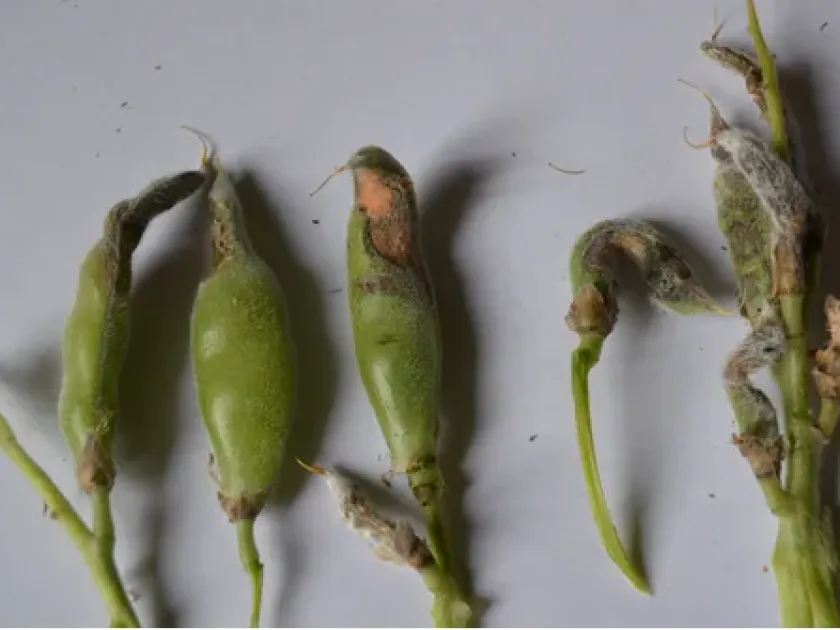
The first signs of the disease appear as curling and twisting of the stem tips, which eventually wither. Affected areas often develop characteristic orange-pink lesions or ulcers surrounded by a dark margin.
Deep, sunken brown or dark spots form on stems, leaf petioles, and pods. Under high humidity, a dense layer of pinkish conidial fungal growth often develops on these lesions.
Infection of the pods leads to deformation and poorly developed seeds. Seeds inside infected pods often become shriveled, covered in mycelium, and lose their viability, serving as a primary source of inoculum for the next cycle.
Early infection can cause seedlings to die completely, leading to significant thinning of the stands. If infection occurs later, plants show stunted growth, and their vegetative mass prematurely wilts and dries out.
Systemic infection often causes the stem to snap at the site of a lesion. The overall appearance of diseased fields is characterized by spotting, twisted plant organs, and patches of complete plant death.
Pathogen
The causal agent of lupine anthracnose is the fungus Colletotrichum lupini. This pathogen belongs to the class of imperfect fungi and shows high specialization toward the Lupinus genus, affecting both annual and perennial lupine species.
The fungus survives primarily in seeds as mycelium and persists on plant debris in the soil for several years. During the growing season, the infection spreads via conidia, which are dispersed by rain splashes, wind, insects, and agricultural machinery.
The biology of the pathogen is characterized by its ability to penetrate plant tissues through wounds or natural openings such as stomata. The active multiplication of the fungus leads to the destruction of plant tissues, making it extremely dangerous for commercial lupine production.
The infection cycle includes repeated sporulation during the season, allowing the fungus to rapidly cover large areas under favorable weather conditions. The high viability of the spores enables the fungus to withstand harsh environmental conditions.
An important feature of Colletotrichum lupini is its latent form of seed infection. This complicates visual identification of infected seeds, which contributes to the widespread dispersal of the disease when using untreated planting material.
Conditions for development
High humidity and frequent rainfall during the growing season promote the development and rapid spread of anthracnose. The optimal temperature for spore germination and fungal growth ranges from +18 to +25 °C.
Fogs, heavy dew, and prolonged rain create the ideal microclimate for the pathogen to colonize young plant tissues. Wet weather during the flowering and pod formation stages is the most critical period for the infection level of the future harvest.
Overcrowded fields, which restrict airflow and increase local humidity, significantly accelerate the epiphytotic development of the disease. Poor ventilation in the canopy provides conditions for massive fungal sporulation.
The presence of susceptible lupine varieties in crop rotation increases the risk of an outbreak, as the pathogen accumulates in the soil layer. Failure to follow proper agricultural practices, such as incorrect sowing dates, can also increase the susceptibility of the plants.
Damage to plants by pests, such as lupine fly larvae, provides additional entry points for fungal spores into the stem tissue, intensifying the disease development in localized areas.
Why it matters
Anthracnose is one of the most devastating diseases of lupine, capable of causing total crop failure in years favorable to the pathogen. High infection rates drastically reduce the thousand-seed weight and the biological value of the grain.
The disease causes not only a decline in grain yield but also a significant deterioration in the quality of green mass used for animal feed. Infected plants become unsuitable for hay or silage production due to the toxicity of fungal metabolites.
The economic loss consists of costs for purchasing high-quality seeds, expenditures on fungicide applications, and losses from reduced production. High risks of epidemics often force farmers to abandon lupine cultivation in certain regions entirely.
Infection of seed multiplication plots leads to the spread of the pathogen to new territories through transport and sowing of contaminated seeds. This makes anthracnose a serious limiting factor in lupine seed production.
The disruption of physiological processes in infected plants leads to a reduced ability to fix atmospheric nitrogen, which negatively impacts soil fertility and the efficiency of fertilizer use.
Protection
The primary control method is the use of healthy, certified seed material that is free from infection. Treating seeds with systemic fungicides is a mandatory procedure before planting.
Maintaining spatial isolation between current-year lupine fields and areas where lupine was grown in previous years helps reduce the risk of primary infection. It is recommended to rotate lupine with other crops, returning it to the same field no sooner than every 3–4 years.
Agricultural measures include deep plowing of crop residues to accelerate their decomposition, as well as weed control, as weeds can act as reservoirs for the infection. Ensuring optimal plant density is important for better ventilation.
During the growing season, if the first signs of the disease are detected, fungicide spraying should be applied. The choice of products must be based on local pesticide regulations, with a preference for broad-spectrum systemic fungicides.
Breeding for resistance to Colletotrichum lupini is the most promising and cost-effective approach for long-term control. The use of tolerant varieties significantly minimizes the risk of harvest loss and reduces chemical dependency.
Discussion
No discussions yet — be the first.