
Onion anthracnose
Colletotrichum circinans
Description
Symptoms
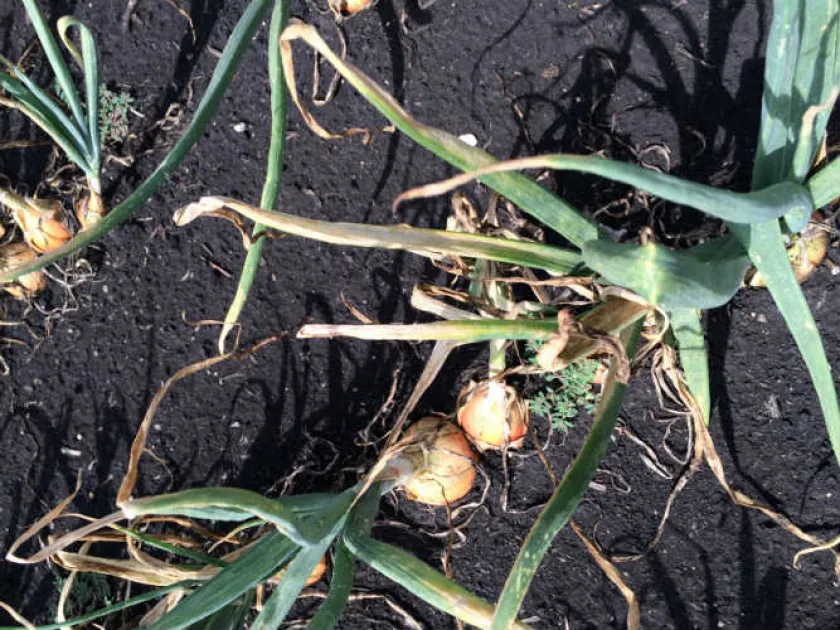
The initial symptoms appear on the outer succulent scales of the bulbs. Dark, slightly sunken spots of varying shapes develop on the surface of the onion skin.
As the disease progresses, the spots become more prominent and turn black, often showing characteristic concentric rings where the fungal spores are produced.
On leaves and the neck of the onion, the symptoms may appear as dry necrotic lesions. Under high humidity, a whitish or pinkish fungal mycelium might become visible on these lesions.
Affected bulbs lose their firmness, become soft, and eventually rot completely, facilitating the spread of the pathogen to healthy bulbs within storage facilities.
When an infected bulb is cut, internal tissue discoloration (browning) is often observed beneath the surface lesions, indicating the depth of the fungal invasion.
Pathogen
The disease is caused by the fungus Colletotrichum circinans, which primarily affects bulb onions, shallots, and leeks. The pathogen survives in soil on crop debris, infected bulbs, and seeds.
The fungus belongs to the Melanconiales order. During its development, it forms conidial sporulation appearing as small black spots or cushions arranged in concentric circles on the plant tissues.
The fungus can persist in the soil for several years, making crop rotation an essential management strategy to reduce infection pressure in production fields.
Spores are disseminated by splashing water, rain, irrigation, and mechanically through contaminated agricultural tools or equipment used in infected areas.
The pathogen becomes active during the bulb maturation phase, entering through mechanical wounds or natural openings, which leads to the degradation of cellular structures.
Conditions for development
High humidity (above 80%) is the primary environmental driver for the development of anthracnose, especially during the pre-harvest period and in storage environments.
The fungus grows optimally at temperatures between +20°C and +25°C, although it remains capable of persisting and developing at lower temperatures during storage.
Excessive soil moisture, poor drainage in fields, and lack of adequate ventilation in storage warehouses significantly accelerate the spread and impact of the fungus.
Poor agricultural practices that result in physical damage to bulbs during weeding, hoeing, or harvesting create entry points for the pathogen to infect the plant tissue.
Planting onions in heavy, waterlogged soils in low-lying areas often leads to earlier disease onset and more severe outbreaks compared to well-drained, sandy-loam soils.
Why it matters
The primary economic damage is caused by significant crop losses both in the field and during long-term winter storage, where the fungus spreads from bulb to bulb.
The commercial quality of the produce is severely compromised, as the unsightly black lesions make onions unsuitable for market sale, causing direct financial losses.
Infected onions are prone to rapid decay due to secondary pathogens, rendering the entire batch unfit for prolonged storage or commercial distribution.
The quality of planting material is downgraded; sets produced in infected fields can carry the pathogen, leading to new outbreaks in subsequent planting seasons.
Severe infestations can lead to thinning of the crop stand and the death of young seedlings, reducing overall yield and increasing input costs for farmers.
Protection
A fundamental strategy for control is rigorous crop rotation, ensuring that onion crops are not grown on the same field for at least 3–4 years.
Farmers should prioritize the use of healthy, fungicide-treated seeds or high-quality sets that show no visual signs of infection or physical injury.
- Removal and destruction of crop residues after harvest.
- Deep plowing to bury infested plant debris.
- Proper drying and curing of bulbs before moving them to storage.
- Maintaining a dry, well-ventilated atmosphere in warehouses.
Fungicide applications during the growing season may be necessary under high-pressure conditions, provided that pre-harvest intervals are strictly observed.
Minimizing mechanical damage during harvest is crucial, as any physical injury to the onion bulb provides a direct gateway for Colletotrichum circinans spores.
Discussion
No discussions yet — be the first.