
Common funnel
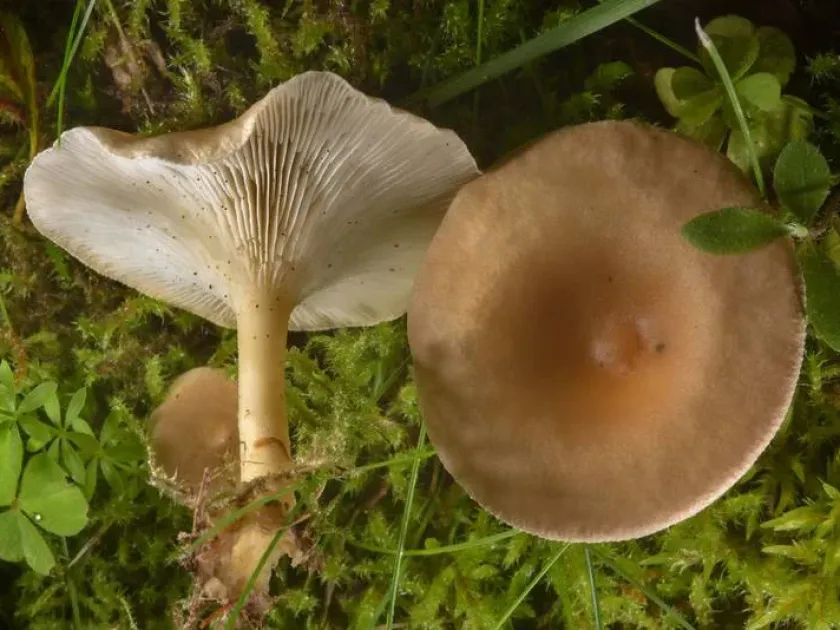
Clitocybe gibba
Description
Pathogen
The common funnel (Clitocybe gibba) is not a plant pathogen and does not cause diseases in agricultural or forest crops.
It is a gilled mushroom belonging to the Tricholomataceae family, which operates as a decomposer in various ecosystems.
This organism strictly functions as a saprotroph, meaning it derives its nutrients from non-living organic material.
It lacks the physiological mechanisms necessary to infect or parasitize living plant tissues.
Its primary biological role is to break down complex organic compounds into simpler forms, assisting in nutrient cycling.
Conditions for development
The development of Clitocybe gibba mycelium is highly dependent on moist environments rich in organic debris.
The fungus thrives in shady locations, such as leaf litter in forest floors, where humidity remains stable.
Temperature ranges typical of summer and autumn are most conducive to the emergence of its fruiting bodies.
High soil organic content provides the substrate necessary for the fungus to establish and propagate effectively.
Persistent moisture levels in the environment are essential for the survival and spore dispersal of this species.
Why it matters
There is no evidence that this mushroom causes harm to crops, trees, or any other type of agricultural vegetation.
Because it is not a plant pathogen, it does not negatively affect plant health, crop yields, or economic assets.
The presence of this fungus is a natural occurrence that does not signify a disease outbreak or a risk to plant vitality.
It does not compete with plants for resources in a way that would hinder their growth or development.
Categorizing this fungus as a plant disease is factually incorrect and misrepresents its ecological function.
Protection
No protection or control measures are necessary, as the common funnel poses no threat to farming or forestry.
The application of fungicides is not recommended, as it would disrupt the beneficial soil microbial communities.
Managing this species is unnecessary and counterproductive to maintaining a balanced soil ecosystem.
Instead of seeking to eliminate the fungus, it should be recognized as a beneficial decomposer of organic waste.
No agricultural protocols are required to address this organism, as it acts in harmony with the environment.
Discussion
No discussions yet — be the first.