
Clavariadelphus truncatus
Clavariadelphus truncatus
Description
Symptoms
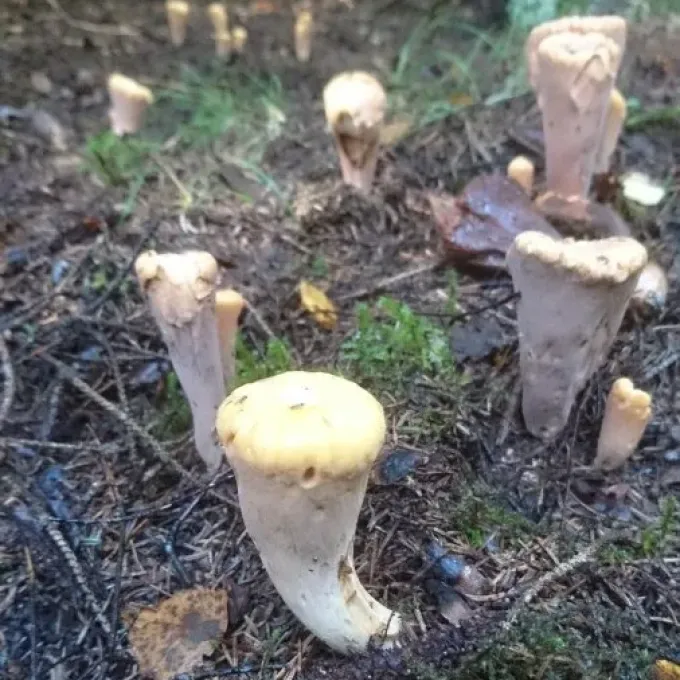
The fruiting body is distinctively club-shaped, often widening at the apex where it appears truncated or flattened.
The color ranges from buff or ochre to a rich brownish-orange, depending on the age and moisture conditions.
- Surface: Smooth to slightly wrinkled.
- Height: Typically 5–15 cm tall.
- Flesh: Firm, white, and resistant to decay.
These mushrooms typically grow in clusters, appearing above the moss or leaf litter on the forest floor.
The absence of spores or lesions on nearby plants differentiates it clearly from any parasitic infection.
Pathogen
It is important to emphasize that Clavariadelphus truncatus is not a plant disease, a pest, or a pathogen of any agricultural crop.
This organism is a fungus belonging to the Clavariadelphaceae family, known primarily as a woodland mushroom.
It does not cause infections, root rot, or any form of damage to the vascular system of trees or plants.
In ecological terms, it functions as a saprotroph or a mycorrhizal partner, which is beneficial for forest health.
Classifying it as a plant disease in an agronomic context would be scientifically incorrect and misleading.
Conditions for development
The species thrives in cool, moist coniferous forests, often associated with spruce and pine trees.
High humidity and consistent moisture in the organic soil layers are essential for its development.
The fruiting season generally occurs from late summer through autumn, coinciding with higher rainfall periods.
It prefers well-drained but nutrient-rich sites where organic matter decomposition is active.
Optimal growth requires undisturbed forest floors where the mycelial network can persist over several years.
Why it matters
Clavariadelphus truncatus causes zero harm to agricultural systems, fruit orchards, or timber production.
It is non-pathogenic, meaning it lacks the biochemical mechanisms to parasitize or destroy living plant tissue.
There are no reported cases of this fungus affecting crop yield or the physiological status of ornamental plants.
The presence of this fungus is considered an indicator of a balanced and healthy forest ecosystem.
Therefore, no economic damage or threat to biodiversity is associated with this organism.
Protection
No protection measures or disease control strategies are needed for Clavariadelphus truncatus.
Fungicides should never be applied to control this species, as it is a natural component of the environment.
Preventive maintenance of forest soils helps maintain the beneficial fungal biodiversity within the area.
Management efforts should focus on conserving native habitats rather than attempting to eradicate beneficial fungi.
In agronomy, monitoring should be directed toward actual plant pathogens, whereas this species remains benign.
Discussion
No discussions yet — be the first.