
Latticed stinkhorn
Clathrus ruber
Description
Symptoms
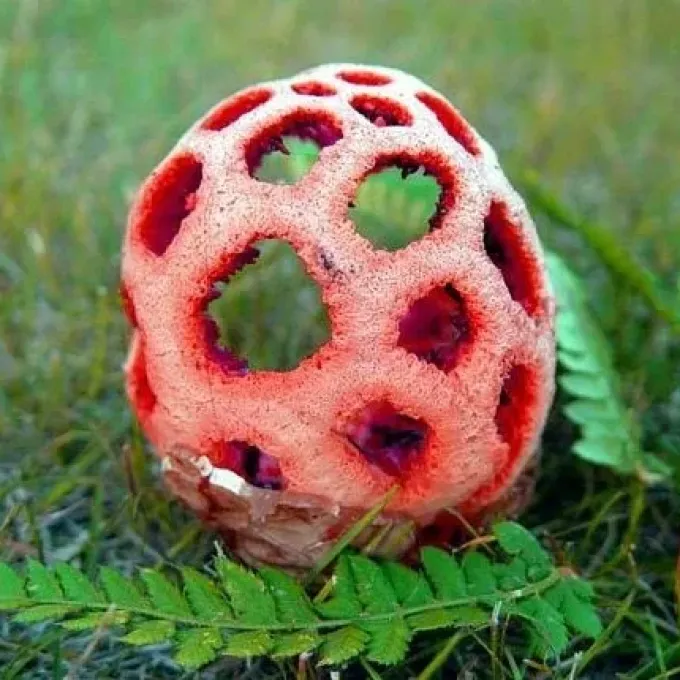
The main external indicator of the Latticed stinkhorn's appearance is the emergence of specific fruiting bodies on the soil surface, resembling a mesh sphere or a red cage.
In the early stages of development, the fruiting body appears as a whitish or yellowish egg, up to 5–8 centimeters in diameter, partially submerged in the substrate.
Upon maturation, the "egg" membrane bursts, and a bright red lattice structure emerges, giving the fungus its unique and recognizable appearance.
The inner surface of the lattice is covered with an olive-green slime (gleba), which contains the fungus spores and emits a pungent, characteristic odor of rotting matter.
This smell is a diagnostic feature, as it attracts insects that act as pollinators and assist in dispersing the spores over long distances.
Pathogen
The Latticed stinkhorn (Latin: Clathrus ruber) is a fungus belonging to the Phallaceae family, categorized as a gasteromycete. It is critical to clarify that it is not a plant pathogen.
Biologically, this organism is a saprotroph. This means it feeds exclusively on dead organic matter, breaking down plant residues within the soil.
Unlike phytopathogens that attack living plant tissues, this fungus has no mechanism to infect healthy cells of cultivated plants. Its presence in a garden indicates a high level of soil humus enrichment.
The mycelium of the Latticed stinkhorn develops in the leaf litter and loose soil, acting as a decomposer. It plays a significant role in forest ecosystems by completing the nutrient cycle in the soil.
The life cycle of the fungus includes the formation of a fruiting body—an "egg"—which gradually ruptures to release the bright red, porous lattice structure characteristic of this species.
Conditions for development
The Latticed stinkhorn prefers moist and shaded areas where there is a consistent level of plant residue humification.
The most favorable substrate for it is organic-rich forest soil, decaying wood, or mulch consisting of bark and fallen leaves.
The temperature range for successful spore development and fruiting body formation must be within moderate limits, typical of warmer regions.
High humidity of both air and soil during the summer-autumn season is a critical factor stimulating the active growth of the mycelium.
The fungus is sensitive to direct sunlight and extreme soil dryness, which is why it is rarely found in open, well-drained areas.
Why it matters
The Latticed stinkhorn does not cause any harm to agricultural crops, garden trees, or ornamental plants.
It is not a parasitic organism, so there is no need to implement eradication measures or protective treatments against it.
On the contrary, its presence indicates a healthy state of soil microflora and sufficient accumulation of nutrients in the substrate.
The only inconvenience for a gardener might be the unpleasant smell emanating from the mature fruiting body during its active spore-releasing phase.
Given the rarity of this species in many regions, the Latticed stinkhorn is protected in several Red Data Books, so destroying it is generally discouraged by environmental standards.
Protection
Because this organism is not a plant disease, special control methods, fungicides, or quarantine measures are not applied.
If the presence of the fruiting body is aesthetically undesirable, it can simply be removed mechanically using gloves and disposed of in a compost heap.
To prevent active growth of the mycelium, one can limit the use of excessive moist mulch if it contradicts the agricultural practices of the cultivated plants.
Regular soil cultivation and improving aeration of the area create less favorable conditions for saprotrophic fungi that thrive in stagnant moisture.
Overall, the presence of the Latticed stinkhorn in a garden is a natural biological feature of the ecosystem that does not require intervention from an agronomist.
Discussion
No discussions yet — be the first.