
Dollar spot
Clarireedia jacksonii
Description
Symptoms
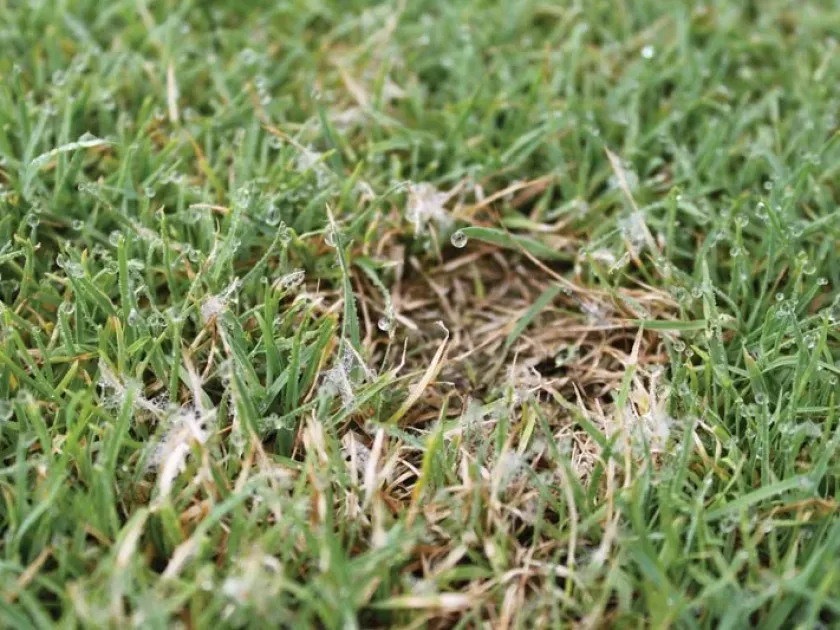
The primary symptom is the emergence of small, circular, straw-colored spots on the turf. These spots typically measure 1 to 5 centimeters in diameter, resembling the size of a silver dollar coin.
Early infections often present as water-soaked spots on the leaves, which eventually turn pale yellow or bleached white, typically outlined with a reddish-brown margin.
During periods of high humidity, particularly in the early morning, a fine, cobweb-like mycelial growth may be visible on the infected grass blades, resembling a layer of light frost.
If left unmanaged, individual spots may coalesce to form large, irregular patches of dead grass, severely compromising the aesthetic quality of the turfgrass stand.
Commonly affected grasses include Kentucky bluegrass, creeping bentgrass, and fine fescue, especially when they are maintained at a low mowing height.
Pathogen
The causative agent of this disease is the fungal pathogen Clarireedia jacksonii, previously classified under the genus Sclerotinia homoeocarpa. This ascomycete fungus specifically targets turfgrass species commonly used in landscaping.
The pathogen survives within infected plant debris and soil in the form of mycelium. Unlike many other fungi, it does not produce hardened sclerotia, but instead relies on its ability to remain active in the thatch layer and soil.
Disease spread is primarily driven by mechanical means, including lawnmower blades, foot traffic, and equipment, which transport fungal spores and mycelial fragments across the lawn surface.
The fungus invades the leaf tissues, using enzymatic activity to degrade cell walls. This action causes a disruption in water and nutrient transport, leading to the characteristic dieback symptoms.
Infection is most successful when humidity is high and the grass canopy remains wet for extended periods, allowing spores to germinate and penetrate the host plant efficiently.
Conditions for development
Dollar spot disease thrives during warm and humid weather conditions, with the pathogen being most active at temperatures ranging from 15°C to 30°C.
Prolonged periods of leaf wetness, caused by heavy dews, frequent light irrigation, or morning fogs, are essential for the rapid development and spread of the fungus.
Turfgrass that is under-fertilized, specifically nitrogen-deficient, is significantly more susceptible to dollar spot outbreaks compared to healthy, well-nourished turf.
Accumulation of thatch creates a moisture-retaining environment and provides a reservoir for the pathogen, making it harder to control the disease through cultural practices alone.
Poor air circulation, often found in enclosed spaces or dense turf stands, prevents leaves from drying quickly after dew or rain, creating an ideal microclimate for infection.
Why it matters
The primary damage caused by dollar spot is the loss of turf uniformity and color, which renders residential lawns and professional golf greens unsightly.
In severe cases, the disease can cause extensive thinning and death of the grass, often necessitating expensive overseeding or sod replacement to restore the lawn.
Weakened turf is more vulnerable to opportunistic weeds and other secondary pathogens, leading to a long-term decline in the quality and composition of the lawn.
For the golf course industry, dollar spot is considered a major economic pest that requires continuous monitoring and costly chemical inputs to maintain playing standards.
The disease significantly lowers the stress tolerance of the grass, making the affected areas more prone to damage from heat, drought, and heavy traffic.
Protection
Effective management begins with proper irrigation practices, specifically watering in the early morning to ensure that the turf canopy dries out quickly during the day.
Cultural practices such as regular aeration and dethatching are crucial for improving soil drainage and reducing the humidity levels within the turf canopy.
Maintaining a regular and balanced fertility program, particularly adequate nitrogen levels, is the best natural defense against the onset of Clarireedia jacksonii.
When cultural measures are insufficient, fungicide applications should be used, utilizing chemical classes like DMI or SDHI inhibitors to control and suppress the pathogen.
- Mowing with sharp blades to minimize tissue damage.
- Dew removal via rolling or mowing in the morning.
- Rotation of chemical classes to prevent fungicide resistance.
Discussion
No discussions yet — be the first.