
Dollar spot
Clarireedia
Description
Symptoms
The first symptoms are small, circular, yellowish-brown spots, roughly the size of a coin (hence the name "dollar spot"). Over time, these spots turn straw-colored and bleached.
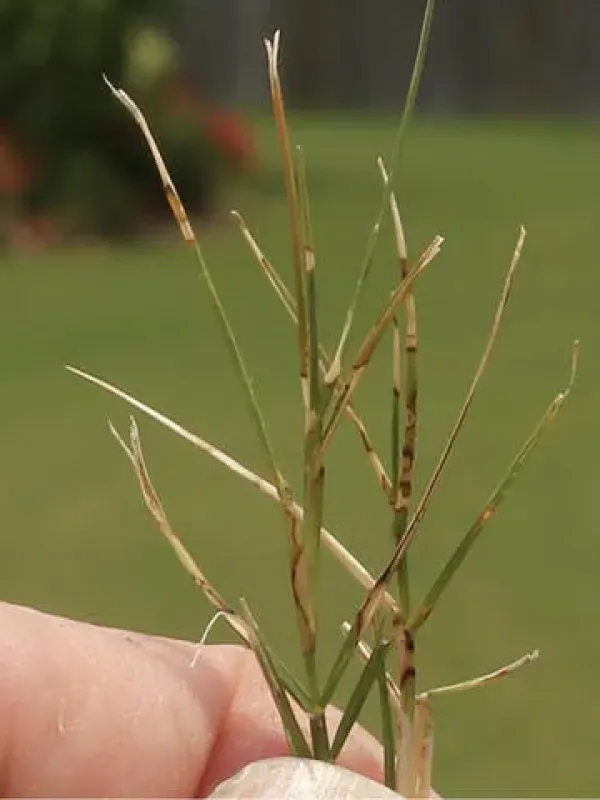
A diagnostic sign is the presence of "hourglass-shaped" lesions on the leaf blades, characterized by a white to tan center with reddish-brown borders at the margins.
During early morning hours with high humidity, a cobweb-like mycelium can be observed on the affected patches, which quickly disappears as the dew evaporates.
If left untreated, individual spots often coalesce into large, irregular, sunken areas of dead turf, significantly disrupting the uniformity of the lawn.
Heavily infected turf displays distinct patches of blighted leaves, leading to a thin, unhealthy appearance that reduces the aesthetic value of the ground cover.
Pathogen
The causative agent of dollar spot is a group of fungi belonging to the genus Clarireedia (formerly identified as Sclerotinia homoeocarpa). These pathogens are common in lawns and golf courses during warm, humid weather.
The fungus survives in the soil and thatch as dormant mycelium. Infection spreads via spores or mycelial fragments moved by mowing equipment, foot traffic, wind, or splashing water from irrigation.
Mycelium penetrates the leaves either through the stomata or directly through the epidermis. It thrives in temperatures ranging from 20 to 30 degrees Celsius, which is typical for summer seasons.
The fungus is highly aggressive in colonizing leaf tissue, especially when moisture levels are consistently high in the canopy layer. It spreads rapidly across dense turf areas.
The biological nature of the pathogen allows it to remain viable in the soil for long periods, meaning that infestations can recur annually if environmental conditions are favorable.
Conditions for development
Dollar spot disease flourishes under conditions of high humidity, heavy dew, and warm temperatures, specifically when night temperatures stay above 15 degrees Celsius.
Low nitrogen fertility levels are a primary risk factor. Turfgrass that is nutrient-deficient is far more susceptible to infection than adequately fertilized grass.
Poor soil aeration and excessive thatch accumulation create a damp environment at the soil surface, providing a perfect refuge for the fungus to persist and grow.
Irrigation practices that involve frequent, light watering or late-evening watering prevent the foliage from drying out, thereby promoting fungal development.
Periods of moisture stress followed by humid weather can weaken the plants, leaving them vulnerable to invasion by the Clarireedia pathogen.
Why it matters
The disease causes significant damage to the aesthetic quality of turf, making it problematic for high-value areas like putting greens and decorative landscapes.
Extensive infestation results in the death of turf blades, leading to thinning of the stand and providing an opportunity for opportunistic weeds to invade the area.
Recovery is slow in the absence of corrective measures, and a weakened lawn is more prone to subsequent stresses, including other diseases and insect attacks.
Maintenance costs increase significantly due to the necessity of frequent fungicide applications, specialized fertilizer programs, and potential overseeding requirements.
Beyond visual impact, persistent infection can degrade the long-term health of the root system, making the turf less resilient to drought or high-traffic conditions.
Protection
Effective management begins with maintaining an adequate nitrogen fertilization program, which keeps the grass growing vigorously and aids in recovery.
Practice deep and infrequent irrigation in the early morning hours, which allows the foliage to dry out completely during the day, making it harder for fungi to survive.
Regular aeration and vertical mowing (dethatching) are essential to improve air circulation, reduce thatch depth, and promote healthy soil conditions.
When environmental conditions favor the disease, the application of registered fungicides is necessary to suppress the pathogen and protect the remaining healthy turf.
Practice good sanitation by cleaning equipment after mowing infected areas to prevent the physical transfer of the pathogen to clean parts of the lawn.
Discussion
No discussions yet — be the first.