
Timothy leaf spot
Cladosporium phlei
Description
Symptoms
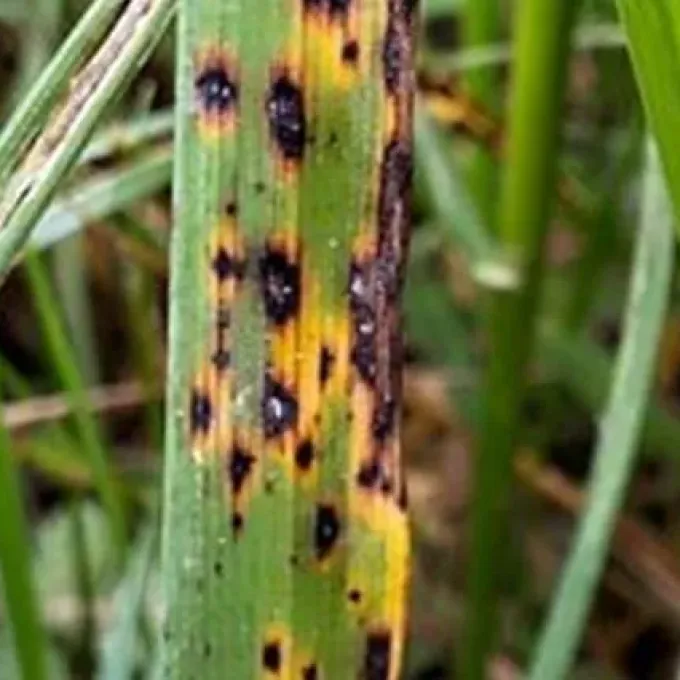
The primary symptom involves the appearance of small, irregular spots on the leaves. Initially, these spots are pale green or yellowish, later turning brown or dark grey as the tissue dies.
A characteristic yellow halo often surrounds the necrotic spots, indicating localized stress in the plant cells. Under high humidity, an olive-brown mold develops on the spots, which represents the fungal sporulation.
As the disease progresses, these lesions enlarge and coalesce, potentially covering the entire leaf surface. This causes the leaves to wither prematurely and die, starting from the lower levels of the plant.
In severe infections, the disease also affects leaf sheaths and occasionally inflorescences. Infected flowers may become deformed, leading to poor seed quality and reduced yield.
The overall appearance of an infected stand is stunted and dull. The vibrant green color is replaced by a chlorotic or brownish hue, significantly reducing the photosynthetic capacity of the plants.
Pathogen
The disease is caused by the fungus Cladosporium phlei, which is an imperfect fungus. It is a highly specialized pathogen that specifically targets plants belonging to the Phleum genus, primarily Timothy grass.
This fungus is known for its resilience and can survive in the environment for extended periods. It persists mainly on crop residues and stubble, ensuring it remains present in the field throughout the winter.
The infection cycle begins with the production of conidia, which are easily disseminated by wind and rain splashes onto healthy foliage. During the growing season, multiple cycles of sporulation can occur.
Infection can also be seed-borne if the seeds are not treated properly. Once on the leaf surface, the spores germinate and enter the tissue through stomata or mechanical injuries.
The mycelium colonizes the intercellular spaces of the leaf tissue, secreting toxins that disrupt the plant's metabolic functions and eventually cause tissue necrosis.
Conditions for development
Timothy leaf spot thrives in moderately warm and humid conditions. The optimal temperature range for spore germination is between 18 and 24 degrees Celsius.
High relative humidity and frequent rainfall are critical factors that promote the widespread dispersal of the fungus throughout the grass stand. Prolonged periods of dew also facilitate infection.
Dense, overgrown stands provide a microclimate with restricted airflow, which keeps the leaf surfaces wet for longer periods. These environments are highly susceptible to outbreaks.
Imbalanced nutrient management, particularly an excess of nitrogen combined with a deficiency in potassium, weakens the natural defense mechanisms of Timothy grass, making it more susceptible.
Continuous monoculture farming without crop rotation leads to a heavy buildup of fungal inoculum in the soil, increasing the pressure of the disease each year.
Why it matters
The main impact of Cladosporium phlei is the significant reduction in both biomass and the nutritional quality of the forage. Affected leaves have a lower content of proteins and essential sugars.
The reduced quality of the hay negatively affects its palatability for livestock. Animals tend to consume less of the infected feed, which results in poorer performance in livestock production.
In seed production fields, the damage is even more severe. Infection reduces seed yield and vigor, leading to low-quality batches that may fail to meet germination standards.
The disease stresses the grass, making it less hardy and less able to survive harsh winter conditions. This often results in thinner stands that may need to be reseeded more frequently.
Economic losses are cumulative, arising from reduced harvest volume, lower quality grades, and the extra costs associated with fungicide applications and additional tillage operations.
Protection
Integrated management is essential for effective control. The use of high-quality, treated seed is the first line of defense to prevent introducing the pathogen to clean fields.
- Implement timely mowing to minimize humidity levels within the canopy.
- Avoid excessive seeding rates to ensure good air circulation.
- Apply balanced fertilization, focusing on potassium to boost plant immunity.
- Remove weeds and volunteer plants that may act as reservoirs for the fungus.
- Select resistant Timothy grass varieties for inclusion in the crop rotation.
Chemical control involving fungicides can be effective during high-risk periods. Products containing triazoles or strobilurins are often used to suppress fungal development when environmental conditions are ideal for the disease.
Deep plowing of crop residues after harvest is a vital cultural practice. By burying the infected plant material, the survival rate of the fungus is drastically reduced for the following season.
Discussion
No discussions yet — be the first.