
Cladonia rangiformis
Cladonia rangiformis
Description
Symptoms
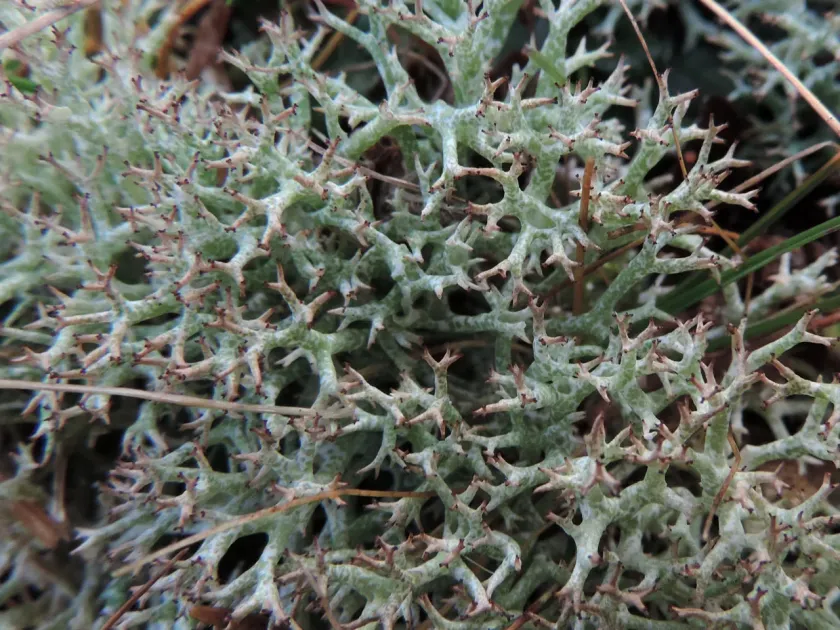
Cladonia rangiformis is a fruticose lichen that forms dense, mat-like clusters on the soil surface. Its color typically ranges from pale grayish-brown to olive.
The lichen exhibits a complex branching structure with small, cylindrical branches that show dichotomous division, often resembling miniature coral or shrub-like structures.
Visible symptoms include the presence of compact patches that can cover significant areas of bare ground. The surface is matte, and the lichen becomes brittle and breakable during dry conditions.
Unlike parasitic plant diseases, this organism does not leave lesions, spots, or rot on vascular plants, as it remains strictly on the ground as an independent life form.
The presence of this lichen serves as a biological indicator of prolonged soil neglect, low plant competition, and lack of recent tillage operations.
Pathogen
Cladonia rangiformis is not a plant pathogen or a disease agent. It is a symbiotic association between a fungus and an alga (lichen), which is functionally distinct from infectious crop diseases.
It does not infect plant tissues, nor does it transport pathogens into crops. Its classification as a disease in some contexts is a common misconception linked to its presence on degraded farmland.
The organism is entirely autonomous, obtaining energy through photosynthesis from its algal partner and minerals from atmospheric deposition and surface dust.
Because it is not a pathogen, fungicides or antibiotic treatments are completely ineffective and irrelevant for controlling this species in an agricultural setting.
It is classified as an epiphytic or epilithic-like growth that simply occupies a niche when conditions for higher vascular plants are unfavorable.
Conditions for development
This lichen thrives in well-lit, open areas with dry or semi-dry soil conditions. It is frequently found on sandy, stony, or calcareous soils where competition from grasses is minimal.
Lack of mechanical disturbance is the primary factor allowing Cladonia rangiformis to establish. Tillage operations disrupt the physical integrity of the thallus and bury the organism.
It prefers environments with high light intensity and low nitrogen availability, which explains why it is often seen on marginal lands or long-term fallows.
The organism exhibits extreme resilience to thermal stress and drought, enabling it to persist where standard crops or forage grasses might struggle.
Soil stability is essential; in frequently plowed fields, the lichen cannot gain a foothold, which makes it a rare sight in intensive farming operations.
Why it matters
The main impact of this lichen is its competitive nature on pasture lands, where it colonizes space that would otherwise support high-quality forage grasses.
On crop land, it acts as a space-occupying competitor, potentially hindering seedling emergence if the soil surface is not prepared correctly before planting.
Its presence is often a marker of poor soil structure, compaction, and low fertility, which are the real underlying issues negatively affecting total crop yield.
While not poisonous, dense colonization can decrease the palatability of pastures, indirectly affecting the economic output of livestock operations.
It adds no nutritional value to the biomass and requires additional mechanical effort to clear if a field has been left unmanaged for several seasons.
Protection
The primary control method for Cladonia rangiformis is consistent mechanical tillage, such as plowing, which breaks up the lichen mats and incorporates them into the soil.
Pasture management strategies, such as over-seeding with productive grass species and applying nitrogen fertilizers, create a dense canopy that outcompetes the lichen.
Improving soil fertility and drainage creates conditions where vascular plants dominate, naturally suppressing the lichen's ability to colonize the surface.
Chemical control is generally not recommended or practiced, as the lichen is resistant to standard herbicides and such treatments would be ecologically harmful.
- Mechanical plowing and harrowing
- Improving soil nutrient levels
- Regular grazing to promote grass growth
- Establishing a diverse plant cover
Discussion
No discussions yet — be the first.