
Cercospora leaf spot of okra
Cercospora malayensis
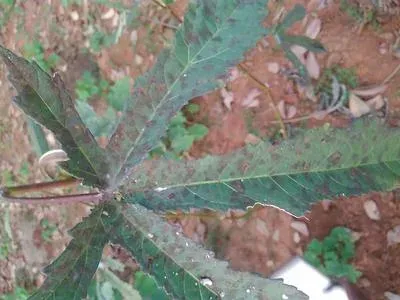
Description
Symptoms
The earliest symptoms appear on the underside of older leaves as small, angular to irregular spots, typically gray or tan in color.
These spots often develop a distinct dark border or halo, differentiating them from other common leaf-spotting diseases of okra.
As the infection advances, the spots increase in size and often coalesce, causing large portions of the leaf tissue to turn necrotic.
A dusty, gray fungal growth is often visible on the underside of the leaves in the center of the spots, representing the mass production of conidia.
Severe infection leads to chlorosis, leaf curl, and eventually premature defoliation, which severely stresses the plant.
Pathogen
The disease is caused by the fungus Cercospora malayensis, a specialized pathogen that primarily targets the Malvaceae family, specifically okra (Abelmoschus esculentus).
This fungal pathogen produces conidia, which serve as the primary inoculum for spreading the disease through wind and rain splashes.
The fungus can survive as mycelium within infected crop residues left in the soil, allowing it to persist between growing seasons.
It colonizes the leaf tissue by entering through stomata or directly through the cuticle, eventually disrupting the plant's metabolic processes.
As a host-specific pathogen, Cercospora malayensis is highly adapted to the growth cycles of okra, ensuring its survival by infecting successive plantings.
Conditions for development
Development of Cercospora leaf spot is favored by high humidity levels, consistently above 80%, and warm temperatures.
The ideal temperature range for rapid infection and fungus spread lies between 22°C and 28°C (72°F – 82°F).
Dense crop spacing limits airflow within the canopy, creating a microclimate with high humidity that is highly conducive to disease outbreaks.
Frequent rainfall or heavy dew provides the necessary moisture for the germination of fungal spores on the leaf surfaces.
Poor drainage and excessive irrigation contribute significantly to the proliferation of the pathogen throughout the field.
Why it matters
The primary damage caused by Cercospora malayensis is the significant reduction of photosynthetic capacity due to massive leaf loss.
As the plant loses its ability to produce energy, growth is stunted, and the overall yield of okra pods is drastically decreased.
The infection negatively impacts fruit quality, often leading to smaller, malformed pods that do not meet market requirements.
Continuous defoliation weakens the entire plant, making it more vulnerable to secondary diseases and various insect pests.
In cases of severe infestation, the disease can lead to total crop failure if management practices are not implemented in time.
Protection
Effective management begins with sanitation; removing and destroying infected plant debris is crucial to reducing the pathogen's load in the soil.
Implementing a proper crop rotation schedule prevents the build-up of the fungus by planting non-host crops for at least three seasons.
Using certified, disease-free seeds and providing adequate spacing between plants improves ventilation and decreases humidity around the foliage.
Fungicidal sprays, such as copper-based compounds or azole-based systemics, can be applied to protect healthy foliage during high-risk periods.
- Practice regular field inspections for early detection.
- Avoid overhead irrigation to keep foliage dry.
- Apply balanced fertilization to keep the plant vigorous and resilient.
Discussion
No discussions yet — be the first.