
Canker stain of plane
Ceratocystis platani
Description
Symptoms
The first external symptom of canker stain is the yellowing and wilting of leaves on individual branches. This foliage often withers prematurely and drops, indicating a severe disruption of the vascular system.
Sunken, elongated lesions or cankers appear on the bark of trunks and main branches. These lesions often reveal dead, discolored tissue underneath the bark, which may eventually crack open.
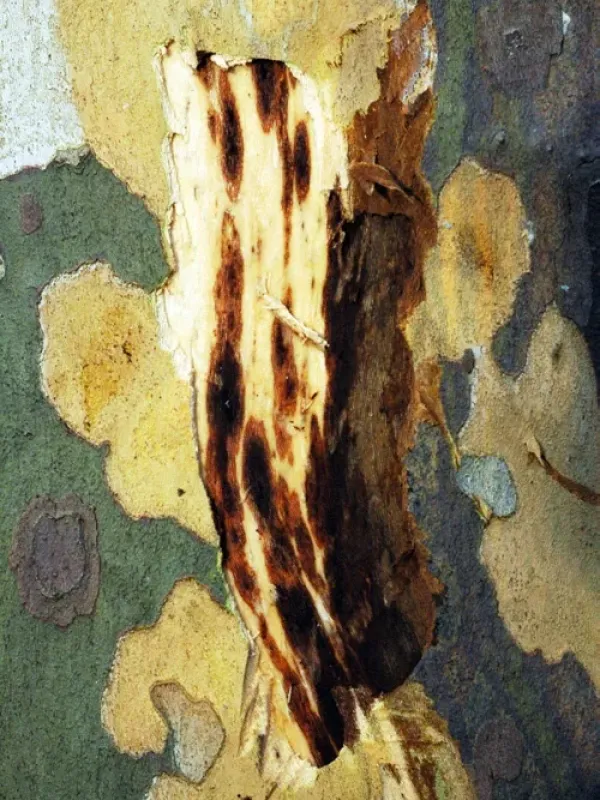
If the bark is removed from an infected area, the wood beneath typically shows dark, brownish-black staining. These stains are characteristic of the fungus as it spreads through the inner layers of the tree.
As the disease progresses, the tree loses its vigor, and whole sections of the canopy die off. In advanced stages, the tree fails to produce new buds and the entire structure loses its ability to survive.
Symptoms are often internal at first, meaning the tree may look healthy externally while the infection is already well-established in the cambium and the sapwood.
Pathogen
Canker stain is caused by the fungus Ceratocystis platani, a highly aggressive ascomycete pathogen. It is a vascular wilt fungus that specifically targets the xylem of plane trees, causing severe tissue damage.
The pathogen is capable of surviving for long periods in infected wood, sawdust, and even in the soil. It is highly contagious, meaning even small amounts of infected material can initiate a new outbreak.
Infection occurs primarily through wounds in the bark. Once inside the tree, the fungus grows through the vascular system, preventing the transport of water and nutrients, which eventually leads to the death of the tree.
Plane trees (Platanus species) are the primary hosts. The pathogen is widespread in many parts of Europe and North America, posing a significant threat to urban forestry and ornamental landscape plantings.
Because of its ability to kill mature trees within a few years, it is strictly monitored as a quarantine pathogen in many countries, and its management is a top priority for arborists.
Conditions for development
The spread of Ceratocystis platani is heavily dependent on human activity, specifically the wounding of trees. Any activity that causes bark abrasions, such as pruning, creates a point of entry for spores.
Transmission often occurs via contaminated pruning tools. If saws, shears, or other equipment are used on an infected tree and not properly sanitized, they effectively inoculate the next healthy tree.
Warm and humid weather conditions favor the growth of the fungus and the production of spores. Such conditions can accelerate the development of an epidemic within a localized area.
Root grafting is another significant factor in disease spread. In dense plantations, the fungus can move from an infected tree to a healthy neighbor through overlapping root systems.
Insects and water runoff can also carry spores. Rainwater can transport spores from active cankers down the trunk, potentially infecting lower parts of the tree or the surrounding soil.
Why it matters
Canker stain is a lethal disease, with no known cure for infected trees. Once the fungus has colonized the vascular system, the tree's health declines rapidly and inevitably leads to death.
The economic impact is profound, especially in urban environments. The loss of mature, high-value plane trees requires significant financial resources for removal, disposal, and replacement.
The disease destroys the aesthetic and ecological value of urban avenues and parks. Because plane trees are often used for their resilience, the loss of these trees creates significant gaps in the landscape.
Infected trees become structurally unstable, posing a risk to public safety. Falling limbs or entire trees can cause significant damage to property and threaten pedestrians in urban areas.
The presence of this pathogen limits the ability of landscape architects to use plane trees, which are otherwise highly tolerant to pollution and urban stressors, forcing them to look for less suitable alternatives.
Protection
Strict sanitation is the cornerstone of disease control. All tools used for pruning must be disinfected with approved sanitizing agents, such as bleach or alcohol, after every tree and even between cuts.
Minimizing bark injuries is essential. Arborists should avoid unnecessary pruning, and any essential wounds should be carefully managed to prevent exposure to fungal spores during the growing season.
Infected trees should be removed as soon as they are identified, including the stump, to prevent the pathogen from persisting in the area. Disposal must be managed carefully to avoid spreading spores.
Quarantine and phytosanitary regulations are critical for preventing the long-distance spread of the disease. This includes monitoring the movement of wood and nursery stock from infested regions.
Ongoing monitoring and early detection are vital. Public education regarding the disease helps park visitors and private tree owners report symptoms early, which allows for quicker containment of the pathogen.
Discussion
No discussions yet — be the first.