
Lemon disco
Calycina citrina
Description
Symptoms
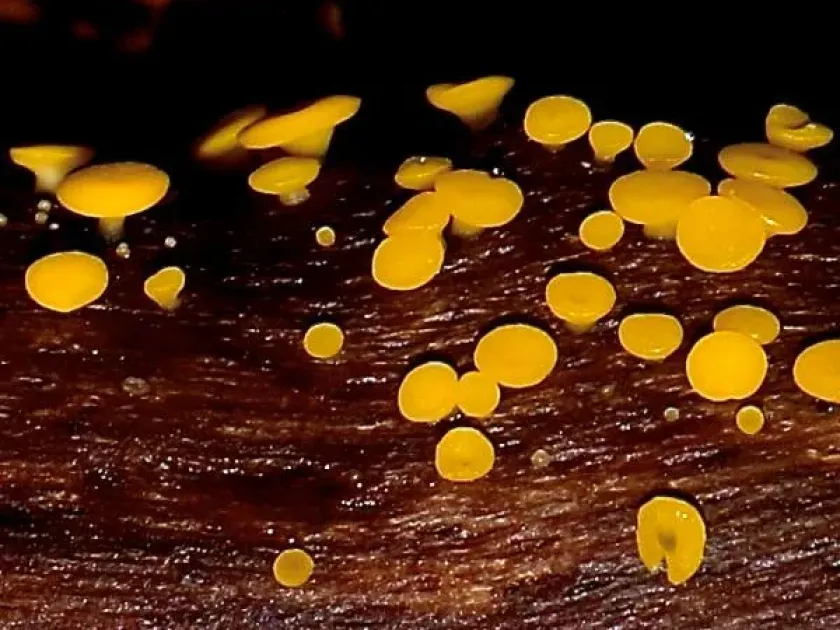
The lemon disco, known scientifically as Calycina citrina, appears as small, bright yellow or lemon-colored cup-shaped fruiting bodies. These often grow in tight clusters, covering the surface of the wood with a vibrant, carpet-like layer.
Physically, they resemble small discs measuring between 1 and 3 millimeters in diameter. Young specimens have inward-curved edges, but as they mature, these flatten out, becoming nearly planar or slightly concave.
The surface of the fruit body is smooth and may look slightly shiny or damp during humid weather. The texture is soft and gelatinous, but it loses its brilliance and shrinks rapidly when exposed to dry conditions.
They are primarily found on stumps, fallen logs, or dead branches of deciduous trees. The colonies are most visible during the autumn, when humidity levels are optimal for their development.
A key diagnostic feature is the near-absence of a stalk, which makes the fruit bodies appear as if they are glued directly onto the decaying wood surface.
Pathogen
The causal agent is Calycina citrina, a fungus belonging to the Ascomycota division. It is a saprotroph, meaning it feeds on dead organic matter rather than attacking living plant tissues.
In nature, this fungus acts as a decomposer, playing a vital role in breaking down lignin and cellulose, which helps recycle nutrients back into the forest soil.
The fungus reproduces via spores that are dispersed by wind and rain. Once they land on a suitable substrate, the spores germinate to form mycelium, which penetrates the wood fibers.
From an agronomic perspective, the lemon disco is considered an indicator of wood decay. Its presence suggests that the wood has already begun a biological degradation process.
The mycelium spreads slowly through the wood structure, gradually breaking down the cellulose, which eventually leaves the wood brittle and structurally compromised.
Conditions for development
Optimal conditions for the appearance of fruit bodies include high relative humidity and moderate temperatures. The fungus is most active during prolonged rainy periods in the autumn and spring.
The lemon disco prefers shaded areas where wood surfaces remain moist for extended periods. Direct sunlight is detrimental to its growth and causes the delicate colonies to wither quickly.
Deciduous wood, such as beech, birch, oak, and hornbeam, serves as the ideal substrate. It is much less common to find this species growing on coniferous wood.
Spore dispersal accelerates when there is a consistent source of moisture, making poorly stored firewood or lumber piles highly susceptible to colonization.
The temperature range for active growth is typically between 10 and 20 degrees Celsius. While freezing temperatures temporarily halt activity, the fungus remains alive in the substrate.
Why it matters
The lemon disco is not harmful to living fruit trees or ornamental plants, as it cannot infect healthy wood with intact bark.
The primary concern is the accelerated degradation of firewood, lumber, or wooden structures in contact with the ground, which reduces the quality and durability of the material.
The appearance of colonies acts as an early warning that the stored wood is too damp and requires proper ventilation or drying to prevent further structural damage.
Persistent fungal activity can create a damp microenvironment that encourages other, more aggressive wood-decay fungi to colonize the same material.
While not toxic to humans, uncontrolled fungal growth in damp basements or indoor storage areas should be avoided, as it can degrade indoor air quality and potentially trigger allergies.
Protection
The most effective prevention is to keep wood dry. Firewood should be stacked under a well-ventilated cover, ensuring it is kept off the damp ground.
Avoid direct contact between wooden structures and the soil. Use bricks, pallets, or metal stands to prevent moisture from wicking into the wood fibers.
Sanitary garden management, such as removing rotting branches, old stumps, and organic debris, helps reduce the overall spore load in the immediate environment.
If wood is already colonized, mechanical cleaning followed by the application of professional wood preservatives or fungicides can help stop the decay process.
- Maintain good airflow in wood storage areas.
- Use pallets to lift wood off the ground.
- Clear away decaying organic waste.
- Apply wood sealants and preservatives.
Discussion
No discussions yet — be the first.