
Calosphaeria canker
Calosphaeria
Description
Symptoms
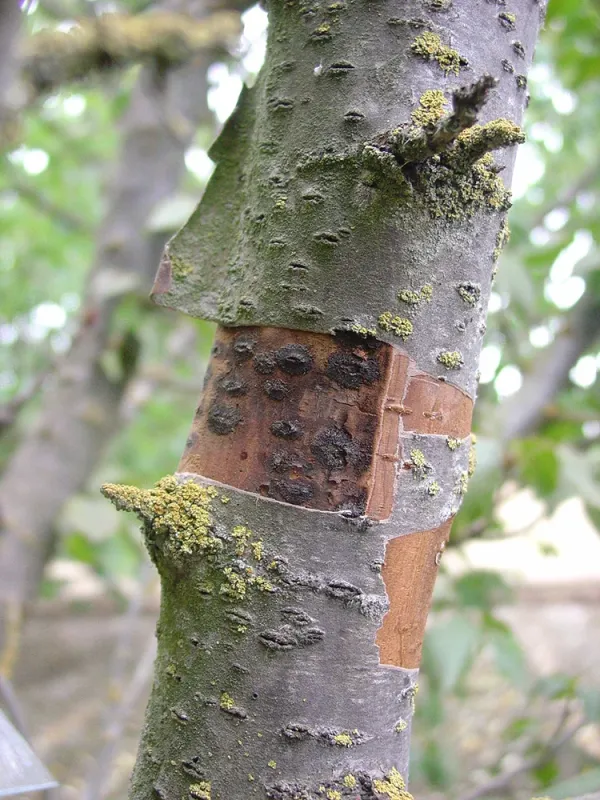
The hallmark of Calosphaeria canker is the development of sunken, necrotic lesions on the bark of branches or the main trunk. These areas often appear dark or discolored.
Over time, these necrotic lesions develop cracks as the fungus kills the underlying cambium layer and destroys the bark structure.
Symptoms often manifest as canopy decline, where leaves on infected branches become chlorotic, wither, and drop prematurely during the growing season.
Upon closer inspection, one can observe small, dark, pimple-like structures on the bark surface, which are the perithecia of the fungus, especially noticeable during wet weather.
If the infection girdles the branch, the entire portion of the canopy above the lesion will die, leading to significant structural damage to the tree.
Pathogen
Calosphaeria canker is a fungal disease caused by species of the Calosphaeria genus, most notably Calosphaeria pulchella. It primarily functions as a wood-decaying pathogen.
The fungus colonizes the woody tissues and bark of host plants, growing deep within the branches. Its life cycle involves the production of perithecia, small fruit bodies that emerge through the bark.
The mycelium of the pathogen persists in infected wood for long periods, allowing the disease to remain established in an orchard year after year.
Spore dissemination is primarily driven by rain splash and environmental factors, which move the fungal spores from the fruit bodies to fresh wounds on healthy branches.
Biologically, the pathogen is an opportunistic parasite that relies heavily on physical vulnerabilities in the tree to initiate infection.
Conditions for development
The spread and development of Calosphaeria are highly dependent on high humidity and rainfall, which facilitate spore release and successful colonization of tissues.
Trees under abiotic stress, such as drought, nutrient deficiency, or poor pruning practices, are significantly more susceptible to the fungal attack.
Open pruning wounds, particularly those left untreated, serve as the primary entry point for fungal spores to colonize the xylem and phloem.
Poor orchard sanitation, characterized by dense canopies and lack of airflow, maintains moisture on the branches for longer periods, promoting fungal growth.
Environmental damage, such as sunscald or winter frost cracks, creates localized weakened spots that are easily exploited by Calosphaeria.
Why it matters
The primary threat of Calosphaeria canker is the cumulative loss of wood tissue, which reduces the structural integrity and longevity of the fruit tree.
The disease causes chronic canopy dieback, forcing growers to prune away large portions of the tree, which results in significant yield reduction over time.
Infected trees become more vulnerable to subsequent attacks by secondary pests and other pathogens, leading to a general decline in overall tree health.
The destruction of conducting vessels impairs the transport of water and nutrients, which negatively impacts fruit size and quality.
The disease can spread rapidly within a susceptible orchard, making it a serious concern for maintaining the economic viability of stone fruit plantings.
Protection
The most effective management strategy is preventive care through rigorous pruning and sanitation practices to remove all infected wood from the orchard.
All pruning cuts should be protected with wound sealants or copper-based fungicides to block the pathogen from entering the fresh wood.
Regular preventive fungicide applications during the dormant season can significantly reduce the pressure of the pathogen and limit spore production.
Providing adequate water and fertilization helps maintain tree vigor, strengthening the plant's natural defense mechanisms against fungal pathogens.
- Disinfecting pruning tools between trees to prevent spread.
- Removing and destroying infected prunings immediately.
- Managing canopy density to improve air circulation and sunlight.
Discussion
No discussions yet — be the first.