
Caloscypha fulgens
Caloscypha fulgens
Description
Symptoms
The initial symptom of infection is pre-emergence damping-off, where seeds die before they can sprout. Upon close inspection, these seeds are often covered in a characteristic yellow or white fungal mycelium.
For seedlings that have managed to sprout, the disease manifests as a lesion at the base of the stem near the soil line, causing the tissue to become soft and necrotic.
As the disease progresses, the stem collapses under its own weight. This phenomenon, known as damping-off, can occur very rapidly, often affecting entire rows of seedlings within a few days.
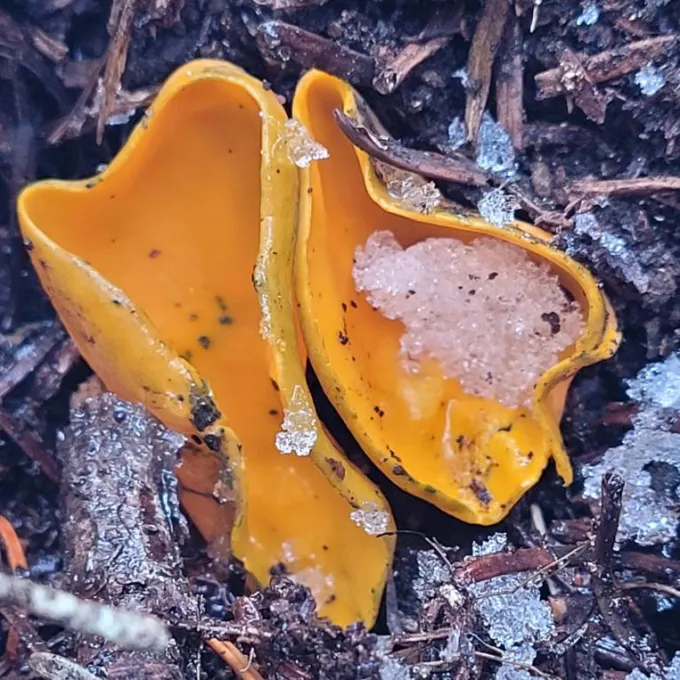
In high humidity, a web-like mycelial mat may be visible on the surface of the soil surrounding the affected plants, eventually leading to the emergence of bright orange fruit bodies.
The presence of these orange cups is a definitive diagnostic feature of Caloscypha fulgens in forest nurseries, indicating that the fungus has established a strong presence in the area.
Pathogen
The causal agent of this disease is the cup fungus Caloscypha fulgens, a member of the order Pezizales. This fungus is known for its ability to devastate forest nurseries by attacking conifer seeds and young seedlings.
Typically occurring as a saprophyte in forest litter, this fungus switches to a pathogenic lifestyle when environmental conditions become favorable for its rapid colonization of germinating seeds.
The pathogen's life cycle is closely synchronized with the early spring period, where its ascospores germinate in cold, moist soil environments, directly infecting young, susceptible plant tissues.
The mycelium of Caloscypha fulgens is highly invasive. It quickly spreads through the soil, using moisture films to reach neighboring seeds and seedlings in a process that often leads to total crop failure.
Morphologically, the fungus is identified by its bright orange, cup-shaped apothecia, which appear near affected plants as a clear sign of active reproduction and pathogen presence.
Conditions for development
Low soil temperature combined with high moisture is the primary condition required for the development and spread of Caloscypha fulgens.
The fungus thrives in acidic, poorly drained soils. Areas where water tends to pond after snowmelt or heavy spring rains are particularly vulnerable to sudden disease outbreaks.
Improper seed storage, such as exposure to excessive moisture or poor aeration, weakens the seed's defense mechanisms, making them extremely susceptible to infection once planted.
High seedling density in nurseries can also facilitate the spread of the pathogen, as the fungus moves easily from one plant to the next through the interconnected root systems.
The accumulation of inoculum in the soil over successive years of coniferous monoculture creates an environment where the disease can become endemic and very difficult to manage.
Why it matters
The economic impact of this disease is profound, as it can cause complete destruction of conifer seedling crops, necessitating costly re-sowing and labor inputs.
Beyond nursery losses, the disease affects the efficiency of forest restoration programs by reducing the availability of healthy, standard-sized planting stock.
Seedlings that survive an initial infection may remain stunted or weak, making them susceptible to secondary infections or environmental stress once outplanted in the forest.
The presence of this fungus in nurseries acts as a bottleneck for genetic diversity in reforestation efforts, as it selectively eliminates large quantities of young planting stock.
Additionally, the difficulty of eradicating this soil-borne pathogen means that affected land may remain unusable for coniferous nursery production for several seasons.
Protection
Effective control starts with high-quality seed management, including the use of appropriate fungicides for seed treatment to prevent early infection during the germination stage.
Improving the physical characteristics of nursery soil, particularly drainage and aeration, is critical to reducing the favorable conditions the fungus requires for development.
Implementing a rigorous crop rotation plan that alternates conifer species with non-host plants helps break the disease cycle and lowers the pathogen load in the soil.
Early detection is vital. If outbreaks occur, infected areas should be immediately removed and treated with fungicides to prevent the spread of spores to healthy portions of the nursery.
In some cases, the introduction of beneficial soil microbes, such as Trichoderma species, can help suppress Caloscypha fulgens by occupying the ecological niche and outcompeting the pathogen.
Discussion
No discussions yet — be the first.