
Caliciopsis pinea
Caliciopsis pinea
Description
Symptoms
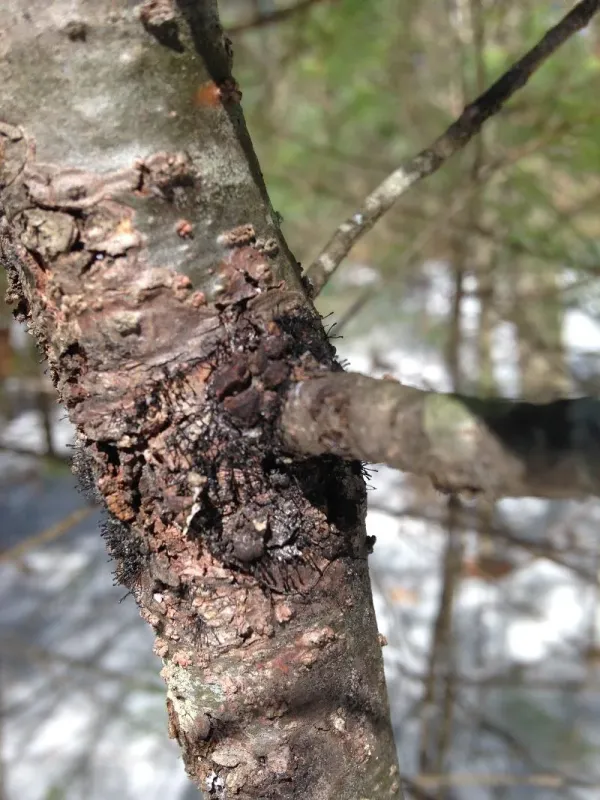
The most prominent sign of infection is persistent resinosis, where large amounts of pitch exude from the bark, hardening into dark, crusty patches on the trunk or branches.
Affected areas of the bark often develop thick, canker-like structures. When the bark is carefully peeled away, one can observe necrotic lesions in the underlying tissue, signaling the death of the cambium layer.
The crown of the infected tree begins to show symptoms of distress, starting with needle discoloration that turns from vibrant green to yellow or reddish-brown as the water supply to the branches is cut off.
- Tiny, black, thread-like fruiting bodies visible on the bark surface.
- Heavy resin flow (resinosis) forming dark streaks on the trunk.
- Formation of localized swellings or cankers on the stems.
- Premature needle drop and crown thinning.
- Dieback of individual branches progressing toward total tree mortality.
As the infection progresses, the girdling effect of the cankers eventually cuts off the circulation of sap, leading to the rapid decline and eventual death of the affected tree section or the entire tree.
Pathogen
The disease is caused by the ascomycete fungus Caliciopsis pinea. This pathogen specifically targets the bark and cambium layers of various pine species, functioning as a parasite that weakens the host tree over time.
The fungus develops within the bark fissures, where it produces characteristic black, stalk-like fruiting bodies known as perithecia. These tiny structures are the most reliable diagnostic feature for identifying the presence of the pathogen on a tree.
By penetrating the cambium, the fungus disrupts the phloem and xylem, effectively interfering with the tree's ability to transport nutrients and water. This metabolic disruption leads to the gradual decline of the host tree.
Spore dispersal occurs primarily through wind currents and splashing rain. Once established, the fungus can survive in the bark tissues of the host, allowing it to remain a persistent threat within a forest stand.
While often considered an opportunistic pathogen, Caliciopsis pinea can become quite aggressive in stressful environments, leading to significant outbreaks in dense or weakened pine populations.
Conditions for development
High stand density is a primary factor favoring the disease, as it promotes humidity and limits airflow around the trunks, creating an ideal microclimate for fungal spores to germinate.
Trees undergoing abiotic stress, such as prolonged drought, nutrient deficiencies, or poor site conditions, are significantly more susceptible to infection. Stress weakens the tree's chemical defenses against fungal attack.
Temperature plays a crucial role in the disease cycle, with mild winters and wet springs facilitating the growth of the fungal mycelium. Warm, humid weather is particularly conducive to active sporulation.
Bark damage caused by insects, wildlife, or mechanical forestry equipment provides easy entry points for the pathogen. Once a wound is present, the fungus quickly colonizes the exposed wood and inner bark.
A high inoculum load in a forest stand, often resulting from long-term neglect of sanitation practices, ensures that the disease can spread efficiently from one tree to another throughout the growing season.
Why it matters
Caliciopsis pinea causes significant economic damage to forest resources by reducing the growth rate and quality of timber. Severe infections render the wood unsuitable for construction purposes due to staining and structural defects.
The ecological harm is profound, as the disease can lead to the widespread mortality of young pines, altering forest composition and reducing the overall health and resilience of the ecosystem.
In nursery settings, the impact is devastating, as the pathogen can destroy entire batches of seedlings, leading to substantial financial losses and supply chain disruptions for reforestation efforts.
Infected trees serve as magnets for secondary pests, including various wood-boring beetles. These insects often accelerate the decline of the host, turning a fungal issue into a catastrophic infestation.
The loss of tree canopy and forest cover reduces the protective functions of the forest, such as soil stabilization and carbon sequestration, which are essential for maintaining regional environmental balance.
Protection
Sanitation harvesting is the most effective management strategy. Identifying and removing infected trees helps to lower the spore count in the environment and prevents the disease from spreading to healthy neighbors.
Maintaining optimal forest health through proper spacing and thinning is essential. Improving air circulation reduces humidity levels around the stems, which inhibits the growth and spread of the fungus.
For high-value trees or nursery stock, application of copper-based fungicides may be recommended. Timing applications to coincide with the periods of highest spore production is critical for success.
Minimizing mechanical damage during forestry operations is a key preventative measure. Workers should be careful to avoid barking or wounding trees, as these injuries are direct portals for the pathogen.
Regular forest health monitoring and early detection are vital components of any management plan. By acting quickly when the first signs appear, forest managers can contain the disease and minimize long-term impact.
Discussion
No discussions yet — be the first.