
Description
Symptoms
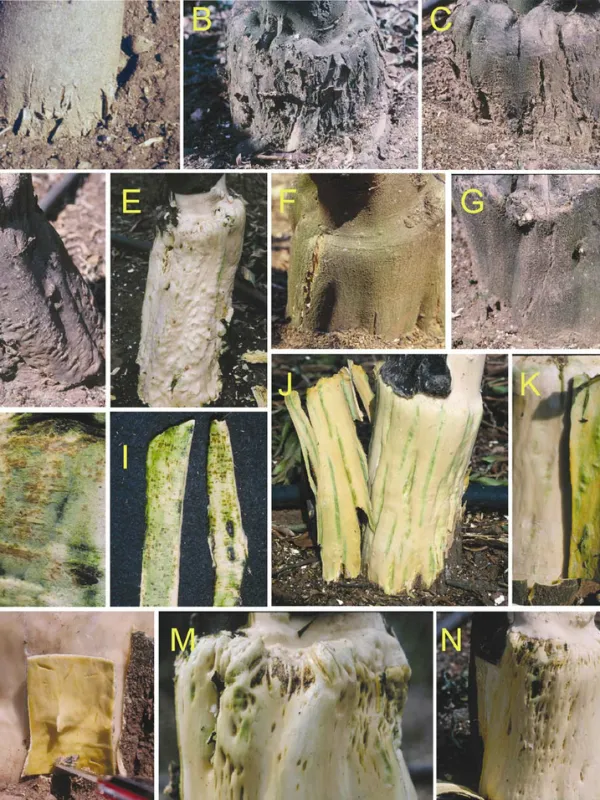
The primary symptom of citrus cachexia is the development of bark scaling, deep furrows, and corky lesions specifically near the graft union.
When the bark is carefully removed, brown staining and discoloration are visible in the wood, indicating necrosis of the cambial tissue.
Affected trees often exhibit reduced vigor, stunted growth, and an overall thin, sparse canopy compared to healthy specimens.
Fruit production is significantly impaired, often resulting in smaller, misshapen, and poor-quality fruit that is unsuitable for the commercial market.
Because the disease progresses slowly, symptoms may remain hidden for several years, allowing the infection to establish firmly within the orchard.
Pathogen
The disease is caused by the Citrus cachexia viroid (CCaVd), a small, circular, single-stranded RNA pathogen devoid of a protein capsid.
This viroid operates as a highly specialized parasite, hijacking the host plant's enzymatic machinery to facilitate its own replication.
Transmission of the pathogen occurs primarily through grafting, where infected budwood is utilized on healthy rootstocks during propagation.
Mechanical transmission is also a significant concern, as contaminated pruning tools can easily transfer the viroid from an infected tree to a healthy one.
Once inside the plant, the viroid becomes systemic, colonizing various tissues and remaining as a latent or active threat throughout the tree's lifespan.
Conditions for development
The disease thrives in environments where nursery practices lack strict phytosanitary standards for sourcing and handling propagation material.
Temperature fluctuations and high-temperature seasons can exacerbate the expression of symptoms by increasing the metabolic activity of the viroid.
Susceptibility is heavily influenced by the choice of rootstock, with certain citrus varieties displaying a higher sensitivity to the pathogen.
Poor hygiene regarding the cleaning of horticultural tools ensures that the viroid remains persistent across large citrus planting blocks.
Inadequate inspection of foundation blocks leads to the inadvertent distribution of infected scion wood to commercial growers.
Why it matters
The economic impact of citrus cachexia is severe, as it causes a long-term decline in yield and reduces the commercial viability of the plantation.
Infected trees suffer from chronic physiological stress, leading to poor nutrient uptake and susceptibility to environmental stressors.
Ultimately, the trees succumb to the infection, necessitating removal and expensive replanting efforts by orchard managers.
The systemic nature of the infection ensures that once a tree is diseased, it cannot be cured, turning it into a permanent reservoir for further spread.
Decreased quality and marketability of the crop lead to substantial financial losses, especially in high-value citrus production regions.
Protection
The most effective strategy is the exclusive use of certified, disease-free nursery stock that has been verified through diagnostic testing.
Rigorous sanitation protocols, such as disinfecting cutting tools with sodium hypochlorite or alcohol after each tree, are essential to stop the spread.
Orchard managers should prioritize the selection of rootstock varieties known for their tolerance or resistance to the specific viroid strain.
Regular diagnostic screening using PCR-based methods allows for the early detection and elimination of asymptomatic carrier trees.
Removing and destroying infected trees immediately upon detection is a critical step in maintaining the health and productivity of the remaining orchard.
Pathogens and affected parts
Affects crops · 1
Discussion
No discussions yet — be the first.