
White rot of onion
Botrytis porri
Description
Pathogen
The causal agent of this disease is the fungus Botrytis porri, a member of the Botrytis family. This pathogen is highly persistent in soil due to its ability to produce sclerotia, which act as resting structures.
It exclusively affects plants of the genus Allium, including onions, leeks, shallots, and garlic. The fungus is well-adapted to surviving harsh conditions, waiting for a host plant to germinate or develop near its location.
Transmission occurs through infested soil, contaminated tools, or infected planting stock. Mycelium can easily penetrate plant tissues through roots or basal plates.
The fungal life cycle is highly dependent on moderate temperatures. The ability of the fungus to survive in the soil for several years makes it a significant long-term threat to onion production fields.
When environmental conditions are right, sclerotia germinate to produce mycelium that colonizes the host, breaking down tissues through the secretion of specialized enzymes.
##signs##Early symptoms include the yellowing and wilting of older leaves, starting from the tips and progressing downward, which often mimics drought stress.
A white, fluffy mold (mycelium) typically develops at the base of the onion bulb. This growth is a clear indicator of the fungal colonization of the plant's basal area.
As the disease advances, the bulb tissues soften and decay, resulting in a mushy or watery rot that emits a characteristic foul odor.
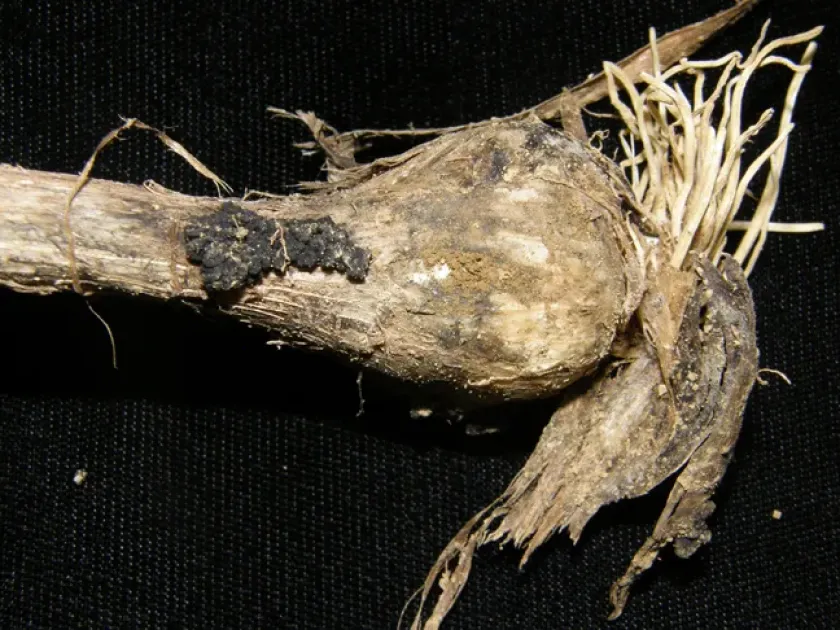
Small, black, seed-like structures known as sclerotia appear within the rotting tissue and on the bulb's surface. These are the survival units of the fungus.
In leeks, the infection manifests as decay at the base of the stem, eventually causing the plant to collapse and wither completely.
Conditions for development
Botrytis porri development is most rapid in cool and moist environmental conditions, typically occurring during spring or autumn with temperatures between +10°C and +18°C.
High soil moisture levels, whether due to excessive rainfall or poorly managed irrigation, significantly promote the activity of the fungus and the rate of infection.
Poor soil aeration and fields prone to waterlogging create the perfect breeding ground for the pathogen, accelerating the spread from plant to plant.
Overcrowded planting beds restrict airflow and maintain a humid microclimate around the base of the plants, which encourages the fungus to spread.
Continuous cropping of onion family members on the same land facilitates the buildup of soilborne inoculum, making severe outbreaks almost inevitable over time.
Why it matters
The primary economic impact is the loss of stand density in the field, leading to significantly reduced yields and financial hardship for producers.
Onions infected with white rot that are accidentally stored with healthy bulbs can cause catastrophic losses in storage, as the fungus spreads through contact.
Affected produce is rendered unmarketable and inedible, resulting in total loss of the investment made in fertilizer, labor, and crop management.
Because the sclerotia can persist in the soil for many years, the land becomes effectively unsuitable for onion production for an extended period.
The disease is notoriously difficult to control once established, as soilborne sclerotia are highly resistant to most standard environmental disinfection methods.
Protection
The cornerstone of white rot management is a long rotation cycle, ideally avoiding onion family crops on the same field for at least 5 years to reduce soil inoculum.
Only certified, disease-free planting material should be used to avoid introducing the fungus into clean fields. Inspection of sets prior to planting is crucial.
Agricultural practices should focus on maintaining optimal soil drainage and avoiding over-irrigation. Ensuring good field hygiene helps limit the pathogen's spread.
Harvesting should be timed to avoid wet conditions, and bulbs must be thoroughly cured and dried before entering long-term storage to prevent post-harvest rot.
- Immediate removal and destruction of symptomatic plants.
- Adjustment of soil pH through liming to create less favorable conditions for the fungus.
- Use of recommended systemic fungicides for seed or soil treatment.
Discussion
No discussions yet — be the first.