
Botrydium
Botrydium
Description
Symptoms
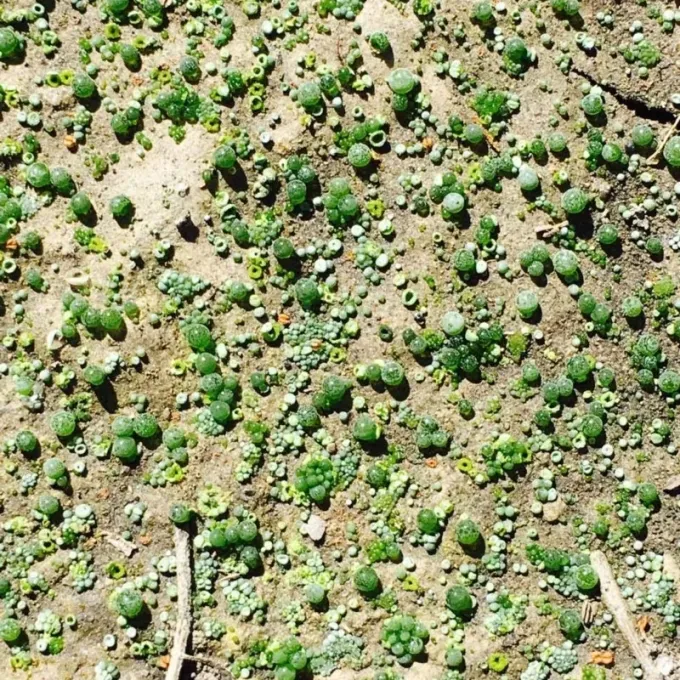
The primary symptom of Botrydium presence is the development of a bright green or yellowish-green granular film or crust on the soil surface. This film can appear as a cluster of tiny, bubble-like structures under magnification.
As the soil surface dries out, the algae colony often hardens into a white or greyish-white crust. This hardened layer significantly reduces the permeability of the soil surface.
Young seedlings often show signs of stress, including stunted growth, leaf chlorosis, and delayed emergence. This occurs because the crust physically inhibits the radical penetration and limits the availability of oxygen to the germinating seeds.
In more advanced stages, the crust may crack, but the algae underneath remain viable, waiting for the next irrigation cycle to resume rapid growth.
The infestation typically begins in low-lying areas of the soil or near drip emitters where moisture levels are consistently high, eventually spreading across the surface of the entire bed.
Pathogen
Botrydium is a genus of yellow-green algae that frequently colonizes the surface of moist soils. While not a parasitic pathogen in the traditional sense, it acts as a competitor for nutrients and space, often causing issues in intensive agricultural systems.
These organisms are coenocytic, meaning they exist as a single cell with multiple nuclei, capable of forming visible macroscopic colonies on the soil surface. They thrive in environments where moisture is abundant and light is available.
In agricultural settings, Botrydium is often an indicator of mismanagement, specifically regarding irrigation practices and soil aeration. They are particularly prevalent in nursery settings and greenhouses where humidity levels are high.
Unlike fungi, Botrydium does not penetrate plant tissues. However, its mass development creates a physical barrier that complicates the exchange of gases and moisture between the soil and the atmosphere.
The biology of these algae relies on photosynthesis, which explains why they are most problematic in open-surface settings like seedbeds or containers where soil is exposed to direct light.
Conditions for development
Constant surface moisture is the most critical factor for the proliferation of Botrydium. If the soil surface remains saturated for extended periods, the conditions become ideal for these algae.
Poor soil aeration and compaction prevent proper drainage and gas exchange. When the soil surface is left unmulched and undisturbed, it facilitates the establishment and expansion of these colonies.
Excessive application of soluble fertilizers, particularly nitrogen-rich formulas, can accelerate the development of Botrydium, as it provides readily available nutrients for the algae on the surface layer.
High relative humidity and poor air circulation in greenhouses exacerbate the problem, keeping the soil surface perpetually damp and suppressing natural evaporation.
Light availability is essential for these photosynthetic organisms, which is why infestations are more severe in clear-sky conditions or in well-lit greenhouse environments with minimal canopy cover.
Why it matters
The main harm caused by Botrydium is the physical impedance of seedling emergence and root development. The crust acts as a seal, reducing soil-to-air exchange and suffocating young root systems.
Botrydium competes with crops for surface-available nitrogen and phosphorus, leading to nutrient deficiencies that manifest as yellowing and reduced vigor in young plants.
The presence of an algae film creates a damp, low-oxygen micro-environment at the base of the stem, which frequently predisposes crops to secondary infections like damping-off or stem rot.
It interferes with irrigation efficiency by creating a hydrophobic or unevenly permeable surface, causing water to run off or pool in undesirable areas instead of infiltrating the root zone.
Economic damage arises from reduced crop stands, increased labor costs for corrective soil maintenance, and the overall decrease in crop quality and yield potential.
Protection
Effective control of Botrydium begins with optimizing the irrigation regime. Using drip irrigation to deliver water below the soil surface or precisely at the base of the plant is highly recommended.
Mechanical management, such as regular hoeing or cultivating of the top soil layer, is essential to break the surface crust and improve soil aeration, which quickly disrupts the algae habitat.
Mulching is one of the most successful preventive strategies. Covering the soil with straw, compost, or opaque plastic sheets denies the algae access to light, effectively starving them.
Improving greenhouse ventilation by using fans and ensuring proper spacing between plants helps lower the ambient humidity, allowing the soil surface to dry out more efficiently between irrigations.
- Implement precision subsurface irrigation;
- Regularly disturb the topsoil;
- Use mulching materials to shade the soil surface;
- Manage nitrogen fertilization to avoid surface nutrient accumulation.
Discussion
No discussions yet — be the first.