
Bondarzewia montana
Bondarzewia montana
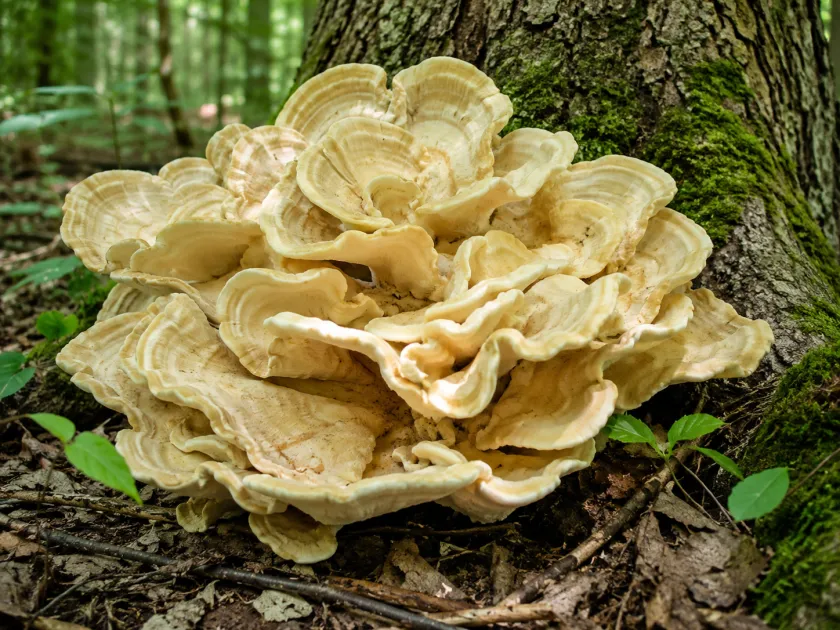
Description
Symptoms
The most evident sign is the formation of fleshy, fan-shaped fruiting bodies at the tree's base. These structures are hard when mature and possess a distinctive yellowish or ochre coloration.
Internally, the wood exhibits advanced brown rot. The decayed tissue becomes brittle, loses its structural integrity, and tends to break into cubical pieces, which is a hallmark of this type of rot.
As the infection progresses, trees show visible signs of decline, such as canopy thinning, chlorotic needles, and a significant decrease in annual shoot growth compared to healthy trees nearby.
Tapping the lower trunk often produces a dull, hollow sound, indicating substantial internal damage and the presence of significant cavities formed by the fungal activity.
In the rhizosphere, white rhizomorphs may be visible, extending through the soil. These structures enable the fungus to bridge the gap between infected and healthy tree roots.
Pathogen
Bondarzewia montana is a specialized wood-decay fungus belonging to the Bondarzewiaceae family. It is the primary cause of brown heart rot in various coniferous tree species, particularly in mature forests.
The fungus acts as a necrotrophic pathogen, entering the tree through damaged roots or trunk injuries. Once established, it spreads through the vascular system and internal tissues, causing intensive wood decomposition.
Its fruiting bodies appear as large, rosette-like structures consisting of multiple fused caps. These are typically yellowish-brown and develop at the base of the tree or directly on the roots during late summer and autumn.
Spore dissemination occurs via wind currents. Upon landing on suitable substrates, such as open wounds or cracks, the spores germinate, eventually forming mycelial colonies within the tree's heartwood.
The lifecycle of this fungus is deeply integrated into temperate forest ecosystems. It typically persists in decaying stumps or fallen timber, serving as a long-term reservoir for potential infections.
Conditions for development
The fungus thrives in high-humidity environments, particularly in dense, shaded forests with rich soil moisture. Stable, moderate temperatures are conducive to both mycelial growth and fruit body development.
Mechanical damage to the root system, often caused by heavy forestry equipment or animal grazing, provides the most common entry points for the pathogen to infect a host tree.
Mature and over-mature stands are significantly more susceptible to infection. The accumulation of dead wood in the forest floor contributes to a higher spore load in the immediate environment.
Poorly managed forest sites where stumps are left unremoved create ideal conditions for the colonization of Bondarzewia montana, facilitating its spread to younger, healthy neighboring trees.
Seasonal patterns, specifically rainy late-summer periods, promote the rapid development of fruiting bodies, allowing the fungus to release spores during peak wind conditions for wider dispersal.
Why it matters
The primary impact of Bondarzewia montana is the degradation of timber quality. The extensive heartwood rot renders the wood useless for construction or industrial woodworking purposes.
Root damage caused by the fungus severely compromises tree stability. Infected trees are prone to windthrow, which poses a safety risk in recreational forests and complicates forest management.
The pathogen causes gradual tree mortality, leading to gaps in the forest canopy. These gaps can alter the microclimate and invite secondary infestations by bark beetles and other pests.
Financial losses are substantial, as forest owners are often forced to execute premature sanitary logging of affected areas, resulting in the loss of long-term revenue from high-value timber.
Ecological impacts include the loss of aesthetic value in parks and protected areas, necessitating expensive remedial actions to remove hazardous trees and restore forest health.
Protection
Sanitary felling is the most effective control method. Removing infected trees, including the removal or treatment of stumps, prevents the pathogen from persisting in the site.
Preventing mechanical damage to tree roots and bark during forest operations is crucial. Careful management of logging equipment helps preserve the natural protective barriers of healthy trees.
Regular forest monitoring is essential for the early detection of fruiting bodies. Mapping infection centers allows managers to act quickly and contain the spread of the disease.
Diversifying the tree species composition in forest stands can reduce susceptibility. Planting resistant or non-host species helps break the transmission chain of the fungus.
While experimental, the use of biological control agents, such as competitive fungi (e.g., Trichoderma species), may offer a sustainable way to limit the expansion of Bondarzewia in forest soils.
Discussion
No discussions yet — be the first.