
Bondarzewia
Bondarzewia
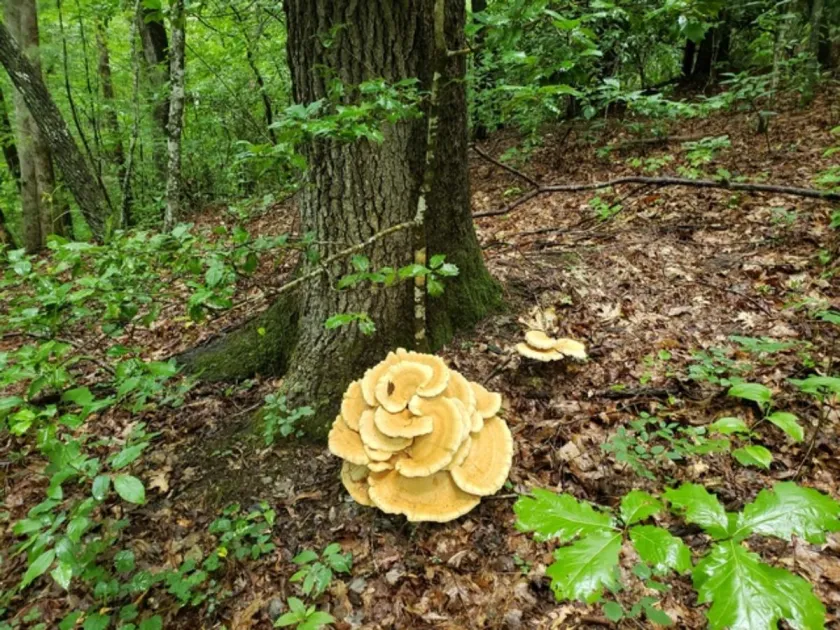
Description
Symptoms
Early symptoms of a Bondarzewia infection are often hidden because the fungus attacks the subterranean parts of the plant. Visually, the disease manifests only in later stages when the mycelium has deeply penetrated the trunk.
The above-ground part of the infected tree begins to show signs of decline: premature yellowing and dropping of needles or leaves. The crown becomes sparse, and the annual shoot growth is significantly reduced.
At the base of the trunk or in the root collar area, one may notice the fungal fruiting bodies. This is the most reliable diagnostic sign of the pathogen's presence in the tree's life-support system.
The wood in the affected area becomes soft, develops a fibrous structure, and turns a light, almost white color. Gradually, the inner part of the roots and the lower trunk decays into a pulpy mass.
Ultimately, the tree loses its ability to remain anchored in the soil, leading to widespread windthrow, especially during strong winds, as the root system loses its structural integrity.
Pathogen
The causative agent of the disease is the basidiomycete fungus Bondarzewia, most notably the species Bondarzewia mesenterica. It is a wood-decay fungus belonging to the Bondarzewiaceae family.
The fungal mycelium penetrates deep into the tree tissues, spreading throughout the root system and moving into the basal part of the trunk. It has the ability to decompose lignin and cellulose, classifying it as a white rot pathogen.
The fruiting bodies of the fungus are typically large, rosette-shaped or fan-like, forming at the base of infected trees or directly on the roots. They exhibit concentric zones and are colored in yellowish-brown tones.
The life cycle involves an active growth phase of the mycelium within the wood and a reproductive phase, where spore-bearing structures form. Spores spread via wind, water, or insects, infecting new hosts through bark wounds or root hairs.
The fungus is perennial and can survive in wood debris in the soil for many years, creating chronic infection centers in forests and plantations.
Conditions for development
The development of Bondarzewia is promoted by high soil and air humidity, creating an ideal environment for spore germination. The fungus prefers shaded areas where a stable microclimate persists.
Infection often occurs through root wounds caused by mechanical operations, as well as damage by rodents or wood-boring insects. Damaged bark acts as an entry point for the infection.
The fungus develops most actively in weakened stands experiencing nutrient deficiencies. High planting density accelerates the spread of the pathogen between adjacent trees.
The temperature optimum for mycelial growth is within moderate ranges typical for forest zones. Sharp temperature fluctuations slow down growth but do not kill the fungal spores.
Soil structure plays a role in the speed of the disease spread: in waterlogged, heavy clay soils with poor drainage, the infection process is faster due to the weakened immunity of the trees.
Why it matters
The primary harm is the destruction of the root system, which deprives the tree of its ability to absorb water and minerals. This leads to the gradual physiological dehydration of the plant.
The disease significantly lowers the market value of timber, making it unsuitable for construction or woodworking due to intense internal rot.
Bondarzewia poses a major threat to forest ecosystems, causing localized dieback of stands. The speed of fungal spread through the roots can lead to the death of entire groups of trees over a few years.
Affected specimens show reduced resistance to secondary pests, such as bark beetles. These insects eventually finalize the destruction of trees weakened by the fungus.
Economic losses include the costs of felling infected trees, the loss of wood raw materials, and the need for reforestation efforts on contaminated sites.
Protection
Prevention starts with maintaining good sanitary conditions in forest stands. Regular removal of fallen branches, deadwood, and stumps helps to lower the infection pressure.
It is essential to avoid mechanical damage to roots and the lower trunk during forest management operations. Any wounds sustained should be treated with antiseptics.
When infection centers are detected, selective sanitary felling is recommended. Infected trees should be removed along with their root systems to prevent the transfer of infection to healthy neighbors.
Improving the overall health of the stand through proper care and soil management increases the trees' resistance to fungal infections. A healthy tree is better equipped to prevent mycelial penetration.
Chemical control in large forest areas is largely ineffective; therefore, the primary method remains monitoring and the timely removal of spore-producing sources to contain the fungus.
Discussion
No discussions yet — be the first.