
Description
Symptoms
The primary diagnostic sign of the disease is a characteristic dark brown to black discoloration located at the embryo end (germ end) of the grain kernel.
Infected seeds show reduced germination rates, and emerging seedlings may exhibit brown lesions on the coleoptile, which often results in stunted growth or seedling death.
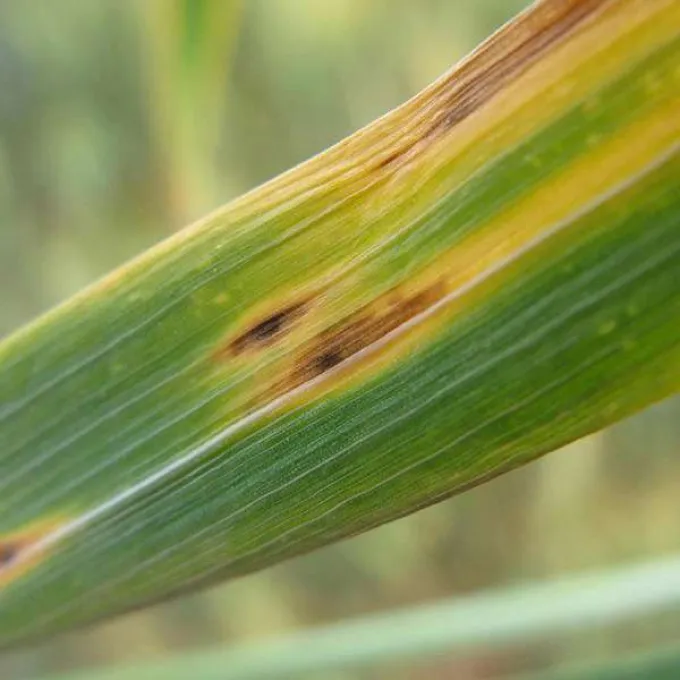
During the growing season, the fungus manifests as spot blotch on leaves, appearing as small, dark brown spots that eventually enlarge and may coalesce, leading to premature chlorosis.
Roots of infected plants often show dark necrotic lesions, significantly impairing the plant's ability to take up water and nutrients from the soil.
In severe cases, the entire spike may be affected, showing darkening and restricted development, which impacts grain filling and uniformity.
Pathogen
The disease known as "Black point" is caused by the fungus Bipolaris sorokiniana (syn. Helminthosporium sativum, teleomorph Cochliobolus sativus). This pathogen is widely distributed and affects many cereal crops globally.
It is a highly aggressive fungus belonging to the Ascomycota phylum, causing not only black point of the grain but also root rot and leaf spot diseases on cereals.
The fungus survives primarily as mycelium, conidia, or chlamydospores in soil, crop residues, and infected seeds, allowing it to persist across seasons.
Under favorable conditions, the pathogen produces toxins that inhibit plant growth, causing severe seedling blight and reducing the overall stand density of the crop.
The high adaptability of the fungus to environmental changes makes it one of the most significant constraints in wheat and barley production worldwide.
Conditions for development
The development of black point is strongly influenced by high humidity (80–90%) and moderate temperatures (20–25°C) during the grain-filling stage of wheat development.
Frequent rainfall and dew during the milk to dough stage significantly increase the incidence of grain infection by promoting the dispersal of fungal spores.
Crop rotation practices that frequently include cereal-on-cereal sequences promote high levels of inoculum in the soil, favoring recurrent infection cycles.
Poor soil structure, such as compaction, combined with nutrient deficiencies (especially potassium or nitrogen imbalance), weakens the host and increases susceptibility.
Excessive nitrogen fertilizer can also lead to lush canopy growth, which maintains a moist microclimate within the crop, ideal for fungal proliferation.
Why it matters
Black point significantly reduces seed vigor and germination, leading to poor crop stands and the need for reseeding in severely affected fields.
The disease causes substantial weight loss in grain kernels, resulting in shriveled grain and decreased test weight, which lowers the overall market value of the harvest.
Milling and baking quality are compromised as the black discoloration can appear in the flour, negatively impacting the appearance and marketability of bakery products.
Infected grain may harbor fungal toxins (mycotoxins), which can be detrimental if consumed by humans or livestock, posing food safety risks.
Root system damage caused by the pathogen reduces the plant's stress tolerance, making it more vulnerable to drought and heat stress during critical growth stages.
Protection
The most effective strategy is the use of high-quality, disease-free seed, verified through laboratory phyto-analysis and treated with broad-spectrum systemic fungicides.
Implementing a diverse crop rotation is crucial to break the infection cycle and reduce the population of B. sorokiniana in the soil naturally.
Balanced fertilization and good soil management practices help maintain healthy crop growth, allowing plants to better resist fungal invasion.
- Removing crop residues to minimize primary inoculum sources.
- Monitoring for leaf spot symptoms and applying fungicides when necessary.
- Choosing resistant or moderately resistant cultivars for high-risk areas.
Timely application of foliar fungicides during the flag leaf to flowering stages can effectively suppress the spread of the fungus to the developing grain.
Pathogens and affected parts
Affects crops · 1
Discussion
No discussions yet — be the first.