
Black root rot
Berkeleyomyces basicola
Description
Symptoms
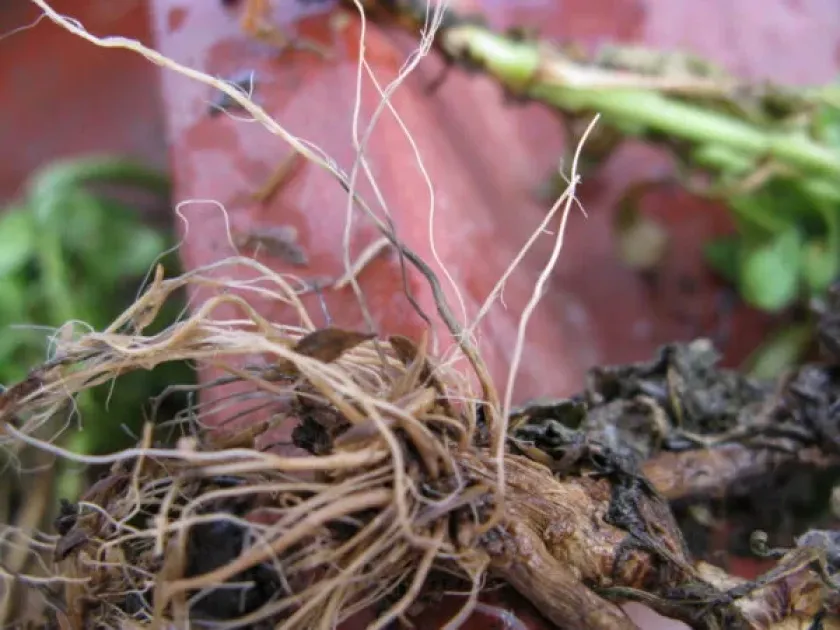
The primary symptom is the appearance of dark, charcoal-colored lesions on the roots. These black areas represent a mass of fungal spores that have replaced the normal healthy cortical tissue of the root system.
Above-ground symptoms include stunting, chlorosis of the lower leaves, and wilting during the hottest parts of the day. Plants often appear to be suffering from severe nutrient deficiencies or water stress, even when conditions are optimal.
When examining the root system, healthy white roots contrast sharply with the blackened, decaying sections. In advanced infections, the entire root structure becomes brittle, black, and prone to breaking off during removal from the soil.
Seedlings are particularly vulnerable, often displaying symptoms resembling "damping-off," where the hypocotyl area darkens and softens, leading to the collapse and death of the plant.
- Dark, necrotic lesions on root tips and lateral roots
- Stunted plant growth and decreased vigor
- Chlorosis (yellowing) of leaves starting from the bottom
- Wilting and loss of turgor pressure
- Extensive decay of the root cortex
Pathogen
The causal agent of black root rot is the soil-borne fungus Berkeleyomyces basicola (formerly identified as Thielaviopsis basicola). It is a persistent pathogen capable of producing two types of spores: endoconidia for rapid infection and chlamydospores that remain dormant in the soil for years.
This pathogen has a very broad host range, infecting many economically important crops including tobacco, cotton, various legumes, cucurbits, and greenhouse vegetables. It survives in plant debris and infested soil, making it a difficult pathogen to eradicate.
The disease is a classic root-inhabiting mycosis. The fungus attacks the cortical tissues of the root system, causing degradation of the plant's vascular integrity and preventing proper uptake of water and nutrients from the soil.
The biological activity of the fungus is highly sensitive to soil pH. Research indicates that B. basicola thrives in neutral to slightly alkaline soils, while its development is significantly suppressed in acidic environments, which is a key factor in managing the pathogen.
Dissemination occurs primarily through contaminated soil, infested equipment, transplanting of diseased seedlings, and irrigation water. The presence of chlamydospores allows it to persist even in the absence of a host for extended periods.
Conditions for development
Black root rot development is favored by cool to moderate soil temperatures, typically between 15°C and 22°C, and high moisture levels. Waterlogged conditions significantly enhance the spread of endoconidia.
Poor soil aeration, caused by compaction or heavy clay content, creates an environment where the plant’s defenses are weakened, allowing the pathogen to colonize the root cortex more aggressively.
Soil pH plays a decisive role in the disease cycle. Liming soil to increase the pH can exacerbate the severity of the infection, as the pathogen faces less competition from other soil microorganisms under neutral or alkaline conditions.
Continuous cropping of susceptible hosts is a major factor in building up the inoculum levels in the soil. Without appropriate rotation, the population of dormant chlamydospores increases, leading to chronic disease problems.
Mechanical wounds created during cultivation, transplanting, or nematode feeding act as direct portals of entry for the fungus to establish itself within the root tissue.
Why it matters
The damage caused by black root rot is characterized by significant yield losses and reduced crop quality. A compromised root system results in a lack of essential nutrients, leading to poor plant development.
Economic impact is most severe when large portions of the crop are stunted or killed in the early stages, requiring total replanting. In mature crops, the disease reduces the overall harvest volume and commercial value.
For crops like tobacco, the pathogen is considered a limiting factor in production. Heavy infestations can render a field unsuitable for susceptible varieties, causing substantial long-term economic harm.
Infected plants are also highly susceptible to secondary pathogens and environmental stress. The weakened state of the crop often leads to a cascade of further issues, complicating management and increasing the reliance on synthetic chemicals.
Financial losses also stem from the increased costs of inputs, such as soil fumigants or specialized fungicide applications, required to protect the crop in high-risk areas.
Protection
The cornerstone of management is long-term crop rotation with non-host species (such as cereals) to decrease the inoculum pressure in the soil. A minimum 4-year rotation cycle is often recommended.
Modifying the soil environment to be more acidic using sulfur-based fertilizers is a proven biological strategy. Maintaining a lower pH helps to create a suppressive environment that hinders the fungus.
Using certified, disease-free transplants and practicing rigorous sanitation in greenhouse production are essential steps. All tools and equipment should be thoroughly disinfected after use in infested fields.
In extreme cases, soil fumigation or the application of specific fungicides targeting soil-borne pathogens can be used. However, these methods must be integrated with good cultural practices to be effective.
Breeding and planting resistant or tolerant cultivars is the most sustainable approach to managing black root rot, reducing the need for chemical intervention and ensuring more stable yields over time.
Discussion
No discussions yet — be the first.