
Description
Symptoms
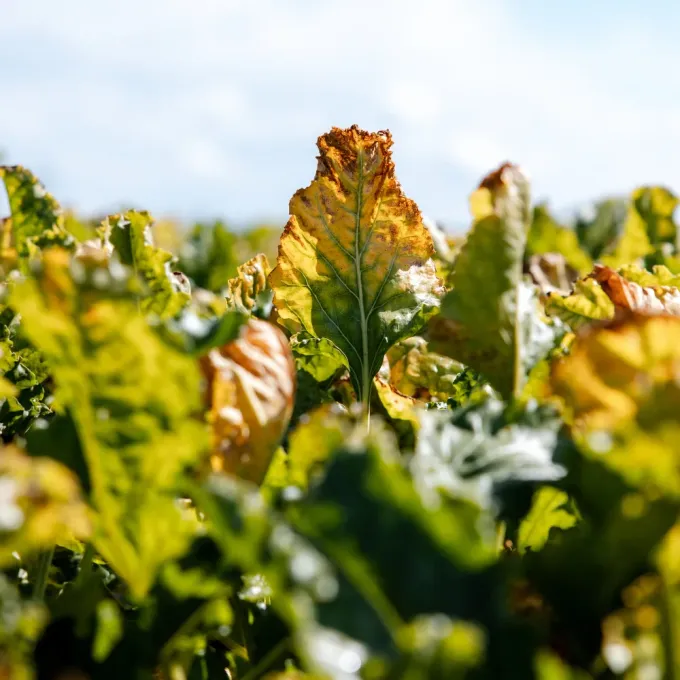
The hallmark symptom of Beet yellows is the chlorosis (yellowing) of leaves, typically starting from the tips or margins of older, lower leaves. These leaves often become thick, leathery, and brittle to the touch.
Unlike nutrient deficiency, the yellowing caused by BYV progresses slowly and systematically through the canopy. In forage beet, one may observe necrotic spots or patches on the leaves as the infection advances and the plant weakens.
Infected plants exhibit stunted growth and reduced vigor compared to healthy neighbors. The taproots of diseased plants are often significantly smaller and have lower dry matter content, directly affecting the yield and quality of the crop.
During the rapid growth phase, diseased fields often display a distinct patchiness, where infected areas show a bright yellow hue against the green background. This is a critical indicator for early field assessment.
Accurate diagnosis requires distinguishing these symptoms from physiological yellowing caused by waterlogging or nitrogen shortage. Virus-induced yellowing is almost always accompanied by a noticeable change in the leaf texture and density.
Pathogen
Beet yellows is a destructive viral disease caused by the Beet yellows virus (BYV), a member of the Closterovirus genus. The virus specifically targets the phloem tissue of the host plant, severely disrupting the translocation of nutrients and photosynthates.
This pathogen does not spread through seeds or mechanical contact in the field. Instead, its primary mode of transmission is through specialized insect vectors, most notably various species of aphids that feed on plant sap.
The primary vector is the black bean aphid (Aphis fabae), although the green peach aphid (Myzus persicae) is also highly efficient in spreading the virus. The transmission is persistent, meaning the aphid can carry the virus for many hours or even days after initial feeding.
Once infected, an aphid can travel between plants or fields, transmitting the virus to healthy plants. This leads to the characteristic spread of the disease across a field, often appearing in patches or along the borders first.
The host range of the virus includes forage beet, sugar beet, and various weeds, such as those belonging to the Chenopodiaceae family, which act as reservoirs for the virus during the winter months.
Conditions for development
The development of Beet yellows epidemics is strongly correlated with aphid population dynamics. Warm, dry weather conditions facilitate the rapid proliferation of aphid colonies, significantly increasing the likelihood of virus spread.
Primary infection sites often arise from weeds or volunteer beets that survived the winter, serving as the initial sources of the virus. Proximity to previous year's seed crops significantly increases the risk of early-season infection.
Agro-ecological factors, particularly poor weed management, are major contributors to disease prevalence. Weeds around field margins and irrigation ditches provide the perfect environment for aphids to congregate and acquire the virus before migrating.
High plant density and lack of crop rotation can create a "green bridge" for the virus, allowing it to move easily between consecutive crops. This continuity of susceptible hosts is a primary driver of sustained viral pressure.
Environmental stress, such as drought or heat waves, can exacerbate the impact of the virus. A stressed plant is less capable of maintaining its physiological defenses, making it more susceptible to successful viral colonization.
Why it matters
The primary impact of Beet yellows is a substantial reduction in total biomass and yield. By interfering with the plant's metabolic processes, the virus limits the amount of carbohydrates stored in the taproot.
For forage beet production, this results in lower nutritional value and lower total dry matter yield. Consequently, the quality of the fodder produced from infected fields is significantly compromised for livestock consumption.
Infected plants are also highly predisposed to secondary infections, such as fungal pathogens, which thrive on weakened tissue. This leads to a synergistic decline in plant health and potential total crop failure in severe cases.
Economic losses arise not only from reduced tonnage but also from the increased cost of insecticide applications aimed at controlling vectors. Failure to manage the vectors early often leads to significant yield losses of 30-50%.
Furthermore, roots from infected fields often show poor storage characteristics. They tend to rot more quickly in storage clamps due to their compromised tissue structure, leading to further losses long after the harvest is completed.
Protection
The most effective strategy for managing Beet yellows involves integrated pest management with a focus on vector control. Regular scouting for aphids and timely insecticide application are critical to reducing viral transmission.
Establishing sufficient spatial isolation between current-year beet fields and overwintered seed crops is a mandatory preventive measure to prevent the movement of the virus into young, susceptible stands.
Rigorous weed control is essential for managing viral reservoirs. Keeping fields and surrounding areas free of weeds like goosefoot and wild beet reduces the number of initial hosts for both the virus and the aphid vectors.
While no commercially available beet variety offers complete immunity to the virus, selecting tolerant cultivars can help maintain higher yields despite the presence of the pathogen in the area.
Maintaining optimal soil fertility and irrigation supports robust plant development. Vigorous plants have better recovery rates and are more capable of buffering the physiological stress imposed by the viral infection.
Pathogens and affected parts
Affects crops · 1
Discussion
No discussions yet — be the first.