
Battarraea stevenii
Battarraea stevenii
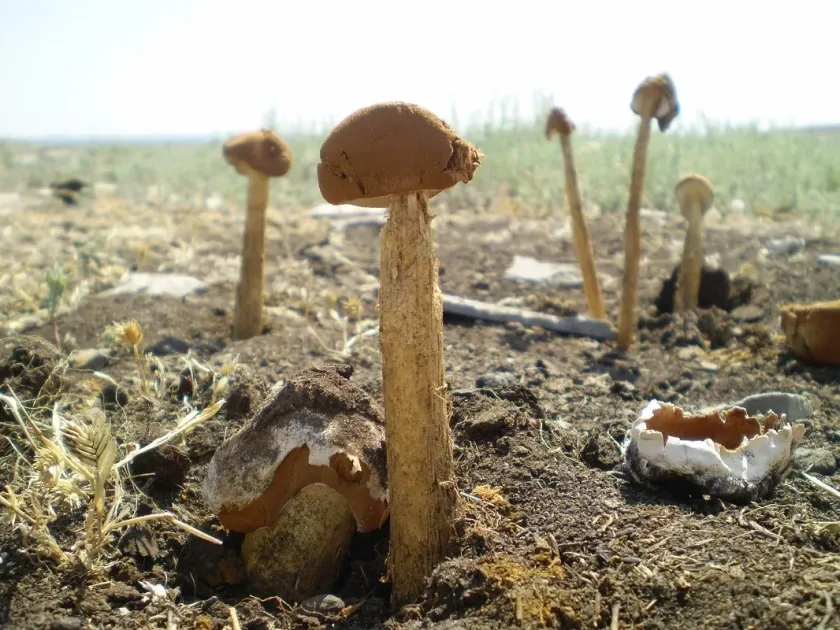
Description
Pathogen
Battarraea stevenii is a rare species of fungus, commonly known as the sandy stilt puffball. It is not a plant pathogen and does not cause diseases in agricultural crops.
This fungus is a saprotroph that plays an essential role in decomposing organic matter in arid soil environments. It lacks the biological machinery to infect or damage living plant tissues.
The fungus is characterized by a distinctive tall, woody stem topped with a powdery spore mass. This structure is an adaptation to wind dispersal in open, dry landscapes.
In terms of agronomy, this species should be considered neutral or even beneficial to soil health as it participates in the natural recycling of nutrients.
Reports labeling this fungus as a plant disease are incorrect and likely stem from a misunderstanding of its presence in agricultural fields or pastures.
Conditions for development
This species thrives in sandy, well-drained soils found in arid and semi-arid regions. It is highly adapted to environments with intense solar radiation and significant temperature fluctuations.
The development of the fruiting body is usually triggered by specific moisture conditions following drought periods, allowing the fungus to complete its reproductive cycle.
Wind is the primary vector for spore dispersal, allowing the fungus to colonize suitable habitats across vast, open areas like deserts or sandy plains.
It prefers undisturbed soils, which is why it is rarely found in intensively cultivated fields where mechanical tillage disrupts the mycelial network.
The fungus maintains its presence in ecosystems through a dormant mycelium that can survive long periods of extreme dryness.
Why it matters
There is absolutely no harm associated with Battarraea stevenii in agriculture. It does not cause root rot, leaf blight, or any other form of crop damage.
Applying fungicides to control this species is completely unnecessary and counterproductive, as it does not pose a threat to plant productivity or human food safety.
The fungus is actually of high conservation value. In many regions, it is listed as a protected or threatened species due to its rarity and habitat loss.
Farmers should be aware that the presence of this fungus is an indicator of a diverse and stable soil ecosystem rather than a sign of pathological infestation.
- Promotes natural nutrient cycling in arid soils.
- Does not interact with crop root systems.
- Requires no specialized protection or control measures.
Discussion
No discussions yet — be the first.