
Dark Honey Fungus
Armillaria ostoyae
Description
Symptoms
The first external symptom is often a reduction in tree vigor, characterized by chlorosis (yellowing) of foliage or needles and a general thinning of the canopy. In conifers, resin flow at the base of the trunk is a common defensive response.
A definitive diagnostic feature is the presence of white, fan-shaped mycelial mats found between the bark and the wood at the base of the stem. These mats actively degrade the cambium tissue, eventually girdling the tree.
Dark, bootlace-like rhizomorphs are frequently observed on the surface of roots or under the bark. These structures are essential for the fungus to move between hosts and survive in the soil environment.
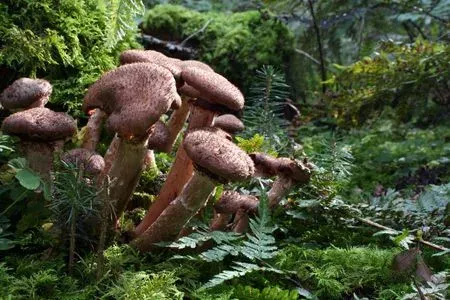
The appearance of clusters of yellow-brown mushrooms at the base of an infected tree or on nearby decaying stumps is a prominent late-stage sign of infection, indicating extensive internal decay.
Trees infected by the fungus eventually show significant root decay, becoming unstable and prone to windthrow. The progression of the disease often results in patches of dead or dying trees within the forest stand.
Pathogen
The dark honey fungus, Armillaria ostoyae, is a pathogenic fungus belonging to the Basidiomycota division. It is recognized as one of the most destructive forest pathogens, capable of killing mature trees and suppressing forest regeneration.
The fungus spreads primarily through underground rhizomorphs, which are root-like structures of dense mycelium. These structures can traverse significant distances through the soil to locate and infect the roots of susceptible trees.
Armillaria ostoyae exhibits both saprotrophic and parasitic behavior. It persists in soil for years by breaking down dead wood, subsequently switching to a parasitic phase when it contacts living tree roots.
Spores produced by the mushroom's fruiting bodies serve as secondary sources of infection, particularly when they settle on fresh wounds or damaged bark of trees during humid conditions.
The pathogen demonstrates a broad host range, affecting both conifers and hardwoods. It is particularly notorious for causing severe root disease in pine, spruce, and fir species across temperate regions.
Conditions for development
The development of Armillaria ostoyae is strongly favored by high soil moisture levels and poor drainage, which place trees under physiological stress and reduce their natural resistance.
Stump density is a critical factor; infected stumps provide the primary food base and energy for the fungus to produce the extensive rhizomorph systems required for new infections.
Moderate temperatures ranging from 15°C to 25°C are ideal for the rapid vegetative growth of mycelium and the subsequent formation of invasive rhizomorphs in the soil.
Disturbed forest sites, such as those with significant soil compaction or damage to tree roots during harvesting operations, exhibit higher rates of infection due to the increased vulnerability of the host.
Accumulation of coarse woody debris on the forest floor increases the inoculum potential, allowing the fungus to maintain a strong presence and spread effectively across the site.
Why it matters
The economic impact of the dark honey fungus is severe, as it leads to widespread mortality in timber-producing stands, causing major losses for the forest industry.
Wood colonized by the fungus undergoes extensive decay, rendering it unsuitable for structural timber or high-value wood products due to the loss of mechanical strength.
Infection leads to the creation of expanding mortality centers within forests, which disrupts long-term management goals and necessitates expensive salvage logging operations.
The disease reduces the growth rates and overall productivity of survivors within a stand, as the root system remains compromised and unable to support full tree development.
In forest nurseries and young plantations, the fungus can cause near-total failure of seedlings, necessitating the replanting of areas and further extending the economic recovery timeline.
Protection
Integrated management is essential, focusing on the removal of infested stumps during site preparation to eliminate the primary food source and inoculum reservoir.
Planting tree species that exhibit higher natural resistance or tolerance to Armillaria can significantly reduce the potential for stand-wide infection.
Biological control, such as treating fresh stumps with the competing fungus Phlebiopsis gigantea, has proven effective in preventing the colonization of stumps by Armillaria.
Proper silvicultural practices, including minimizing stand density and protecting the integrity of root systems during thinning, help maintain tree health and resilience.
- Regular forest health monitoring and early detection of infected patches.
- Physical isolation of disease centers through trenching to prevent rhizomorph spread.
- Ensuring timely disposal of infested biomass away from susceptible timber stands.
Discussion
No discussions yet — be the first.