
Northern honey fungus
Armillaria borealis
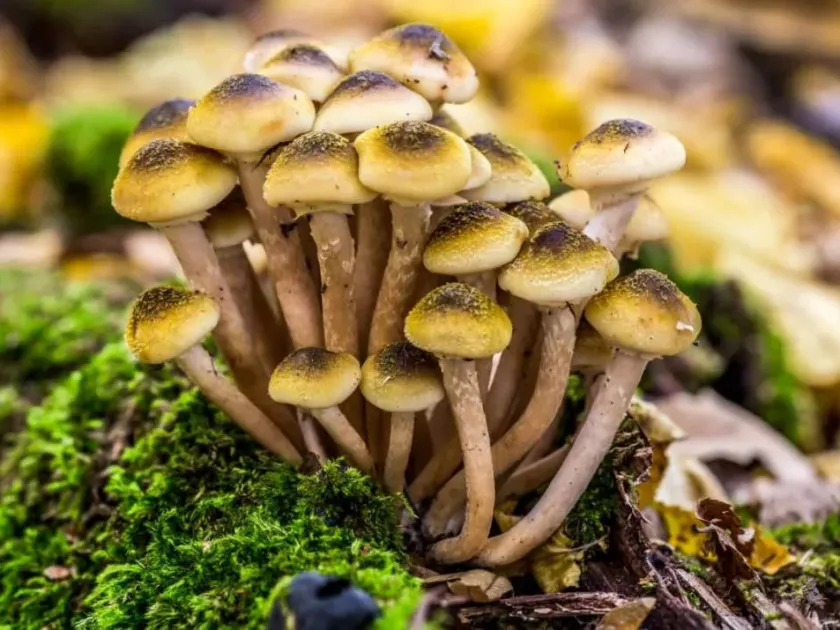
Description
Symptoms
A diagnostic sign of infection is the presence of white, fan-shaped mycelial mats located beneath the bark, usually at the root collar or base of the trunk.
Rhizomorphs, appearing as dark brown or black cords that resemble shoestrings, can often be found wrapping around the roots or within the soil directly adjacent to the tree.
Initial physical symptoms include yellowing or thinning foliage, loss of tree vigor, and premature leaf or needle drop. Coniferous trees may exhibit excessive resin flow at the base of the trunk.
In the final stages of the disease, clusters of honey-colored mushrooms appear at the base of the tree or on nearby stumps, signaling that the fungus has successfully consumed the host tissue.
Decayed wood shows signs of white rot, often characterized by a yellowish-white color interspersed with distinct black lines known as zone lines, resulting from the fungus's enzymatic activity.
Pathogen
The causative agent of the disease is the fungus Armillaria borealis, a member of the Armillaria genus. It acts as an aggressive parasite and necrotroph affecting both coniferous and broad-leaved trees.
The fungus spreads via rhizomorphs, which are root-like fungal strands that grow through the soil to infect new hosts. It also produces basidiospores that are dispersed by wind or insects, facilitating colonization of new areas.
This pathogen possesses a robust saprotrophic capability, allowing it to survive for many years on decaying stumps and woody debris. This makes the fungus a persistent resident in forest soils.
Armillaria borealis is well-adapted to cooler climates, showing high growth efficiency in northern and temperate regions, which distinguishes it from some other related species.
The fungus infects the cambium layer of the host, disrupting the tree's vascular system and effectively starving it of water and essential nutrients from the roots.
Conditions for development
Excessive soil moisture and poor drainage create favorable conditions for the development of Armillaria borealis, as these environments weaken the root systems of trees.
Trees that are already stressed due to drought, mechanical injuries, or insect infestations are significantly more susceptible to infection by this opportunistic pathogen.
A high density of stumps and leftover woody debris in the soil serves as a primary reservoir for the fungus, allowing it to expand its network through the soil to infect nearby healthy roots.
The fungus thrives in the temperate and boreal climatic zones. Its ability to tolerate lower temperatures gives it a competitive edge in northern ecosystems.
Poor silvicultural practices or lack of garden maintenance, such as leaving infected debris on-site, promote the continuous spread and establishment of new infection centers.
Why it matters
The primary damage caused by the fungus is the destruction of root systems and the root collar, leading to the rapid decline and death of the host tree.
This pathogen can devastate forest stands, creating large gaps in the canopy and causing long-term ecological and economic losses by killing timber resources.
In orchards and private gardens, the fungus is highly destructive to fruit and ornamental trees, often killing them entirely as there is no practical curative treatment for infected specimens.
The wood of affected trees becomes soft, spongy, and brittle, rendering it unusable for construction, furniture, or high-quality timber products.
Because the fungus persists in the soil via its rhizomorph network for decades, the site of an infected tree remains a biological hazard for future plantings of susceptible species.
Protection
The most effective management strategy is the removal of infected trees, including the complete extraction of stumps and major root systems to eliminate the food source.
Maintaining high forest and garden hygiene by removing deadwood and potential debris is essential to minimize the risk of new infestations.
Preventing mechanical damage to the bark and roots of trees during maintenance or construction is a critical preventative measure to avoid creating entry points for the fungus.
In some cases, digging physical barriers or trenches around the infected area can help isolate the pathogen and prevent the rhizomorphs from spreading to neighboring healthy trees.
Strengthening the health of the trees through proper fertilization and irrigation helps improve their natural resistance, although this is secondary to proper site management.
Discussion
No discussions yet — be the first.