
Aphanomyces root rot
Aphanomyces laevis
Description
Symptoms
Initial symptoms often manifest as yellowing and wilting of seedlings, which can easily be mistaken for nitrogen deficiency or water stress.
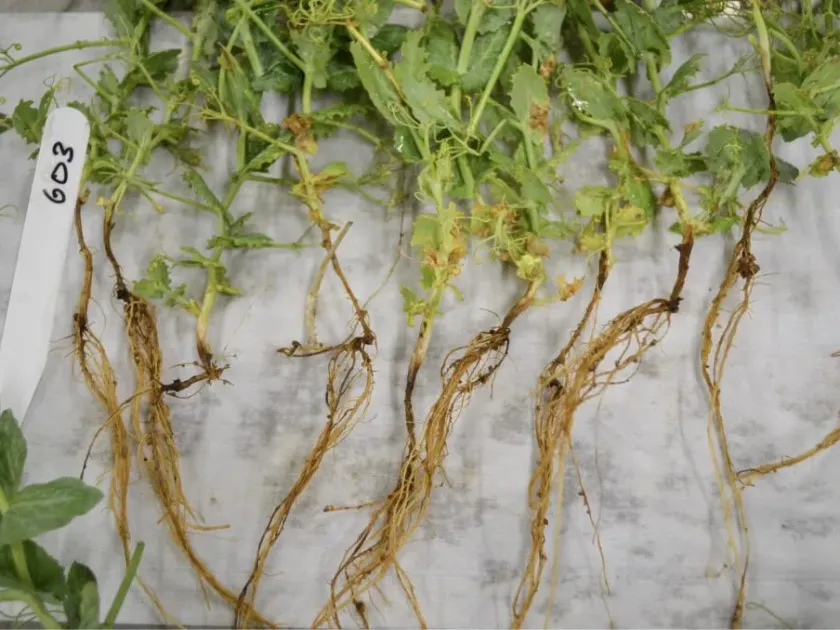
Affected root systems show distinct browning and a water-soaked appearance. In high-moisture conditions, roots may become soft, mushy, and eventually decay completely.
Advanced stages of the disease feature the disintegration of root tissue, where the outer cortex may slough off, leaving only the central vascular core, often referred to as a stringy appearance.
Above-ground, affected plants exhibit stunted growth, chlorosis of the lower leaves, and a significant loss of turgor pressure during the heat of the day.
- Yellowing of cotyledons and true leaves.
- Browning and softening of the root system.
- Severe stunting of young seedlings.
- Necrosis of lateral and fine feeder roots.
- Patchy emergence and seedling death in fields.
Pathogen
The disease is caused by the oomycete Aphanomyces laevis, a soil-borne organism belonging to the class Oomycetes. It is capable of persisting in the soil for many years in the form of dormant oospores.
The biology of this pathogen is highly dependent on moisture, as its zoospores require water films in the soil to move and locate the roots of host plants.
Unlike some highly specialized species, Aphanomyces laevis often acts as a secondary pathogen, taking advantage of plants weakened by environmental stress or other root issues.
The oomycete penetrates roots through root hairs, then rapidly colonizes the cortical tissue by growing through intercellular spaces, leading to tissue degradation.
The life cycle concludes with the production of new oospores within decaying root tissues, which are then released into the soil, replenishing the inoculum reservoir.
Conditions for development
High soil moisture is the most critical factor for the development of Aphanomyces root rot, as the pathogen’s zoospores require free water to swim toward host roots.
The pathogen thrives at moderate temperatures, making it a significant concern during cool, wet springs when seedling development is slow.
Compacted, heavy soils that lack proper drainage create a perfect environment for the pathogen, as oxygen depletion and persistent water films inhibit plant root respiration.
Soil pH plays a notable role; the pathogen is generally more active in neutral or slightly acidic soils, whereas well-drained, slightly alkaline soils can sometimes suppress activity.
Continuous cropping of susceptible species leads to a rapid buildup of inoculum in the soil, which increases the likelihood of severe outbreaks in subsequent seasons.
Why it matters
The primary economic harm is caused by significant stand reduction, which may require costly reseeding operations and leads to uneven plant populations.
Damaged root systems limit the plant's ability to access water and essential nutrients, rendering the crop highly susceptible to drought stress later in the season.
Plants that manage to survive remain stunted and unproductive, contributing to significant yield losses that can range from minor to total depending on the infestation intensity.
Weakened roots are more prone to secondary colonization by other soil-borne fungi, such as Fusarium or Rhizoctonia species, complicating the disease complex.
In severely infested fields, the cumulative impact of reduced root function and secondary infections can result in yield reductions exceeding 30-50%.
Protection
A well-planned crop rotation is the most effective management tool, avoiding susceptible crops for at least 4-6 years to allow the inoculum level in the soil to decline.
Improving field drainage, such as through subsoiling or tile drainage, is essential to prevent the waterlogged conditions that favor pathogen movement.
Managing soil pH through liming can help suppress the pathogen's activity, making the environment less hospitable for the growth of oomycetes.
Using high-quality, fungicide-treated seeds is a standard practice to provide a protective window for the plant during the most vulnerable germination and seedling stages.
Regular field scouting and effective weed management are necessary, as weeds can act as alternative hosts that maintain the pathogen population during the growing season.
Discussion
No discussions yet — be the first.