
Fringed ruffle lichen
Anaptychia ciliaris
Description
Symptoms
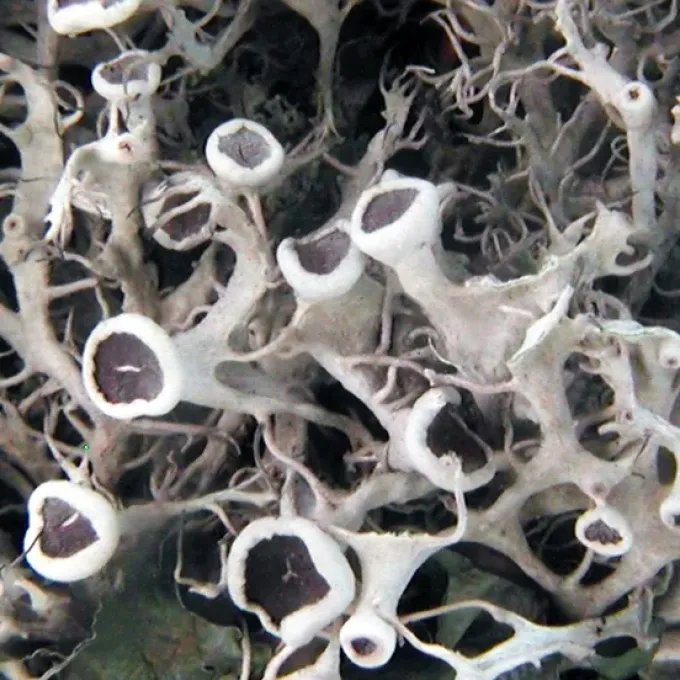
External signs of the lichen's presence on a tree appear as dense or loose growths on stems and skeletal branches. These are bushy formations that look like gray or brownish rosettes.
A distinctive feature of this species is the well-defined cilia that give the thallus a "fringed" appearance. The lichen attaches firmly to the bark with rhizines, creating a clear relief pattern on the tree surface.
This species is most often found on old trees with a thick layer of dead bark. The lichen does not cause bark deformation, necrosis, or ulcers typical of true infectious diseases.
When inspecting the garden, it is important to distinguish this lichen from symptoms of cancer or scab. The lichen can be easily detached from the surface without leaving damaged, rotting, or softened tissues behind.
The presence of this epiphyte makes the bark look darker and rougher, but this has nothing to do with the death of living cambium cells or the plant's vascular system.
Pathogen
Fringed ruffle lichen (Anaptychia ciliaris) is a foliose lichen often mistaken for a pathogenic fungus or a tree bark disease. From a biological perspective, this is not a plant pathogen, but an epiphytic organism.
This species belongs to symbiotic organisms consisting of a fungus and an alga that live solely on the surface of tree bark. It is not a parasite, as it does not penetrate into the living tissues of the plant or feed on its sap.
In agronomy, this object is considered a bioindicator of air quality. Its presence on tree trunks indicates stable ecological conditions and a lack of toxic atmospheric pollutants in the orchard.
Anaptychia ciliaris has a characteristic thallus in the form of bushy or foliose lobes with long cilia along the edges. The color varies from gray to brownish, depending on the light intensity.
The lichen reproduces vegetatively through small fragments of the thallus, which are spread by wind or raindrops and attach themselves to the rough surfaces of old tree bark.
Conditions for development
The development of Anaptychia ciliaris depends directly on air humidity and light intensity. The lichen prefers bark areas that are well-warmed by the sun and receive sufficient atmospheric moisture.
An important distribution factor is air purity. This species is extremely sensitive to sulfur dioxide levels, which is why it is almost never found in industrial zones or near busy highways.
For the lichen to grow, a stable and non-aggressive environment is required. It chooses trees with sufficiently porous bark, which ensures reliable spore fixation and moisture retention.
Violations of agricultural practices, such as crown thickening, can create a microclimate with high humidity favorable for epiphyte colonization, although this process is secondary.
The period of active growth occurs during the spring-autumn season, when temperature conditions and precipitation levels ensure constant moisture for the wood surface.
Why it matters
Despite common beliefs, Anaptychia ciliaris does not cause direct harm to the health of fruit or ornamental crops. It is not a pathogen and does not cause wilting or growth stagnation.
Harm may only arise from indirect effects: dense lichen covers can harbor pests or spores of true pathogenic fungi that attack the bark.
Massive growth of epiphytes on young trees may indicate a slowdown in growth, as lichens prefer to colonize bark that is rarely updated and remains in a state of rest for long periods.
The lichen can interfere with bark respiration if it covers large areas with a very dense layer, which theoretically hinders gas exchange, but this effect is negligible for a healthy tree.
Thus, the harmfulness of the object is exaggerated, and the agronomist's primary task is not to fight the lichen as a "disease," but to maintain the overall health of the tree.
Protection
Special measures against Anaptychia ciliaris are usually unnecessary. If the lichen is aesthetically unpleasing, mechanical cleaning of the trunks during the dormant period is recommended.
Cleaning should be carried out using scrapers or stiff brushes, taking care not to damage the living bark. After the procedure, it is recommended to disinfect the trunk with a copper sulfate solution.
Basic prevention consists of proper garden care: regular pruning to improve crown ventilation and timely fertilization to promote active bark growth.
Whitewashing stems with lime helps reduce the probability of epiphyte colonization as it creates an environment unsuitable for lichen thallus attachment.
- Thinning of dense crowns
- Mechanical cleaning of old bark
- Maintaining an optimal water regime
- Using whitewash to protect stems
Discussion
No discussions yet — be the first.