
Amanita submembranacea
Amanita submembranacea
Description
Symptoms
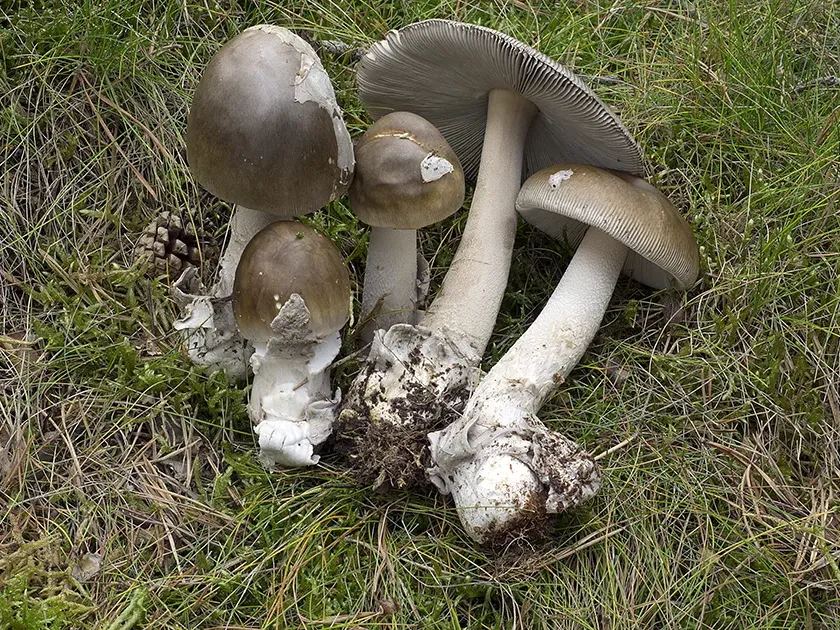
The fruit body features a pileus (cap) ranging from 5 to 10 cm in diameter, exhibiting a greyish-brown to dark brown surface. The margin is notably striate, featuring distinct radial grooves.
The stipe (stem) is typically whitish to pale grey and lacks a ring, distinguishing it from many other members of the Amanita genus. The surface of the stipe may appear slightly fibrillose.
At the base, the stipe is enclosed in a prominent, often free, membranous volva. This structure is a defining taxonomic character and is usually well-developed in mature specimens.
The lamellae (gills) are free from the stipe, crowded, and pale white to creamy. The context (flesh) is white and does not exhibit any color change upon bruising or slicing.
- Cap: Brown-grey, with a strongly striate margin.
- Stipe: Ringless, pale, with a soft texture.
- Volva: Large, membranous, sheathing the base.
Pathogen
Amanita submembranacea, commonly known as the grey-brown ringless amanita, is a basidiomycete fungus in the Amanitaceae family. It is strictly a non-pathogenic organism that plays no role in agricultural plant diseases.
This fungus establishes mutualistic mycorrhizal relationships with coniferous trees, particularly spruce and fir. It provides nutrients and water to the host roots while receiving sugars in return, which is beneficial for forest health.
As a forest-dwelling species, it does not possess the enzymes or pathogenic strategies required to infect crop plants. It is a vital component of the woodland soil microbiota rather than a pest.
From an agricultural standpoint, this fungus presents zero risk to orchards, field crops, or greenhouses. It remains confined to ecological niches where its tree hosts are present.
Scientific classification confirms that Amanita submembranacea is a saprotrophic and mycorrhizal fungus, not a phytopathogen. Therefore, no control measures are required for this species in any farming context.
Conditions for development
The fungus thrives in coniferous forest environments, typically in mountainous or hilly regions. It relies on deep layers of forest humus and litter to support its mycelial network.
Optimal conditions for fruiting include cool, humid temperatures, especially during the late summer and autumn months. Consistent soil moisture is essential for development.
Amanita submembranacea is sensitive to soil disturbances and requires the presence of established tree root systems to survive. It cannot colonize disturbed agricultural soils.
Spore dispersal is facilitated by air currents. Once spores land in a suitable habitat, they germinate and explore the soil for potential host tree roots to form mycorrhizal symbiosis.
The species has a narrow ecological tolerance, preferring stable forest ecosystems. Habitat fragmentation and deforestation are the primary threats to its natural population dynamics.
Discussion
No discussions yet — be the first.