
Alternaria blight
Alternaria consortialis
Description
Symptoms
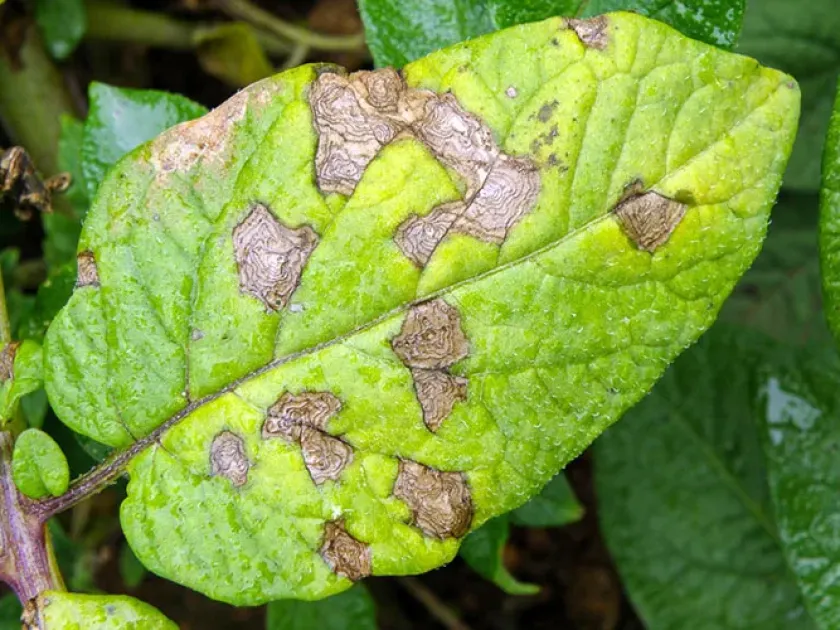
Symptoms typically manifest as necrotic spots of various shapes on leaves and stems. These spots often develop a velvety, olive-gray fungal mat on their surface.
Under high humidity, heavy sporulation occurs, appearing as dark or black patches that may exhibit a concentric pattern within the necrotic tissue.
As the disease progresses, lesions merge, causing premature drying and defoliation. In cereals, infection of the spike can result in shriveled and low-quality grain.
In vegetables, the disease appears as sunken, dark lesions on the fruit. The underlying tissue gradually softens and decays due to the enzymatic activity of the fungus.
Early diagnosis is challenging, as the symptoms of Alternaria consortialis may overlap with other Alternaria species, often requiring laboratory confirmation.
Pathogen
The disease is caused by the fungus Alternaria consortialis (also known as Ulocladium consortiale). It is a saprophytic or weakly parasitic organism found in soil and on plant debris.
The fungus survives as mycelium and conidia in various substrates. Its life cycle is linked to the decomposition of organic matter, but it can infect stressed agricultural crops under suitable conditions.
Conidia are highly resistant to temperature fluctuations and desiccation, which allows them to remain viable for extended periods. Spores are primarily dispersed by wind, rain splashes, and insects.
Microscopically, the pathogen features multicellular, darkly pigmented conidia arranged in short chains. This pigmentation provides protection against ultraviolet radiation during dispersal.
The fungus often acts as a secondary pathogen, colonizing plant tissues already damaged by other fungi, pests, or abiotic environmental stress.
Conditions for development
Development is favored by warm weather and high relative humidity. The optimal temperature range for spore germination is between 20 and 25 degrees Celsius.
Frequent rainfall, heavy dew, and fog create an ideal environment for spore dispersal and host infection, significantly shortening the incubation period.
Plants suffering from nutrient deficiencies or other physiological stresses have reduced resistance, making them more susceptible to colonization by the fungus.
Dense crop canopies with poor air circulation retain higher humidity levels, which encourages the development of the infection within the lower plant strata.
The presence of large amounts of crop residue on the soil surface serves as a primary source of inoculum for subsequent growing seasons.
Why it matters
The harm caused by Alternaria consortialis includes a significant reduction in leaf area, which severely inhibits photosynthesis and plant vigor.
Infection of reproductive organs leads to significant yield losses. Grain quality is negatively impacted, resulting in reduced weight and poor seed germination potential.
For vegetable crops, the disease causes fruit rot, which renders the produce unsuitable for storage, processing, or fresh market sales.
Prolonged infection weakens the plant, predisposing it to secondary bacterial pathogens that can completely destroy the crop stand.
In severe cases, yield losses can range from 10% to 30%, depending on the host's susceptibility and the duration of favorable weather conditions.
Protection
Crop rotation is the primary preventive measure, as it disrupts the disease cycle by removing susceptible hosts from the field for an extended period.
Deep plowing and proper residue management help accelerate the breakdown of organic material, effectively reducing the soil-borne inoculum level.
The selection and use of resistant crop varieties represent the most sustainable and economically viable strategy for long-term disease management.
The application of preventive fungicides during critical developmental stages can effectively mitigate the risk of epidemic disease outbreaks.
- Use of disease-free, high-quality seeds.
- Balanced application of phosphorus and potassium fertilizers.
- Timely pest control to minimize tissue damage.
- Proper field spacing to improve air circulation.
Discussion
No discussions yet — be the first.