
Alternaria leaf spot of brassicas
Alternaria brassicicola
Description
Symptoms
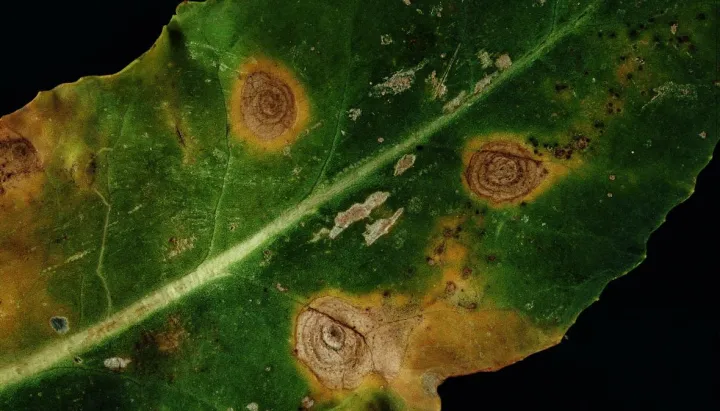
The primary symptom is the appearance of dark brown or black circular spots with distinctive concentric rings, resembling a target pattern. These lesions can occur on any part of the plant surface during all growth stages.
Under humid conditions, the centers of the spots often develop a dark, sooty, or velvety layer of fungal spores. This growth is a clear indicator of active sporulation, which facilitates the further spread of the disease within the crop.
On mature cabbage heads, the disease manifests as dark, sunken lesions that can penetrate deep into the interior, leading to rotting and tissue breakdown. This reduces the marketability and the shelf-life of the produce significantly.
In seedlings, the infection causes black lesions on the stem, commonly referred to as "damping-off" or "black leg." This results in weak, stunted plants that often collapse and die before reaching maturity.
In seed-producing fields, the fungus colonizes the pods, leading to premature shattering. Consequently, the seeds become infected, discolored, and exhibit a significantly reduced germination rate and overall seed vigor.
Pathogen
The causative agent of Alternaria leaf spot in brassicas is the fungus Alternaria brassicicola (or A. brassicae), belonging to the hyphomycetes class. This pathogen is a significant threat to all crops within the Brassicaceae family.
The fungus survives in the soil on crop residues, in seeds, and on volunteer plants. Its ability to persist for extended periods in various environmental conditions makes it a difficult pathogen to eradicate from agricultural fields.
Spore production occurs via conidia, which are easily disseminated by wind, rain splashes, and human activities. This efficient spread enables the pathogen to rapidly infect large areas of cabbage, broccoli, canola, and mustard crops.
The pathogen attacks various plant parts, including seedlings, leaves, stems, and seed pods. It thrives by penetrating plant tissues either through natural openings like stomata or by directly breaking through the leaf cuticle.
Biologically, the fungus is highly adapted to exploit stressed or weakened plants, though it can also infect healthy crops under high humidity conditions. Its genetic plasticity allows it to adapt to various climates and brassica host varieties.
Conditions for development
Optimal conditions for disease development include temperatures ranging from +18°C to +25°C coupled with high relative humidity. Prolonged periods of rainfall, heavy dew, or overhead irrigation provide the water films necessary for spore germination.
Poor agricultural practices, such as excessive moisture management and high plant density, create an ideal microclimate for the pathogen. Insufficient air circulation prevents leaves from drying, thus extending the infection window.
Plants suffering from nutrient deficiencies, particularly in potassium and phosphorus, are more susceptible to infection. Furthermore, tissue damage caused by insect pests provides easy entry points for the fungal mycelium.
The pathogen thrives in areas where host crops are grown in monoculture or with insufficient crop rotation cycles. Continuous cropping leads to a high concentration of fungal spores in the soil and ambient air.
Environmental stress, such as drought followed by sudden high humidity, can also trigger disease outbreaks. Understanding the interaction between climate and pathogen biology is essential for effective disease forecasting.
Why it matters
Alternaria leaf spot causes substantial economic losses by reducing crop yield and quality. In severe outbreaks, the market value of the harvested produce can drop drastically, leading to significant financial losses for farmers.
The premature loss of foliage due to infection severely inhibits the plant's ability to photosynthesize. This reduction in energy production leads to smaller, less dense heads, making the crop non-viable for commercial sale.
Stored produce infected with Alternaria is highly susceptible to secondary bacterial and fungal infections. This often leads to massive spoilage in storage facilities, turning healthy produce into waste within a short period.
The cost of implementing chemical control programs adds significantly to production expenses. Furthermore, the presence of these pathogens requires stringent quality control measures to prevent spread during logistics and distribution.
In seed production, the infection reduces the supply of high-quality, viable seeds. This has long-term implications for the agricultural supply chain, affecting the quality of subsequent planting seasons.
Protection
Integrated Pest Management (IPM) is crucial for controlling Alternaria leaf spot. Key practices include long crop rotation cycles, ideally 3-4 years, to break the disease cycle and reduce the soil-borne inoculum.
Ensuring the use of disease-free, certified seeds is the first line of defense. Treating seeds with authorized fungicides can eliminate pathogens carried on the seed surface or internally, protecting seedlings during emergence.
- Eliminate crop debris after harvest through deep plowing.
- Control insect pests to reduce physical wounding of plants.
- Maintain optimal plant spacing to promote air circulation.
- Apply fungicides preventively during high-risk weather conditions.
Fungicide applications are most effective when applied at the earliest sign of disease development. Farmers should rotate different chemical classes to prevent the emergence of resistant fungal strains in the field.
In greenhouse environments, rigorous sanitation protocols and humidity control are mandatory. Maintaining a clean growing environment and monitoring plant health daily are the most effective strategies for long-term disease management.
Discussion
No discussions yet — be the first.