
Pavement mushroom
Agaricus bitorquis
Description
Symptoms
The primary sign of presence is the development of dense mycelial mats in the casing layer, showing more aggressive growth than the intended crop.
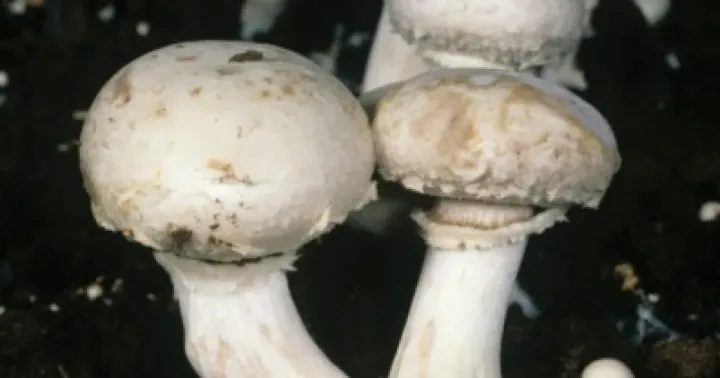
Fruit bodies are characterized by a white, firm cap and the distinct double ring on the stem, which can sometimes be subtle in young specimens.
Infected areas are quickly covered with thick white mycelial strands that penetrate deep into the substrate, disrupting its structure.
Often, the fungus causes premature pinning, which distorts the casing soil surface and creates visible irregularities.
The odor of the mycelium can be more intense and pungent than that of standard button mushrooms, especially during the spore-releasing phase.
Pathogen
The causative agent is the fungus Agaricus bitorquis, belonging to the Agaricaceae family. In industrial mushroom farming, it is often viewed as a competitive or invasive organism.
It is a soil-inhabiting saprotroph known for its high mycelial growth vigor, allowing it to colonize dense substrates more effectively than other species.
Biologically, it is defined by the presence of two rings on the stem, which makes it resilient to environments that would inhibit standard mushroom species.
In cultivation facilities, it acts as a competitor that can rapidly overwhelm the cultivated Agaricus bisporus mycelium.
This organism produces a powerful mycelial network that quickly depletes the nutrient base intended for the primary crop.
Conditions for development
The main condition for its spread is high substrate temperature, as this species is notably thermophilic compared to standard varieties.
It thrives in substrates with an alkaline pH and high organic content, making nutrient-rich mushroom beds highly susceptible.
Spore dispersal typically occurs through ventilation systems, contaminated tools, or improperly pasteurized casing materials.
High relative humidity combined with elevated temperatures creates optimal conditions for the fungus to colonize new areas of the mushroom bed.
Failure to follow strict thermal processing protocols for the casing soil is the primary factor allowing the infection to enter the production blocks.
Why it matters
The main damage is caused by direct competition with the commercial crop for available water and nutrients within the substrate.
Its presence leads to a significant reduction in yield, as the fungus displaces the primary mycelium and prevents it from fruiting.
Metabolic byproducts of the fungus may inhibit the growth of the intended crop, leading to poor quality produce that does not meet commercial standards.
Destruction of the substrate structure renders it unsuitable for further harvest cycles, resulting in total loss of the infected blocks.
Economic losses arise from the need to discard entire infected batches and perform extensive sanitation of the growing rooms.
Protection
The most effective control method is strict adherence to pasteurization protocols for the casing soil to ensure complete spore destruction.
Regular sanitation of all surfaces, equipment, and growing racks using appropriate fungicidal agents is essential for prevention.
Maintaining strict quality control over spawn and raw materials is crucial to prevent the accidental introduction of unwanted fungal species.
Upon detection of infection, immediate isolation and removal of the affected substrate patches and surrounding casing layer are required.
- Stringent thermal treatment of all casing materials.
- Implementation of hygiene barriers between different growing rooms.
- Continuous monitoring of air filtration systems for fungal spores.
Discussion
No discussions yet — be the first.