
Blueberry witches broom
Vaccinium witches
Description
Symptoms
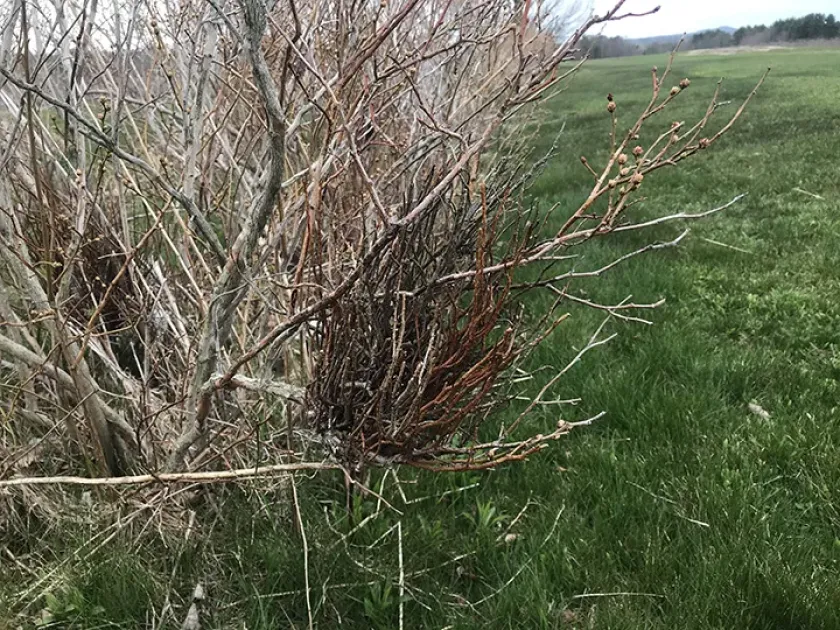
The hallmark symptom is the development of dense, broom-like clusters of thin, stunted, and distorted branches.
Stems become abnormally thickened, lose their flexibility, and show signs of premature drying and brittleness.
During the sporulation stage, conspicuous orange-brown powdery pustules (aecia) appear on the surface of the deformed branches.
Leaves on infected shoots are typically smaller, discolored, and fall off prematurely compared to healthy foliage on the same bush.
The plant exhibits severe stunting, loses its ability to bear fruit, and gradually declines in vigor until it eventually dies.
Pathogen
The disease is caused by the rust fungus Pucciniastrum goeppertianum (often synonymous with Thekopsora goeppertiana).
This is a heteroecious fungus, meaning it requires two unrelated hosts, specifically spruce trees and blueberry or lingonberry plants.
The mycelium survives systemically within the woody tissues of the host, allowing the disease to persist for many years.
Spore dissemination occurs via wind currents, which transport aeciospores from infected spruce trees to young blueberry shoots.
The fungus invades the vascular system, leading to a long-term chronic infection that disrupts the plant's normal physiological functions.
Conditions for development
High humidity and prolonged periods of wet weather are the primary environmental drivers for the development of this rust fungus.
The presence of spruce trees in close proximity to the blueberry plantation significantly increases the risk of successful infection.
Poor air circulation within the canopy, often caused by overly dense planting, creates a microclimate favorable for spore germination.
Optimal conditions for infection often coincide with cool, moist springs where moisture lingers on the foliage for extended periods.
Environmental stress factors, such as poor drainage or nutrient imbalances, make the plants more susceptible to initial fungal colonization.
Why it matters
Blueberry witches broom is highly damaging as it renders infected plants permanently non-productive, leading to complete fruit loss on affected stems.
Since the pathogen is systemic, infected bushes cannot be cured and remain a persistent source of inoculum for the rest of the field.
The disease contributes to a steady decline in the stand density, which directly impacts the profitability and yield of a commercial blueberry operation.
Unchecked, the infection can spread rapidly across a planting, leading to significant economic losses and the potential abandonment of the site.
Furthermore, the physical distortion of the plant makes it difficult to harvest and complicates mechanical maintenance of the crop.
Protection
The most effective control strategy is the prompt removal and destruction of all infected bushes, including the root system, to prevent spread.
Establishing new blueberry fields at a safe distance from spruce forest stands is essential for long-term disease management.
Implementing regular field inspections allows for the early detection and elimination of infected shoots before widespread sporulation occurs.
Preventative application of copper-based fungicides may help reduce the initial infection pressure, though it does not cure established systemic cases.
- Strict sanitation by removing infected plants.
- Strategic spacing away from coniferous hosts.
- Regular pruning to improve air circulation.
- Monitoring for symptoms in early spring.
Discussion
No discussions yet — be the first.