
Lethal yellowing of palms
Palm lethal
Description
Symptoms
The first noticeable sign is often the premature dropping of fruits, which occurs even if they are immature. This is typically accompanied by the necrosis (blackening) of inflorescences, which die prematurely.
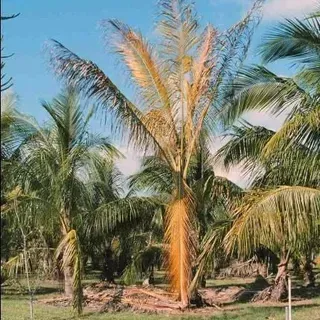
A classic symptom is the progressive yellowing of leaves. It begins with the oldest (lower) leaves and gradually advances upward. As the foliage turns yellow, it dries out and eventually breaks, hanging from the trunk.
The yellowing eventually affects the entire crown, and the palm loses its foliage. Once the central apical bud (the point of growth) dies, the palm can no longer produce new leaves, signaling the end of the infection cycle.
The speed of disease progression varies significantly based on the palm species. However, once the initial yellowing of the crown occurs, the decline to total plant death is usually rapid and irreversible.
In the final stages, only the bare trunk remains, often appearing as a telegraph pole. At this point, the tree is dead and represents a high risk as a source of inoculum for neighboring trees.
Pathogen
Lethal yellowing is caused by a group of phytoplasmas (group 16SrIV), which are specialized wall-less prokaryotes that inhabit the phloem tissue of susceptible plants. These microorganisms disrupt the transport of nutrients, leading to systemic collapse.
The disease is transmitted by the planthopper insect Haplaxius crudus. During feeding on infected palm sap, the insect acquires the phytoplasma and subsequently introduces it into healthy trees during its feeding cycle.
Because phytoplasmas cannot be cultured in standard laboratories, diagnostics rely heavily on molecular techniques such as PCR to detect the DNA of the pathogen within the plant's vascular system.
The infection process is systemic, meaning the pathogen spreads throughout the palm's entire vascular network. This often happens well before any external symptoms become visible to the naked eye.
A broad range of palm species is susceptible to the disease. While some species show rapid decline, others may act as reservoirs, carrying the pathogen without showing obvious signs of stress, thus complicating containment efforts.
Conditions for development
The spread of lethal yellowing is heavily influenced by the presence and activity of its insect vector. Warm, humid climates provide the optimal environment for Haplaxius crudus to thrive and reproduce.
Densely planted areas act as "highways" for the disease. If palm trees are spaced closely, the planthopper can easily jump from an infected host to a healthy one, causing the disease to sweep through an entire grove quickly.
The presence of alternative host plants for the vector in the surrounding landscape helps maintain insect populations throughout the year, ensuring a constant threat to nearby palm collections.
Human activity is a major driver of expansion. Moving infected nursery stock from one region to another is the primary way the disease jumps long distances, often bypassing natural geographic barriers.
Ecological factors, such as the overall health and nutrition of the palm, can influence susceptibility. While healthy palms might withstand some stress, they are not immune to the lethal yellowing phytoplasma.
Why it matters
Lethal yellowing is arguably the most destructive palm disease globally. It has decimated coconut palm plantations in various parts of the world, devastating local economies that rely on these trees for sustenance.
In residential and commercial landscapes, the impact is both aesthetic and financial. Homeowners and resorts face the loss of valuable mature trees, requiring expensive removal and disposal services.
The disease causes profound environmental disruption. In regions where palms are the dominant species, their mass death alters the ecosystem, reducing shade and increasing soil erosion due to the loss of root systems.
There is no known cure for the disease. Once a palm is infected, it is effectively doomed, and all attempts to save it are usually unsuccessful, leading to 100% mortality in untreated susceptible varieties.
The inability to stop the disease once it enters an area puts indigenous palm species at risk, potentially leading to a loss of biodiversity in areas where these trees provide essential habitat for local fauna.
Protection
Strict quarantine measures are the first line of defense. Restricting the movement of palm nursery stock from infected regions is essential to prevent the pathogen from reaching new, uninfected areas.
Rapid detection and prompt removal are critical. Once a palm displays symptoms, it should be cut down and destroyed immediately to eliminate the source of the pathogen for the local vector population.
Managing the vector population with insecticides can slow the spread, but this is rarely a long-term solution due to the difficulty of treating large landscapes and the high cost of repeated applications.
The most effective long-term strategy is the planting of resistant or tolerant palm varieties. Breeding programs focus on identifying and propagating species that can resist the phytoplasma without succumbing to the disease.
While trunk injections with antibiotics like oxytetracycline can sometimes extend the life of an infected palm, it is a palliative treatment that does not provide a cure and is not sustainable for large-scale operations.
Discussion
No discussions yet — be the first.