
Phyllody of knautia
Knautia phyllody
Description
Symptoms
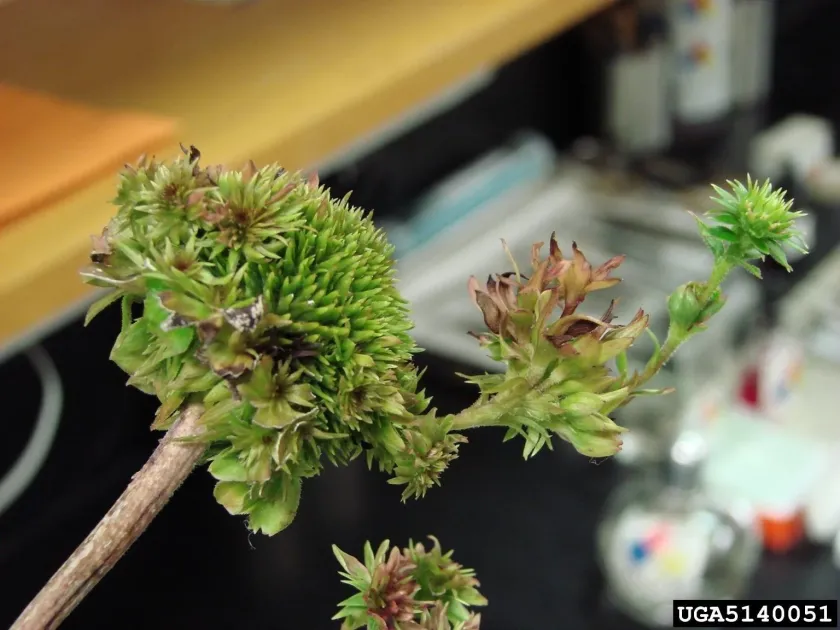
The hallmark symptom of phyllody is the transformation of floral parts into vegetative, leaf-like structures. Sepals, petals, stamens, and pistils lose their typical morphology and become green, foliaceous leaves.
In knautia, the inflorescence is severely affected, losing its characteristic shape and color. Instead of productive flowers, the plant produces distorted, greenish structures that lack any functional reproductive parts.
In addition to floral changes, plants often exhibit excessive branching, resulting in a stunted and shrubby appearance. This phenomenon is frequently referred to as witches' broom growth.
Chlorosis is another common sign, manifesting as yellowing or pale green leaves due to impaired photosynthesis. The plant's metabolism is hijacked by the pathogen, leading to overall reduced vigor.
Because the flowers are deformed and non-functional, the plants become sterile and are unable to produce seeds. This leads to the total reproductive failure of the individual plant.
Pathogen
The causal agent of phyllody in knautia is a phytoplasma, a type of specialized prokaryotic organism lacking a cell wall. These pathogens inhabit the phloem tissue of the host plant, disrupting its normal physiological processes.
Phytoplasmas are obligate parasites and cannot be cultured on standard nutrient media, making them difficult to study in laboratory settings. They are part of a large group of phytoplasmas known for inducing yellows-type diseases in various botanical families.
Transmission occurs primarily through the feeding activities of phloem-sucking insects, such as leafhoppers (Cicadellidae). The insect acquires the phytoplasma while feeding on an infected plant and subsequently transfers it to healthy individuals.
Once inside the insect host, the pathogen undergoes a latent period before it can be transmitted. After this, the insect remains a vector for the rest of its life, effectively spreading the disease across the field.
The infection is systemic, meaning the pathogen spreads through the plant's vascular network, eventually reaching meristematic tissues where it triggers the characteristic developmental anomalies.
Conditions for development
Phyllody development is strongly linked to the population dynamics of insect vectors. Warm, dry weather conditions facilitate the breeding and migration of leafhoppers, which in turn leads to higher incidence rates.
The presence of perennial weeds or wild knautia species surrounding the fields acts as a reservoir for the phytoplasma, allowing the disease to persist year after year.
High plant density and overcrowding create a favorable environment for the rapid spread of vectors between plants. When plants are grown close together, it is easier for insects to transmit the pathogen from one host to another.
Environmental temperature significantly influences the multiplication rate of phytoplasmas within the host tissues, with warmer conditions typically favoring the progression of the disease.
Plants under stress, whether from drought, nutrient deficiency, or poor soil conditions, are more susceptible to the colonization by sucking insects, thereby increasing the likelihood of successful infection.
Why it matters
Phyllody is particularly devastating for seed production farms. Since the inflorescences are modified into sterile leaves, the potential for seed yield is entirely lost on affected plants.
The disease degrades the quality of medicinal or ornamental crops. In cases where the plant is grown for its harvestable biomass or active compounds, the quality is severely compromised.
The disease has a cumulative effect; without intervention, the number of infected plants will increase with each growing season, potentially leading to the abandonment of the field.
Infected plants exhibit reduced resistance to secondary pathogens, including various fungal and bacterial infections that can colonize the weakened and distorted tissues.
The loss of reproductive capacity across the population means that the natural or artificial regeneration of the crop is prevented, leading to significant economic losses for the grower.
Protection
The primary control strategy involves managing the population of insect vectors. The use of systemic insecticides targeting leafhoppers and aphids is essential during the early stages of plant growth.
Strict sanitation practices, including the removal of weeds and wild plants near the field, are crucial. Eliminating these reservoirs reduces the inoculum source available to the insect vectors.
Phytosanitary management includes the immediate roguing (removal and destruction) of any plants showing symptoms of phyllody. These plants should be burned to prevent further spread.
Spatial isolation between new crops and existing, potentially infected fields helps minimize the migration of vectors into the clean production area.
- Regular application of insecticides to control sucking insects.
- Elimination of weeds that serve as disease reservoirs.
- Immediate removal and destruction of symptomatic plants.
- Use of certified, healthy planting material.
- Implementation of spatial isolation to prevent vector movement.
Discussion
No discussions yet — be the first.