
Asian bacterial pear blight
Erwinia pyrifoliae
Description
Symptoms
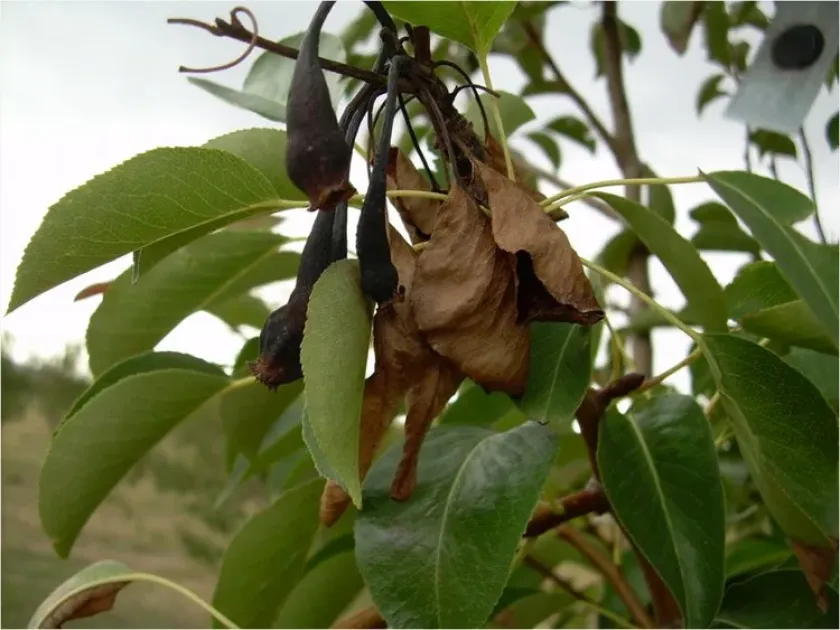
The first symptoms of Asian bacterial pear blight appear on blossoms, which suddenly wilt, turn black, and dry up as if scorched by fire. The infection then spreads rapidly to young shoots and fruit-bearing twigs.
Leaves on affected branches turn dark brown or black, curl, but remain attached to the tree for a long time. Infected shoots often bend, taking on a characteristic "shepherd's crook" shape, which is a hallmark sign of this bacterial infection.
Necrotic cankers form on the bark of branches and the main trunk. Under conditions of high humidity, these cankers may ooze a sticky, opaque bacterial exudate that ranges in color from milky white to amber.
When cutting into the bark and cambium of infected parts, one can observe a reddish-brown internal discoloration, indicating systemic tissue damage. If the infection reaches the main trunk, the entire tree may die within one season.
During humid weather, infected tissues may emit a distinct, unpleasant rotting odor. The disease progresses in waves, potentially devastating large sections of the orchard canopy if left untreated.
Pathogen
The causative agent of this disease is the Gram-negative bacterium Erwinia pyrifoliae, which belongs to the Enterobacteriaceae family. Initially identified in Asia, this phytopathogen is closely related to the agent of American fire blight, though it possesses distinct genetic properties.
The bacterium primarily affects plants of the Rosaceae family. Its main hosts are pear (Pyrus pyrifolia) and apple trees, although the range of susceptible species may expand depending on environmental conditions and horticultural practices.
The microorganism can persist for extended periods within infected plant tissues, including bark and roots. During the active growing season, bacteria multiply rapidly within the vascular system, obstructing the plant's nutrient transport.
Dissemination occurs via infected nursery stock, pruning tools, rain splashes, and insect pollinators. Insects, in particular, play a critical role in the primary infection of blossoms during the spring blooming period.
This pathogen is classified as a quarantine object in many countries. Its biological activity is strictly dependent on temperature and humidity levels, requiring constant monitoring in regions where the climate favors its rapid development.
Conditions for development
The development of Erwinia pyrifoliae is most intense under warm and humid conditions. The optimal temperature range for bacterial colony growth is between +18°C and +30°C, with high relative humidity serving as a critical facilitator.
Spring seasons characterized by frequent rains and fog are the most conducive to disease outbreaks. Moisture droplets facilitate the movement of bacteria onto flowers, allowing them to penetrate the plant tissues through nectaries.
Pollinating insects and pests are major drivers of disease dispersal within an orchard. They transfer bacterial exudate between trees and blossoms, creating new infection epicenters with every visit.
Horticultural practices, such as excessive nitrogen fertilization, induce vigorous growth of young shoots, which are highly susceptible to infection. Lush, rapidly growing vegetation provides an easier entry point for the pathogen.
Improper sanitation, particularly the failure to disinfect pruning tools, is a leading cause of epidemic spread. Orchards that neglect standard hygiene practices face a significantly higher risk of catastrophic infection.
Why it matters
Asian bacterial pear blight causes severe economic losses in fruit production. The disease can destroy entire orchards in a short amount of time, rendering affected plantations completely unprofitable.
The primary impact is the rapid loss of blossoms, fruit, and productive limbs. In cases of mass infection, total harvest yields can drop to near zero, causing significant financial hardship for growers.
The disease is difficult to manage due to the pathogen's ability to persist in a latent form within the vascular tissues. Systemic infections often mean that seemingly healthy trees may harbor the bacteria, leading to future outbreaks.
As a quarantine object, the presence of the disease leads to trade restrictions, including bans on the movement of nursery stock and fruit. This disrupts supply chains and damages the export potential of the entire region.
Aggressive control measures, including the uprooting and burning of infected trees, are often necessary. This requires massive investments in replanting and a long waiting period before a new orchard can return to productivity.
Protection
The foundation of defense against Erwinia pyrifoliae is strict phytosanitary control during the procurement of planting stock. Only certified, disease-free nursery material from trusted sources should be used.
Regular sanitary pruning and the removal of infected shoots, including a buffer of healthy tissue, are essential. Pruning tools must be thoroughly disinfected with antiseptic solutions after every single cut to prevent cross-contamination.
Copper-based treatments can help reduce the overall infectious pressure in the orchard. Applications are most effective when timed for the pre-bloom period and during blooming, if weather conditions pose a high risk.
Integrated pest management is crucial, as insects act as vectors for the pathogen. Controlling pest populations helps minimize the transmission of bacteria between trees throughout the growing season.
If symptoms are detected, the affected area must be isolated immediately. Infected plant material should be removed and destroyed by burning to ensure the pathogen does not spread to the rest of the orchard.
Discussion
No discussions yet — be the first.