
Guava bacterial wilt
Erwinia psidii
Description
Symptoms
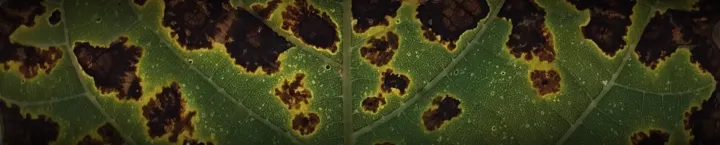
The initial manifestation of the disease is the appearance of water-soaked spots on leaves, which soon turn into dark, necrotic lesions.
Stems and branches frequently develop sunken cankers that may ooze a bacterial exudate, especially under high humidity conditions.
Flowers and young fruits are highly susceptible, often showing rapid wilting, blackening, and premature abscission from the tree.
As the infection progresses, branches may die back completely, giving the tree a scorched and stunted appearance due to vascular clogging.
- Water-soaked spots on leaves.
- Sunken bark cankers on stems.
- Blackening of flower clusters.
- Vascular discoloration in branches.
Pathogen
The causal agent of this disease is Erwinia psidii, a bacterium belonging to the Enterobacteriaceae family known to impact various tropical fruits.
This pathogen acts as a facultative parasite that can persist in crop residues, soil, and even within the vascular system of infected host plants.
The infection process typically begins when the bacteria enter the plant tissue through natural openings like stomata or through wounds caused by insects or pruning.
Once inside, the bacteria multiply rapidly in the intercellular spaces, secreting cell wall-degrading enzymes that break down the plant's structural integrity.
The systemic spread of the pathogen through the xylem disrupts the plant's physiological processes, leading to characteristic symptoms of wilting and necrosis.
Conditions for development
The development of Erwinia psidii is heavily favored by warm, humid environmental conditions, which are typical for tropical cultivation areas.
Frequent rainfall and persistent leaf wetness provide the necessary conditions for the bacteria to thrive and spread throughout the canopy.
Poor orchard management, such as dense planting, limits airflow and keeps the foliage moist, significantly increasing the risk of an outbreak.
High temperatures accelerate the bacterial growth rate, leading to rapid disease progression once the initial infection has been established.
Mechanical injuries resulting from pruning or pest activity serve as primary entry points for the pathogen in humid, high-risk conditions.
Why it matters
This disease poses a severe threat to commercial guava production, capable of causing total crop failure in highly susceptible orchard plots.
The primary economic impact stems from the total loss of fruit quality, as infected fruits develop necrotic spots and undergo decay.
The systemic nature of the pathogen can lead to the death of mature trees, requiring costly removal and replanting of the affected orchard areas.
The ease of spread via agricultural tools makes the management of Erwinia psidii a labor-intensive and expensive endeavor for farmers.
Uncontrolled outbreaks can cause significant yield reduction and long-term damage to the productivity of the entire agricultural ecosystem.
Protection
Integrated disease management begins with the use of disease-free propagation material and the selection of resistant cultivars where available.
Sanitation is critical; all infected plant material should be pruned carefully and destroyed by burning to minimize the inoculum source.
Sterilizing pruning tools with appropriate disinfectants after every cut is essential to prevent the mechanical transmission of the pathogen.
Copper-based bactericides may be applied as a preventive measure to protect healthy tissues and reduce the bacterial population on the plant surface.
Maintaining optimal tree health through balanced fertilization and proper orchard ventilation helps strengthen the plants' natural resistance to infections.
Discussion
No discussions yet — be the first.