
Dickeya dianthicola
Dickeya dianthicola
Description
Symptoms
Early symptoms of the disease include stunted plant growth, chlorosis, and the wilting of lower leaves. Infected plants often appear visibly weaker than healthy ones during the initial stages of development.
A hallmark symptom is the darkening of the stem base, which turns dark brown or black. Under high humidity conditions, these tissues become soft and watery, emitting a distinct, pungent, and unpleasant foul odor.
Cross-sections of affected stems reveal discolored vascular bundles, indicating that the bacteria have invaded the plant's transport system. This leads to the eventual collapse and death of the entire plant canopy.
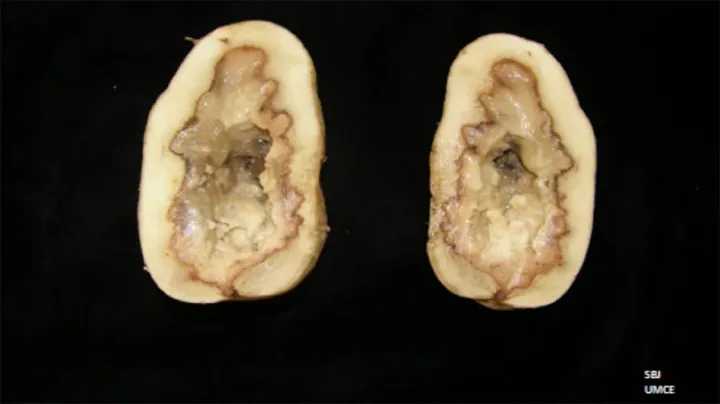
Tubers exhibit soft rot symptoms, characterized by the decay of internal tissues into a mushy, slimy mass. On the surface, depressed dark lesions are often visible before the internal decomposition becomes severe.
- Stunted plant growth and chlorosis
- Wilting of the leaves
- Blackening and softening of the stem base
- Internal soft rot of tubers
- Strong, foul-smelling bacterial exudate
Pathogen
The causative agent of the disease is the gram-negative bacterium Dickeya dianthicola. This pathogen belongs to the Pectobacteriaceae family and is known for its high efficiency in degrading plant cell walls through the secretion of pectinolytic enzymes.
The host range of this bacterium is broad, including not only potatoes but also various ornamental plants such as carnations, dahlias, and chrysanthemums, making it a significant concern for both field agriculture and greenhouse production.
The primary route of infection is through infected seed tubers. The pathogen often persists in a latent state, meaning that infected tubers may appear perfectly healthy while harboring the bacteria internally.
The bacterium can survive for extended periods in crop debris, soil, and surface water. Its ability to persist in the environment poses a continuous threat to subsequent planting seasons in infested fields.
Spread within fields occurs via contaminated irrigation water, agricultural machinery, and tools. Additionally, insect vectors and harvesting equipment contribute significantly to the dissemination of the pathogen across large areas.
Conditions for development
The development of Dickeya dianthicola is strongly favored by high temperatures, typically ranging from 25°C to 30°C. Warm conditions significantly accelerate bacterial growth and the progression of infection.
Excessive soil moisture is another critical factor. Waterlogged conditions, resulting from heavy rainfall or over-irrigation, facilitate the rapid movement of bacteria toward the roots and developing tubers.
Poor soil aeration and compaction increase the vulnerability of potato plants. In anaerobic environments, the bacteria can easily penetrate roots and stems, leading to severe localized infection zones.
During storage, high humidity and lack of ventilation are detrimental. A single infected tuber in a bulk storage environment can lead to the rapid infection of neighboring tubers, causing widespread spoilage.
Mechanical damage caused by farm equipment, pest feeding, or poor handling during harvest creates entry points for the bacteria, significantly increasing the probability of infection in the harvested crop.
Why it matters
The primary harm caused by this pathogen is massive yield loss. Infections can destroy a significant portion of a field, and in severe outbreaks, the entire harvest may become unsalvageable.
In addition to volume loss, the disease renders tubers completely unmarketable. Because the decay is bacterial, the affected product is unfit for processing or consumption due to health risks and quality degradation.
The disease severely impacts seed potato production. Using infected seed potatoes guarantees the introduction of the pathogen into new fields, making it impossible to certify the crop as healthy and high-yielding.
International trade is often restricted due to the presence of Dickeya dianthicola, as many countries impose strict quarantine measures to prevent the introduction of this highly contagious pathogen.
Because there are currently no effective chemical treatments to cure infected plants, the damage is essentially permanent once the disease is established, necessitating strict avoidance and sanitation measures.
Protection
The cornerstone of management is the use of certified, disease-free seed potatoes. Thorough laboratory testing of seed batches before planting is the most effective way to prevent the pathogen from entering the field.
Crop rotation is essential for breaking the pathogen's life cycle. Avoiding potato cultivation on the same land for at least four years helps reduce the bacterial population in the soil significantly.
Sanitation of machinery, storage facilities, and tools is mandatory. Disinfecting equipment after working on infested fields prevents the spread of bacteria to clean areas and minimizes the risk of cross-contamination.
Implementing proper irrigation management and controlling weeds that might act as alternative hosts are vital components of an integrated pest management (IPM) strategy to suppress disease spread.
Careful harvesting practices that minimize tuber bruising and mechanical injury are crucial. Proper drying and ventilation post-harvest are essential to prevent the development of secondary rot during storage.
Discussion
No discussions yet — be the first.