
Brinjal little leaf
Brinjal little leaf phytoplasma
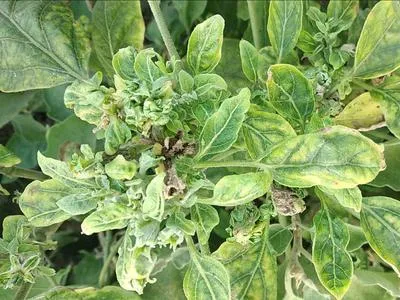
Description
Symptoms
The primary symptom of Brinjal little leaf is the drastic reduction in leaf size, where the leaves become extremely small, narrow, and often yellowish. The affected plants show shortened internodes, leading to a characteristic bushy or "rosette" appearance at the top of the stem.
Infected plants exhibit severe stunting and fail to reach their normal height, effectively stopping their vegetative growth. The overall plant architecture becomes highly distorted, giving it a broom-like look as the number of lateral branches increases abnormally.
Floral development is severely impacted; flowers on infected plants are often malformed, sterile, and incapable of setting fruit. If any fruit development occurs, the fruits remain tiny, hard, and commercially useless, making them unfit for consumption.
The root system of diseased eggplants is typically poorly developed and weak. As the infection progresses, the plant tissues may show symptoms of chlorosis and, in advanced stages, vascular necrosis, which leads to the premature wilting and eventual death of the plant.
Early-stage diagnosis is difficult because the symptoms can be mistaken for nutrient deficiencies or mite infestations. However, the persistent "little leaf" trait combined with the bushy appearance is a reliable diagnostic indicator of this phytoplasma infection.
Pathogen
Brinjal little leaf disease is caused by phytoplasmas, which are specialized wall-less prokaryotes. These pathogens colonize the phloem tissues of the host plant, disrupting the translocation of photoassimilates from the leaves to other parts of the plant.
Phytoplasmas cannot spread mechanically through tools, contact, or standard farm operations. They rely entirely on insect vectors for transmission. In the case of brinjal little leaf, various species of leafhoppers are the primary biological vectors responsible for spreading the infection.
The transmission process begins when a leafhopper feeds on an infected plant, ingesting the phytoplasmas. After an incubation period within the insect's body, the pathogen multiplies, and the leafhopper becomes a permanent carrier, capable of transmitting the disease for the rest of its life.
The pathogen is known to persist in various reservoir hosts, including weeds and other solanaceous crops that grow in the vicinity of eggplant fields. These reservoirs maintain the infection in the area, providing a constant source of inoculum for subsequent growing seasons.
Because phytoplasmas inhabit the sieve tubes, they interfere with the plant's physiological functions, leading to the stunted growth and reproductive failure. The severity of the symptoms depends on the age of the plant at the time of infection.
Conditions for development
The spread of the disease is highly dependent on the population dynamics of the insect vectors. Hot and dry weather conditions are particularly favorable for the multiplication and migration of leafhoppers, leading to rapid disease outbreaks in eggplant fields.
Poor sanitation practices, such as allowing weeds to thrive around the field, provide essential refuge for both leafhoppers and the phytoplasma itself. Weeds act as the bridge between seasons, ensuring the pathogen survives the winter.
Inadequate crop rotation plays a significant role in disease development. Planting eggplants or related crops in the same area year after year allows the pathogen and its vector populations to establish and thrive in the local ecosystem.
Environmental stress, such as drought or excessive nitrogen application, can make plants more susceptible to feeding by vectors. Lush, succulent growth induced by high nitrogen levels is often more attractive to leafhoppers, increasing the risk of transmission.
Using infected transplants is a major pathway for introducing the disease into a clean field. Since the pathogen is systemic, even asymptomatic seedlings can carry the phytoplasma and initiate an infection cycle once planted.
Why it matters
The economic impact of Brinjal little leaf is devastating, as it can lead to total crop failure. Once a plant is infected, it can no longer produce marketable fruit, resulting in a 100% loss of yield from that specific plant.
In high-pressure areas, the disease can spread throughout an entire plantation, destroying the harvest potential. This forces farmers to perform aggressive roguing, which removes productive plants and reduces the overall density of the field.
The disease poses a long-term threat to farm viability. If not managed, the cumulative loss of yield across multiple seasons can drive farmers to abandon eggplant production entirely in favor of less susceptible crops.
Furthermore, the presence of the disease decreases the vigor of the plant, making it more susceptible to secondary fungal and bacterial infections. This increases the overall maintenance costs and reduces the success rate of any subsequent treatments.
There is no known cure for infected plants once the symptoms appear. The harm is irreversible, making prevention and early vector control the only viable economic strategies for maintaining a healthy and profitable crop.
Protection
- Implement strict field sanitation by removing and destroying weeds that serve as alternate hosts for phytoplasmas.
- Apply systemic insecticides regularly to manage leafhopper populations and reduce the frequency of feeding.
- Use physical barriers like fine mesh nets in nurseries to protect seedlings from insect vectors.
- Practice long-term crop rotation (3-4 years) to break the cycle of the pathogen in the soil and local environment.
- Rogue and burn any plants showing early symptoms of little leaf to prevent the spread to healthy neighboring plants.
Selecting tolerant or resistant varieties, where available, is the most effective long-term strategy for managing the disease. Farmers should prioritize seeds from certified, disease-free sources to ensure the health of their initial crop.
Coordinated efforts across regional farms to manage vector populations simultaneously can significantly lower the overall disease pressure, as leafhoppers are highly mobile and can migrate from neighboring infected fields.
Discussion
No discussions yet — be the first.