
Verticicladiella wilt
Verticicladiella
Description
Symptoms
Initial symptoms are often subtle, appearing as a general loss of tree vigor. Over time, the foliage turns chlorotic and may drop prematurely, leading to a sparse, thinning canopy.
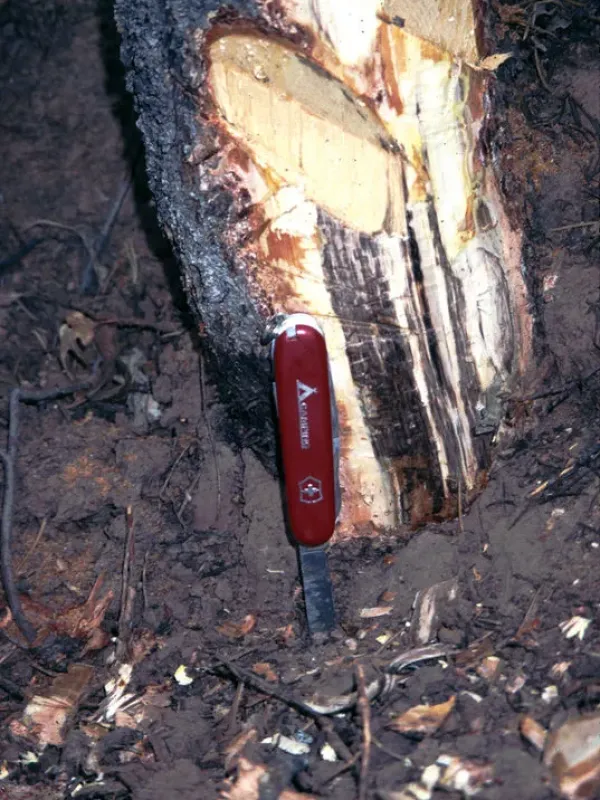
A diagnostic sign can be found under the bark of the lower trunk or on exposed roots, where dark, necrotic lesions are present. These areas often exhibit heavy resin flow as a defensive response.
Upon closer inspection, the wood beneath the bark will reveal characteristic staining, often blue or black, caused by the colonization of the fungal hyphae within the tracheids.
Tree growth slows significantly, and in advanced stages, the top of the crown may start to die back. This dieback pattern is a critical visual indicator of severe root system compromise.
In the final stages, the tree becomes highly susceptible to secondary invaders, including various wood-boring insects, which rapidly accelerate the decline and eventual death of the host.
Pathogen
The disease is caused by fungi of the genus Verticicladiella (often classified within the Leptographium complex). These pathogens are known to primarily attack the root systems and the lower trunk sections of various coniferous tree species.
The fungus acts as a vascular pathogen, colonizing the sapwood and blocking the tree's internal water transport system. This systemic infection severely restricts the flow of water and nutrients throughout the host.
Spores of the pathogen are disseminated through natural environmental factors, such as wind and rain splash, but they are most efficiently spread by bark beetles and root-feeding insects.
The pathogen can persist in the soil for extended periods, remaining viable in decaying stumps or root fragments. This makes total eradication in an infected forest stand extremely challenging.
The life cycle involves the production of mycelium that invades the xylem and produces toxins, which weaken the plant's structural integrity and physiological resistance to additional stressors.
Conditions for development
High moisture levels in the soil and atmosphere act as primary drivers for fungal development. Extended rainy periods provide the optimal environment for spore germination and colonization.
Trees growing under environmental stress, such as drought, soil compaction, or nutrient deficiencies, show significantly higher susceptibility to Verticicladiella infections.
Mechanical damage is a key factor; any wound on the roots or the lower trunk serves as a direct point of entry for the fungus, making timber management operations a potential risk factor.
Densely planted stands with poor airflow are more prone to infections. When trees are spaced too closely, the fungus spreads more easily between them through root contact.
High insect activity is essential for the rapid spread of the disease. Infestations of bark beetles create a cycle of wounding and spore introduction that promotes widespread outbreaks.
Why it matters
The disease leads to widespread mortality of conifers, causing significant economic losses in the forestry industry. The mortality rates can be particularly high in vulnerable or poorly managed stands.
Timber quality is severely degraded due to the fungal staining and decay within the wood, rendering it unsuitable for high-value construction or furniture purposes.
Outbreaks disrupt the balance of forest ecosystems, leading to loss of biodiversity and the destruction of protective forest covers, which may take decades to restore.
The presence of infected trees necessitates expensive sanitation logging and disposal of affected timber, adding a heavy financial burden to forest management programs.
The long-term impact includes an increased susceptibility of the remaining forest to climate change, wildfire risks, and other opportunistic pathogens, creating a cascade of health issues.
Protection
Early detection through systematic forest health monitoring is the most effective management strategy. Identifying and removing infected trees before the fungus spreads is crucial.
Implementing proper hygiene practices during forest operations, such as disinfecting tools and minimizing tree injuries, significantly reduces the likelihood of new infections.
Managing populations of vector insects through integrated pest management, including pheromone traps and biological controls, can break the chain of transmission.
Promoting diverse and resilient forest stands by selecting appropriate tree species for specific sites helps build natural resistance against fungal outbreaks.
When an infection center is confirmed, rapid containment measures, including the removal of infected trees and stump treatment, are necessary to prevent further colonization of neighboring areas.
Discussion
No discussions yet — be the first.