
Onion smut
Urocystis magica
Description
Symptoms
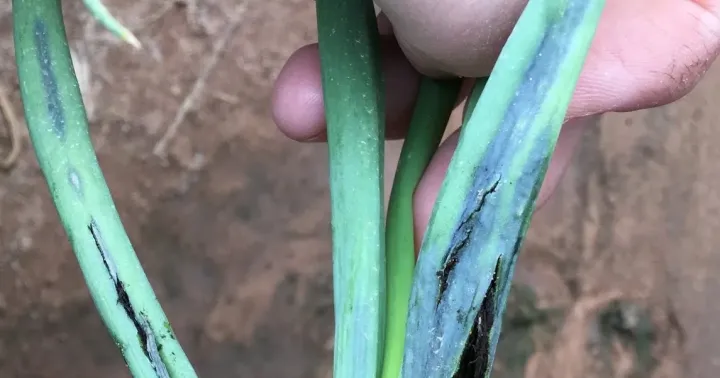
The most common symptoms appear on the cotyledons and early true leaves as pale, slightly elevated streaks. Over time, these streaks become more prominent and show noticeable thickening.
The plant epidermis eventually ruptures, exposing a dense mass of black, dusty spores. This characteristic «smutty» appearance is what gives the disease its name and makes it easily recognizable in the field.
Severely infected seedlings often show stunted growth, distorted leaf shapes, and extreme curling. In many cases, young seedlings collapse and die prematurely, leading to sparse plant stands.
If infection is less severe, symptoms may persist into the bulb formation stage. Infected bulbs often display dark, spore-filled streaks beneath the outer scales, making them unfit for market.
Early field identification relies on monitoring for thinning populations and discolored, twisted seedlings that fail to establish healthy growth compared to neighboring plants.
Pathogen
Onion smut is caused by the fungal pathogen Urocystis magica (synonym Urocystis cepulae). This is a soil-borne fungus that is host-specific, exclusively infecting species of the genus Allium.
The fungus persists in the soil as teliospores, which are extremely resilient. These spores can remain dormant in the soil for many years, waiting for favorable conditions to infect host plants.
Infection occurs primarily during the germination phase. As the onion seed sprouts, the fungus penetrates the young seedling, entering the developing tissues through the cotyledons or the embryonic shoot.
Once inside, the mycelium spreads systemically throughout the plant. It grows alongside the host, colonizing the stems and leaves while the plant attempts to continue its normal development.
As the plant tissues mature, the fungus completes its life cycle by forming dark, soot-like masses of new spores. These spores are released into the soil, replenishing the reservoir of the pathogen for future seasons.
Conditions for development
The development of onion smut is highly temperature-dependent. The fungus thrives in soil temperatures ranging from 10°C to 20°C. Temperatures above 25°C generally inhibit the growth of the pathogen.
Soil moisture plays a crucial role in spore germination and host colonization. Moderate moisture levels are optimal, while extreme soil conditions can influence the pathogen's ability to infect the seedling.
Continuous cropping of onions on the same land significantly increases the concentration of spores in the soil. This «infection buildup» makes it nearly impossible to grow healthy onions without intervention after a few years.
The pathogen is easily dispersed via contaminated soil, infected sets, and farm machinery. Spores can travel long distances if equipment is not cleaned properly after working in infested areas.
Soil pH also influences the pathogen, with neutral to slightly alkaline soils often being more favorable for infection compared to acidic conditions, which may provide some natural suppression.
Why it matters
Onion smut causes substantial economic losses by killing seedlings shortly after emergence. This significantly reduces plant density, leading to lower total yields and inefficient use of land.
Infected plants that manage to survive usually produce small, deformed bulbs. These bulbs are typically unmarketable due to the presence of visible fungal spores within the fleshy scales.
Harvested produce contaminated with smut spores is highly prone to secondary storage rots. Bacteria and other fungi quickly invade the damaged tissues, leading to rapid decay and loss during transit or storage.
Contaminated fields require long-term management strategies, as the soil remains infectious for several years. This limits the farmer's flexibility in crop planning and land use.
The disease poses a persistent threat to commercial operations, as it is difficult to eradicate once it becomes established in the field soil.
Protection
The most effective strategy is a long-term crop rotation, avoiding onion and related Allium crops for at least 5 to 7 years to allow the spore population in the soil to decline.
Use high-quality, disease-free seed and treat sets with systemic fungicides before planting. Proper seed treatment acts as a crucial barrier during the most vulnerable stage of seedling emergence.
Optimizing planting dates to favor warmer soil temperatures can help the seedlings outgrow the period of high susceptibility. Avoiding cool, wet soil at sowing is essential.
Practice strict sanitation by removing and destroying all infected crop debris. This prevents the further accumulation of spores and helps contain the disease within localized areas.
- Utilize resistant or tolerant onion cultivars where available.
- Clean machinery thoroughly to prevent the spread of soil and spores between fields.
- Monitor fields regularly during the early growing season to identify and isolate infestation zones.
Discussion
No discussions yet — be the first.