
Black Perigord truffle
Tuber melanosporum
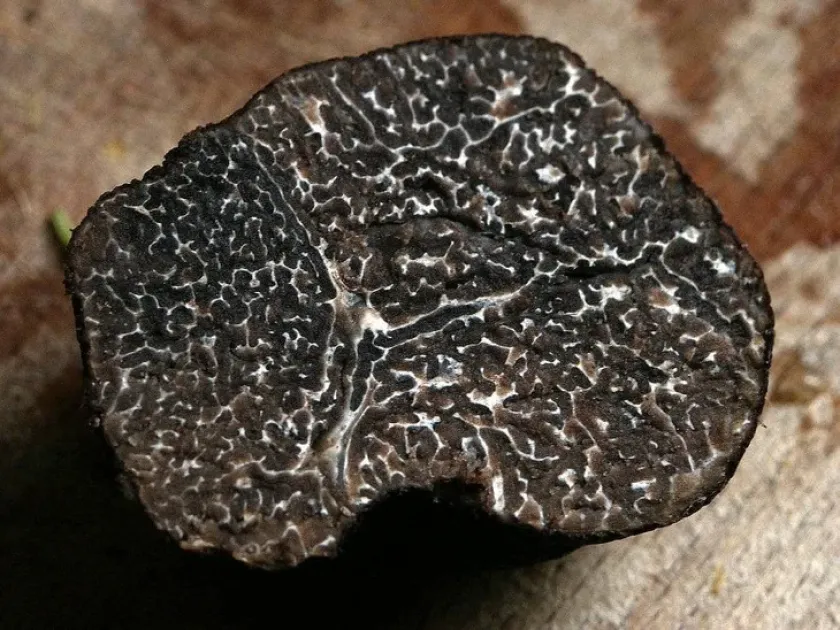
Description
Symptoms
The most distinctive sign is the development of a brûlé (burn) area around the host tree. In these zones, the ground vegetation gradually dies off, leaving the soil beneath the canopy barren and often revealing a change in texture.
Plants within the impact zone exhibit signs of stunting, chlorosis, and reduced vigor. This occurs as the fungus effectively monopolizes the water and nutrient uptake capacity of the soil, starving nearby herbaceous vegetation.
The fruiting bodies develop underground, typically at depths of 5 to 30 cm. Their presence is often detected by a local softening of the soil structure and, during the maturation phase, a distinct aroma that signals the release of spores.
Root systems of host plants undergo a physiological shift as they become densely colonized by the fungal mycelium. While this can sometimes promote initial growth in young trees, it eventually leads to intense resource competition between the tree and its symbiont.
Visual monitoring of leaves and overall canopy density is essential for assessing the impact. A premature decline or thinning of the tree foliage can sometimes indicate an over-colonization by the fungus, stressing the host tree.
Pathogen
The agent is the fungus Tuber melanosporum, belonging to the Ascomycota phylum. In agronomic terms, it acts as a specialized symbiont that, under certain conditions, exhibits aggressive behavior toward surrounding flora, suppressing its development.
The fungus forms an extensive mycorrhizal network on the roots of host trees, typically oaks, hazelnuts, or hornbeams. Its survival depends on this symbiotic relationship, through which it competes for vital resources with other plant species in the vicinity.
The biology of the fungus involves the release of specific metabolites into the soil. These substances serve to claim territory by inhibiting the germination and growth of other plants, an effect frequently observed around host trees.
Propagation occurs via spores, which are distributed by small mammals, soil-dwelling insects, or through the movement of contaminated soil. Once introduced to a suitable environment, the spores germinate and initiate new colonies.
Tuber melanosporum remains viable in the soil for extended periods, waiting for optimal conditions. Its presence is highly dependent on the stability of the soil structure and the continued health of the host tree.
Conditions for development
The fungus requires specific soil conditions: high calcium content, a pH range between 7.5 and 8.5, and excellent drainage. Excessive moisture or heavy clay soils inhibit its development significantly.
Climate plays a critical role, as the fungus favors regions with hot, dry summers followed by mild, moist autumns. Moderate thermal fluctuations are necessary to trigger the development of reproductive organs and ensure successful spore maturation.
A host plant is an absolute requirement for the lifecycle of Tuber melanosporum. Without a functioning mycorrhizal link to a host like Quercus or Corylus, the fungus cannot survive or produce its fruiting bodies.
Agricultural practices, particularly heavy nitrogen fertilization or deep mechanical soil disruption, are highly detrimental to the fungus. It thrives in undisturbed, nutrient-stable environments that mimic natural forest conditions.
Light exposure and soil temperature gradients influence the fungus's horizontal and vertical distribution. If the surface soil becomes too hot or dry, the fungal activity shifts deeper to maintain an optimal internal humidity level.
Why it matters
The harm is primarily related to the loss of agricultural utility for the affected land. Because the fungus creates "sterile" zones through the release of phytotoxic compounds, it excludes the possibility of intercropping or standard farming practices.
The depletion of soil nutrients and the alteration of the microbial balance lead to a long-term reduction in the overall fertility of the site. This often necessitates intensive input management to maintain the host plant's health.
The phytotoxic effect acts as a natural herbicide, preventing the survival of cover crops. This creates an economic challenge, as the land becomes limited to forest or truffle-focused use, preventing crop rotation.
In nursery settings, accidental infection of young trees is a significant risk. If infected stock is planted into clean fields, it can lead to unintentional establishment of the fungus, creating long-term management issues.
Economic damage is also associated with the restricted land-use options. Once a site is colonized by Tuber melanosporum, it essentially becomes dedicated to the fungus, complicating potential future agricultural plans.
Protection
Adjusting soil chemistry is a primary control method. By reducing the pH through the application of acidic fertilizers or organic amendments, one can create an unfavorable environment for the fungal colony.
Application of fungicides targeting ascomycetes can be effective for localized control. However, this must be balanced against the necessity of protecting the host tree's root system from chemical stress.
Mechanical removal of the upper soil layers in the affected zone can help to significantly reduce the fungal biomass, especially if performed before the maturation of the fruiting bodies.
Quarantine and strict inspection of nursery seedlings are the most effective preventative measures. Ensuring that all new plantings are free of mycorrhizal colonization is vital for maintaining control.
- Implementing irrigation regimes that increase soil moisture beyond the fungus's tolerance levels.
- Using high-nitrogen fertilizers to disrupt the symbiotic efficiency.
- Introducing competitive microbes to suppress the mycelial spread.
- Regular soil testing to monitor changes in alkalinity and fungal presence.
Discussion
No discussions yet — be the first.