
Tubakia leaf spot
Tubakia americana
Description
Symptoms
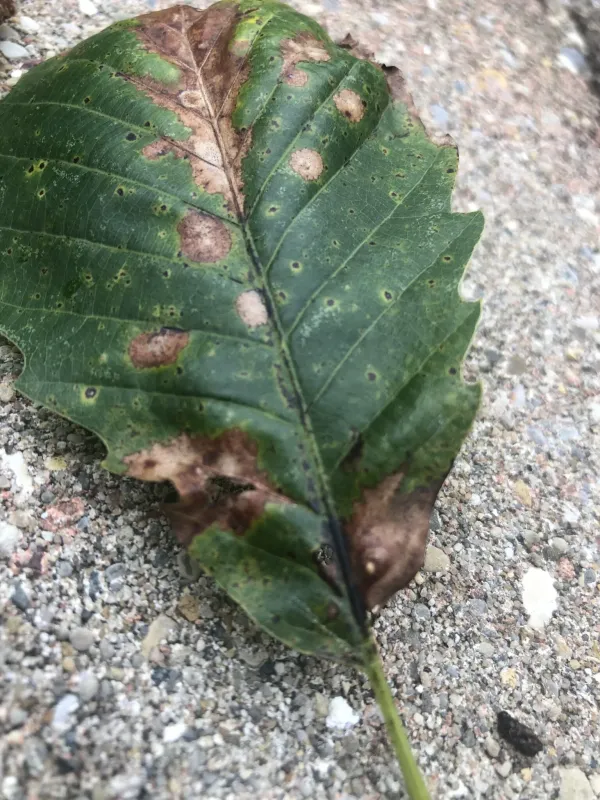
The primary symptom of this disease is the appearance of brown, dark brown, or reddish spots on the leaf surface. These lesions are often irregular in shape and restricted by the veins of the leaf.
As the infection progresses, lesions may coalesce, leading to large areas of tissue death. Severely affected leaves often curl at the edges, become brittle, and may detach prematurely from the branch.
One of the most diagnostic features is the development of tiny, black, circular structures on the underside of the leaf, which are the fruiting bodies (pycnidia) of the fungus.
Typically, the disease is most visible in the lower parts of the canopy. The combination of leaf spotting and premature defoliation significantly alters the visual appearance of the affected oak trees.
- Irregularly shaped brown or necrotic leaf spots
- Merging of necrotic lesions on the leaf blade
- Presence of black pycnidia on the leaf undersides
- Early leaf drop occurring during the summer months
- Dieback of tips in cases of severe long-term infestation
Pathogen
The disease is caused by the fungal pathogen Tubakia americana. This fungus belongs to the order Diaporthales and is a known agent causing leaf spots on various species of oak (Quercus spp.).
The fungus acts as a hemibiotroph, initially colonizing leaf tissues and eventually causing localized necrosis. The pathogen overwinters primarily in the fallen leaf litter, where it survives in the form of dormant mycelium or pycnidia.
Spore production is triggered by spring warming and moisture. Conidia (asexual spores) are dispersed by wind and rain splash onto emerging young leaves, initiating the infection cycle during the growing season.
Research suggests that Tubakia americana has developed mechanisms to adapt to various oak hosts. The interaction between the pathogen and the host plant is complex, depending on the genetic resistance of the tree.
Advancements in molecular diagnostics have helped identify this fungus more accurately in complex disease complexes that often affect oak trees, distinguishing it from other similar fungal leaf blights.
Conditions for development
Tubakia americana thrives under conditions of high humidity and moderate temperatures. Prolonged rainy periods during the spring are particularly conducive to the rapid spread of the disease.
Dense tree canopies with limited airflow create a microclimate that allows leaves to stay wet for longer periods, which is essential for the germination and penetration of fungal spores.
Stressed trees, particularly those suffering from drought or recent defoliation by insects, show higher susceptibility to Tubakia infection. Host vigor plays a major role in the tree's ability to resist the pathogen.
The accumulation of unraked leaf litter under the trees acts as a primary reservoir for the fungus, ensuring that inoculum is present to infect the new growth in the following season.
Fluctuations in climate, especially increased late-spring precipitation, can lead to widespread outbreaks, as these conditions perfectly align with the period of greatest host susceptibility.
Why it matters
The main impact of this disease is the reduction of the total photosynthetically active leaf area. This leads to a decrease in the tree's overall energy production and carbohydrate storage.
Chronic infestation results in stunted growth and a general decline in the tree's physiological health. For timber production, this means reduced growth rates and lower quality wood.
Premature leaf drop negatively affects the tree's ability to prepare for winter dormancy. This can lead to increased vulnerability to cold injury and may predispose the tree to other environmental stresses.
In ornamental and landscape settings, the aesthetic harm is significant. Defoliated branches and necrotic leaves reduce the visual value of the trees in parks and urban forests.
Long-term weakening caused by persistent Tubakia infections can make the oak susceptible to secondary invaders, such as borers, which may eventually lead to the mortality of the host tree.
Protection
The most fundamental control measure is sanitation. Removing and destroying fallen leaf litter significantly reduces the primary source of the fungus for the following growing season.
Promoting air circulation is critical. This can be achieved through selective pruning to open up the canopy, which allows the leaves to dry faster after rain and suppresses fungal growth.
In high-value ornamental trees, fungicide applications may be warranted. Copper-based products or systemic fungicides, applied preventatively at bud break, have shown efficacy in protecting the foliage.
Maintaining tree vigor through proper watering, mulching, and soil care is essential. A healthy, well-nourished tree possesses a much stronger natural resistance to fungal invasion.
Early monitoring of nursery stock and newly planted trees is important. Identifying symptoms in the early stages allows for targeted interventions, which are far more effective than trying to manage an established, widespread infection.
Discussion
No discussions yet — be the first.